Last updated: 13 November 2026
White label link building is when a specialist provider finds sites, writes the content and secures backlinks for your clients and your agency sells, approves and reports that work under its own brand. It works when you hand off the production and keep the strategy, the site approval and the final quality check in-house.
Most pages selling this service promise two things at once: “100% white hat” and “every link dofollow”. When money changes hands for a placement, those two promises rarely fit together under Google’s spam policy. As the founder of a link building marketplace who has worked in SEO and link building since 2012, my position is simple: outsource the labour, never the judgement. This guide covers how the model works, what to hand off and what to keep, how to vet a provider, what it costs with prices checked this month and a short shortlist by buying model.
What is white label link building?
White label link building is outsourced link production delivered without the provider’s branding. The provider prospects sites, pitches or pays publishers, writes the articles and places the links. You receive unbranded reports and present the results to your client as your agency’s work.
“White label” describes the deliverable, not the link type. The links themselves are the usual formats:
- Guest posts: a new article on a third-party site with a link to your client.
- Curated links or niche edits: a link added to an existing, already indexed article.
- Digital PR: coverage earned from journalists and media sites through data, stories or expert commentary.
- Resource and broken link placements: links won by offering a better or working page in place of a dead one.
A white label link building agency is simply a provider that sells these formats to other agencies instead of to end clients. Some are full agencies with account managers. Others are self-serve platforms where you order by DR tier and download an unbranded CSV. If you want the wider picture of reselling SEO in general, start with our explainer on why white label SEO providers are getting popular. This page sticks to the link side.
How does white label link building work?
The AI Overview for this search describes four steps: briefing, outreach, approval and rebranding. That skips the two steps that protect your client. Here is the full workflow we would insist on:
- You set the plan. Target pages, link count per page, anchor mix and topics to avoid. This comes from your audit, not the provider’s package.
- The provider proposes sites. A list of domains with organic traffic, topic and price per placement.
- You approve or reject each domain before any content is written. This is the step that cheap packages remove.
- The provider writes and places. Content is drafted, the publisher’s editor decides what goes live and the link is published.
- You run QA on every live link. Live, indexable, correct target, correct rel attribute, sensible anchor, relevant host.
- You build the client report from your own QA log. Not from the vendor’s export and with nothing that identifies the vendor.
Steps 3 and 5 are where agencies lose clients. Skip them and you are reselling a list you have never looked at, under your own name.
What should you hand off and what should you keep?
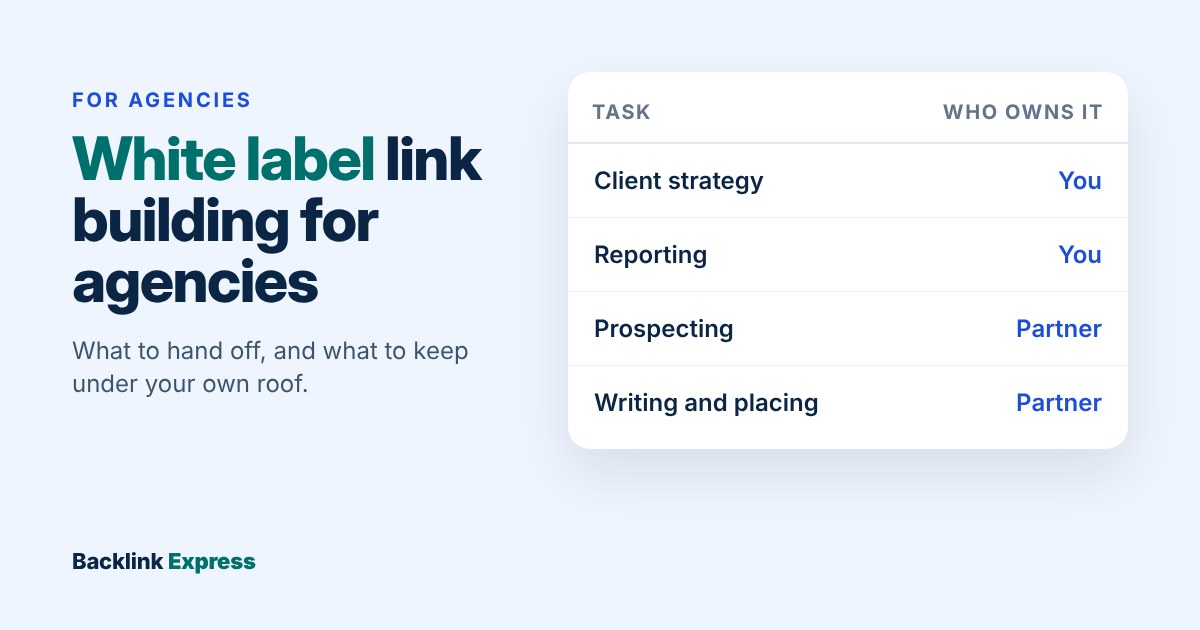
The provider should do the slow, repeatable work. Your agency should keep every decision that the client will hold you responsible for. This is the split we recommend:
| Task | Who owns it | Why |
|---|---|---|
| Link strategy: which pages, how many links, which anchors | Keep | It depends on the client’s rankings, content and competitors. A provider’s package cannot know that. |
| Prospecting and site lists | Hand off | Time-consuming and providers already hold publisher relationships. |
| Domain approval | Keep | You are the one who answers for a bad site in the client’s backlink profile. |
| Outreach and negotiation | Hand off | Pure labour. It scales better with a specialist team. |
| Content writing | Hand off, with your brief | Fine to outsource if you set tone, claims the client can make and topics to avoid. |
| Rel attribute decision on paid placements | Keep | This is a policy and risk call, covered in the next section. |
| QA of live links | Keep | A vendor checking its own work is not a check. |
| Client reporting and communication | Keep | The client relationship is the asset you are protecting. |
| Link monitoring and replacement claims | Shared | The provider replaces lost links; you detect them and log the claim. |
Anchor text is where agencies most often hand off too much. Providers that “naturally embed” exact-match anchors in every post create the pattern you are trying to avoid. Set the mix yourself, using our guide to exact match anchor text as the baseline.
Is white label link building allowed by Google?
Google has no rule about who builds a link or whose logo is on the report. Its rules are about the links. That is the part most white label pages leave out.
Google’s spam policies (last updated 28 August 2026) define link spam as creating links primarily to manipulate search rankings. The first example is “buying or selling links for ranking purposes”, which includes “exchanging money for links, or posts that contain links”. The same policy says it is not a violation to have such links as long as they are qualified with rel="nofollow" or rel="sponsored". Google’s guide to qualifying outbound links says to mark advertisements or paid placements with sponsored and that nofollow is still acceptable though sponsored is preferred.
Put that next to a provider’s sales page. If a publisher was paid for a placement and the provider guarantees every link is dofollow, that placement is the exact thing the policy describes. Calling it “white hat” does not change what it is. Not every white label link is paid: editorial digital PR and genuine outreach wins are not. But you cannot tell which is which unless the provider tells you, in writing, per link.
So the rule we work by: ask the provider to state, for every placement, whether any money or consideration went to the publisher and what rel attribute the link carries. Then decide with the client whether paid placements are part of the plan and how they are marked. Our guide to dofollow and nofollow links explains what each attribute does.
Is white labeling illegal?
No. Reselling a service under your own brand is a common commercial arrangement in SEO and many other industries. The real questions sit in your contracts: what your client agreement says about subcontractors and data sharing, what the NDA with the provider covers and who pays to fix a problem. This is general information, not legal advice; have a lawyer read the final terms.
Keeping the provider’s name private is normal. Hiding what the client is buying is not. If a client asks whether links are paid placements, the honest answer protects you far more than the margin you might lose.
How to vet a white label link building provider
Vet the provider like you would a new hire who will work in every client account. Run these ten checks before you sign anything and fail the provider on any of the first four.
| # | Check | Pass | Fail |
|---|---|---|---|
| 1 | Rel attribute policy | States in writing how paid placements are marked and tells you per link | “All links dofollow, guaranteed” with no answer on payment |
| 2 | Domain pre-approval | You see and approve every domain before content is written | Sites revealed only after the link is live |
| 3 | Recent live samples | 10 or more live placements from the last few months, in niches close to yours | Screenshots, or only “DR 70+” claims |
| 4 | Traffic, not just DR | Shows organic traffic per site and accepts your own check | Sells on DR or DA alone |
| 5 | Host site quality | Recent posts on the host are on-topic and not wall-to-wall casino, loan and CBD links | Every recent post carries an unrelated commercial link |
| 6 | Content standard | Follows your brief, no invented stats, no claims the client cannot back | Mass-produced articles written around the anchor |
| 7 | Replacement terms | Written window and a definition of “lost” that includes removed, noindexed, redirected or changed attribute | “We replace lost links” with no period or definition |
| 8 | Confidentiality and data | NDA, no contact with your client, placement data handed over on request | Provider keeps the site list and contacts when you leave |
| 9 | Reporting | Unbranded export with URL, target, anchor, rel, date and host metrics | A PDF you cannot edit or audit |
| 10 | Test order | Accepts a small paid test of 3 to 5 links before volume | Requires a large minimum or long contract up front |
For checks 4 and 5, run every proposed domain through your own tools rather than trusting the vendor’s numbers. Our free DR checker and spam score checker are quick first filters; organic traffic trends from your SEO tool are the real test. A site with high DR and no organic traffic is rarely worth the price.
Red flags that should end the trial
- “100% white hat” and “every link dofollow” on the same page, with paid placements in the menu.
- Prices far below the market for the DR on offer. A DR60 placement sold for less than a DR20 one elsewhere tells you something about the site.
- A hidden site list, or a refusal to name the domain before payment.
- Any mention of a private blog network, “our own network of sites” or link packages sold by the hundred.
- Replacement promises with no time limit and no definition of a lost link.
How much does white label link building cost?
White label link building is sold in three ways: per link, as a brokerage fee on top of the publisher’s price, or as a quoted managed campaign. Published per-link prices start around $60 and climb to several hundred dollars as DR and traffic rise. The table below uses prices from each vendor’s own page, pricing checked October 2026.
| Model | How you pay | Published example | Watch out for |
|---|---|---|---|
| Per link, self-serve | A fixed price per placement, tiered by DR and traffic, content included | FatJoe: $72 (DR10+) to $456 (DR60+) per placement (checked 13 November 2026). Rhino Rank: curated links from $60, guest posts from $75. | DR tiers with low traffic floors (FatJoe’s DR10+ and DR20+ tiers start at 0 monthly traffic) |
| Brokerage fee | A fee per link on top of the publisher’s own fee | Stan Ventures: brokerage fee of $35 to $60 per link, depending on volume (200+ or 400+ links) and DA tier | The publisher fee is extra, so the brokerage number is not your total cost |
| Managed or quoted campaign | A custom quote or monthly retainer for a planned campaign | Loganix: flat rate quotes and custom packages, no prices published on its white label page | Harder to compare; ask for the cost per live link after month one |
One answer engine we checked claimed that legitimate white label link building is priced per project, not per link. The vendor pages above show the opposite: per-link pricing is the most common published model. Price model tells you nothing about quality on its own. The vetting table does.
If you are pricing a full white label SEO package rather than links alone, our breakdown of white label SEO pricing covers per-client packages, platform fees and markup maths.
A worked margin example
These numbers use published prices plus stated assumptions. Swap in your own.
| Line | Monthly amount |
|---|---|
| 4 placements at FatJoe’s DR30+ tier ($120 each) | $480 |
| Your domain approval, QA and reporting (assumption: 2 hours at $50) | $100 |
| Replacement and failure buffer (assumption: 10% of wholesale) | $48 |
| Loaded cost | $628 |
| Client price at a 50% gross margin | $1,256 |
The line agencies forget is the second one. If you skip QA to protect margin, you are not saving $100. You are betting the client account on a vendor’s self-assessment.
A short shortlist, by buying model
We are not ranking these. Each is listed because its own pages publish enough about pricing or white label delivery to compare and none paid to be included. Backlink Express is not listed. For a wider comparison of agencies, see our list of the best link building agencies.
| Provider | Model | Published price | White label and guarantees (from its own pages) | Ask before you buy |
|---|---|---|---|---|
| FatJoe | Per link, self-serve | $72 to $456 per placement by DR tier (checked 13 November 2026) | Unbranded CSV export, example white label report, orders taggable by client, lifetime replacement if a link is removed | Links are listed as do-follow; the page does not mention sponsored. Ask how paid placements are marked. |
| Rhino Rank | Per link, self-serve | Curated links from $60, guest posts from $75 | White label pricing, reseller program, 12-month replacement cover, first-order money-back guarantee up to $550 | The pricing page does not mention rel attributes. Ask in writing. |
| Stan Ventures | Brokerage fee plus publisher fee | $35 to $60 brokerage per link (200+ or 400+ link tiers) | NDA, pre-approval of blogs, white label reports, money-back guarantee and link replacement (terms not detailed) | Ask for the publisher fee per site and the replacement window in writing. |
| Loganix | Managed, quoted | Not published (flat rate quotes) | Re-brandable monthly reports, custom dashboard, no contact with your clients unless asked | Pre-approval and replacement terms are not stated on the white label page. Get both before signing. |
Notice the pattern in the last column. Not one of these pages explains how paid placements are attributed. That is not proof of a problem. It is the question you must ask, because the answer decides whether you are reselling a service or reselling risk.
White label provider, marketplace or in-house?
Pick the model by how much control you need and how much time you have. A simple decision rule:
- White label provider: you have more client demand than outreach capacity and you want one team to handle prospecting, content and placement while you approve and QA.
- Marketplace: you want to choose every site yourself from a list that shows the domain, traffic and price up front, with the publisher’s editor deciding what goes live. Better when your strategist already knows which sites fit.
- In-house outreach: you build enough links every month that a full-time person costs less than the vendor and you want the publisher relationships to stay with you.
Many agencies mix the three: a white label provider for volume clients, a marketplace for specific sites a client asks for and in-house work for digital PR. That is fine, as long as the same QA and the same rel attribute rule apply to every link, whoever built it.
Is link building still worth reselling at all? Links remain important enough that Google keeps a dedicated spam policy for manipulating them and the vendors above still sell them by the placement. What has changed is the cost of a bad link list: it lands on your agency, not on the provider you hid behind.
Mistakes agencies make with white label links
- Buying the package, not the plan. “10 links a month” is a quantity, not a strategy. Decide target pages first.
- Forwarding the vendor’s report. Rebuild it from your own QA log, so every number in front of the client is one you checked.
- Treating DR as the quality test. DR is a third-party metric, not a Google signal. Check organic traffic and the host’s recent posts.
- Ignoring the rel attribute. If you do not know whether a link was paid, you cannot tell the client what risk they carry.
- No exit plan. If the provider keeps the site list and contacts, you cannot switch vendors without starting from zero.
Want to pick the sites yourself, with traffic and price shown before you order? Browse vetted publishers on Backlink Express.