In 2026, a standard guest post or link insertion bought directly or through a marketplace usually costs $150 to $500. Agency outreach links usually cost $600 to $1,500, and digital PR links $1,250 or more each. Monthly retainers start around $2,500.
Those are the numbers everyone quotes. I think the per-link price is the least useful number in link building. After a decade in SEO and link building, the figure I care about is what you pay for a link that is still live, indexed and relevant a year later. This guide gives you both numbers and shows you how to work out the second one before you sign anything.
Key takeaways
- Published averages range from about $78 to $461 for a guest post, because each study measured a different thing. Read the method before you trust the number.
- The price a site asks and the price buyers actually pay are different. One 2026 dataset found a median ask of $170 and a median paid price of $150.
- Traffic, topic fit and editorial standards move price more than Domain Rating does.
- The all-in cost of a link is the fee plus content, vetting time and the risk that the link disappears. Budget on that number, not the sticker price.
- Google treats paid links as link spam unless they carry
rel="sponsored"orrel="nofollow". Any vendor who tells you otherwise is selling you risk.
How much does link building cost in 2026?
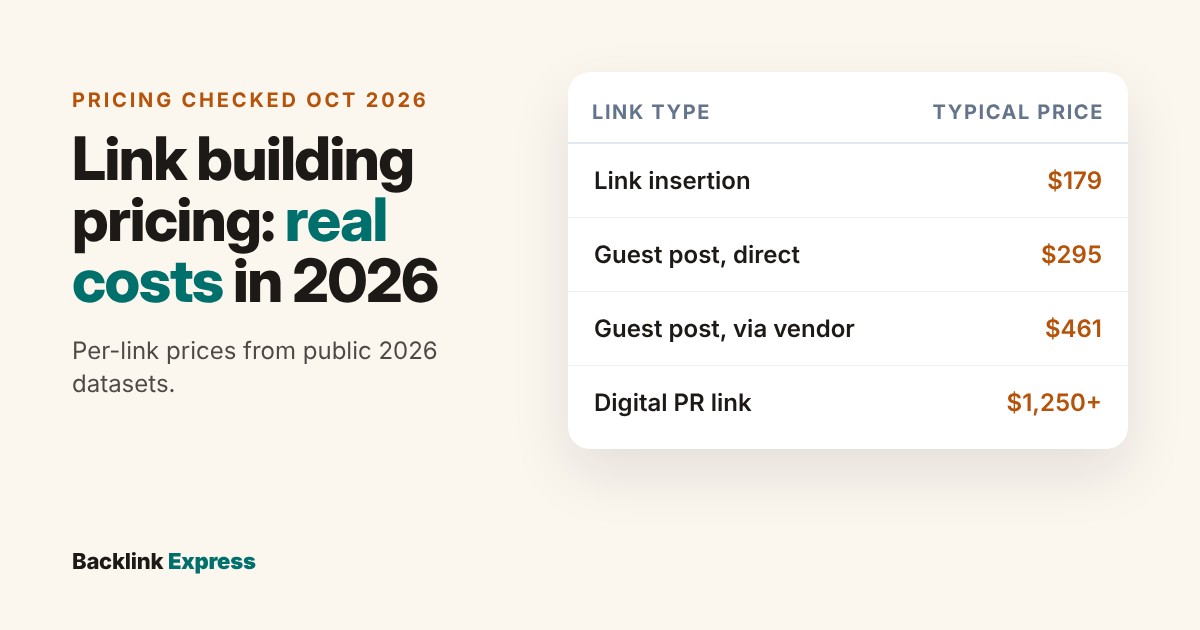
It depends on what you buy. Here is how the main link types price out in 2026, with the source behind each range. Pricing checked October 2026.
| Link type | Typical price per link | Where the number comes from |
|---|---|---|
| Link insertion (niche edit) on an existing page | $179 average; Ahrefs’ own outreach test averaged $361.44 | BuzzStream data on 62,916 sites (updated Oct 2026); Ahrefs study of 450 sites |
| Guest post bought directly from the site | $295 average | BuzzStream data on 257,267 sites |
| Guest post bought through a vendor or reseller | $461 average | BuzzStream data on 257,267 sites |
| Guest post on a “write for us” blog that asked for a fee | $77.80 average | Ahrefs study of 180 sites in nine niches |
| Mainstream mid-tier link, price actually secured | $150 median ($179 average) | Backlink Outreach Agency’s 2026 dataset of 526 placements |
| Editorial outreach link from an agency | $600 to $1,500 | Agency quotes cited by BuzzStream |
| Digital PR link from news and top-tier sites | $1,250 to $1,500 | BuzzStream’s digital PR cost analysis |
| Monthly agency retainer | $2,500 to $10,000+ | Agency pricing pages cited by BuzzStream |
If you only remember one row, remember this: a normal, relevant link on a real site with real traffic costs a few hundred dollars. Anything far below that deserves suspicion. Anything far above that should come with a reason you can see, like a news publication, a hard niche or a strong, high-traffic page.
Why do the published averages disagree so much?
Look at the table again. Guest posts appear at $77.80, $295 and $461. All three numbers are real. They just measure different things, and most pricing articles mix them together without telling you.
Who you asked changes the answer
In a study published on its blog, Ahrefs pitched 180 blogs that publicly advertise a “write for us” page. About a quarter replied, and roughly half of those asked for money. The average fee was $77.80. Those are small, open blogs that already accept outside posts, so the price is low.
In the same study, Ahrefs asked 450 sites in nine competitive niches to sell a link on an existing page. Only 12.6% agreed, and those that did averaged $361.44. When most sites say no, the ones that say yes can charge more.
BuzzStream’s guest post figures come from a database of more than 257,000 sites with listed prices. That pool includes much larger publications, which pulls the average up to $295 when you buy direct.
The middleman adds a markup
The same BuzzStream dataset shows guest posts at $295 bought directly and $461 bought through a vendor. That is a markup of about 56%. A markup is not automatically bad. You are paying someone to find the site, write the content, chase the publisher and replace the link if it drops. Just know that the service is part of the price.
Asking price is not paying price
Backlink Outreach Agency published one of the more useful 2026 datasets because it separates what sites ask from what buyers actually pay. Across its own campaigns, sites asked a median of $170 and links were secured at a median of $150. The agency also reports that acceptance falls sharply once a quote passes about $200. Treat this as one vendor’s data: it sells outreach services and excluded casino, crypto, CBD and adult sites.
Averages hide the spread
One $5,000 placement can drag an average up for hundreds of $150 links. That is why averages almost always come out higher than medians. When a study only gives you an average, assume the typical link costs less and the expensive ones cost much more.
My rule: never compare a price from one study with a price from another. Compare quotes for the same link type, in the same niche, from sites with similar traffic.
What drives the price of a backlink?
Price follows scarcity and risk. A publisher with real readers, strict editors and a topic advertisers want can charge more, because they turn most requests down. Here are the factors that move price, roughly in order of how much they matter.
Real organic traffic
Traffic is the clearest sign that Google trusts a site and that people read it. BuzzStream’s data shows both insertion and guest post prices rising with monthly organic traffic. Backlink Outreach Agency’s sellers also priced on traffic first. If two sites have the same Domain Rating and one gets 50,000 visits a month while the other gets 500, they are not the same product.
Topic fit and niche
A link from a site about your exact topic is worth more to you and costs more to get. Some niches also carry a premium because fewer sites accept them and editors check them harder. Finance, legal, insurance, SaaS, crypto and gambling are the usual examples. Backlink Outreach Agency’s finance data put the median asking price at $350, against $170 across all niches.
Their finance numbers also show how the premium grows with authority. Finance sites asked a median of $350 and links were paid at a median of $318. For finance sites at DR 70 and above, the median ask rose to $500, with the middle half of quotes between $336 and $850. Again, that is one vendor’s campaign data, but it gives you a useful reference point.
| Segment (Backlink Outreach Agency, 2026) | Median asking price |
|---|---|
| All mainstream niches | $170 |
| Finance, all DR levels | $350 |
| Finance, DR 70+ | $500 |
If you work in a niche that dataset excluded, such as casino, crypto or CBD, expect fewer sites to accept you at all and higher prices from the ones that do. Get several quotes before you decide what normal looks like in your space.
Domain Rating and authority metrics
DR and similar scores still drive prices because buyers filter on them. But DR is a third-party metric, made by Ahrefs. Google does not use it. A site can raise its DR with junk links and still get no traffic. Use DR as a quick filter, then check traffic and the site’s own linking pattern. Our guide to DR and UR explains what the score does and doesn’t tell you.
Placement type
A guest post needs a new article, an editor’s time and a slot in the publishing calendar. A link insertion adds a link to a page that already exists and often already ranks. That is why insertions can cost less (BuzzStream’s $179 average) or more (Ahrefs’ $361.44 average). It depends on how much traffic the existing page has.
Content
Somebody has to write the guest post. Backlink Outreach Agency reports that in 96% of its placements the buyer supplied the content. If your vendor includes writing, part of your fee pays for it. If not, add it to your budget yourself.
Editorial standards
Sites that reject weak pitches, edit hard and label sponsored content cost more. They are also the sites whose links tend to last. A site that publishes anything for anyone is cheap for a reason.
Market and language
Prices differ by country. Backlink Outreach Agency reports a higher median ask for German-language sites than for English ones, though from a small sample. If you need links in a specific market, budget for local sites and local content, not a translated English post.
Link building pricing models compared
The same link can be sold five different ways. The model shapes what you can check, what you pay for and who carries the risk.
| Model | How you pay | Good for | Watch out for |
|---|---|---|---|
| Per link | A set price for each placement | Buyers who want to choose every site | Low prices that hide weak sites; no say on content |
| Package | A bundle, such as 10 links at a set DR range | Testing a vendor on a small budget | Site lists you can’t see until after you pay |
| Monthly retainer | A fixed monthly fee, usually $2,500 to $10,000+ | Ongoing campaigns with strategy and reporting | Vague deliverables; ask for a link count or a clear target |
| DR or tier pricing | Price rises with the site’s DR | Quick budgeting | Rewards a metric Google doesn’t use; check traffic |
| Digital PR campaign | A project fee, often $5,000 to $10,000 per campaign | Earning links from news and top-tier sites | Results vary by story; links per campaign aren’t guaranteed |
| Marketplace | You pick a listed site and pay its listed price | Buyers who want to see the site, traffic and price before paying | Quality depends on how well the marketplace vets publishers |
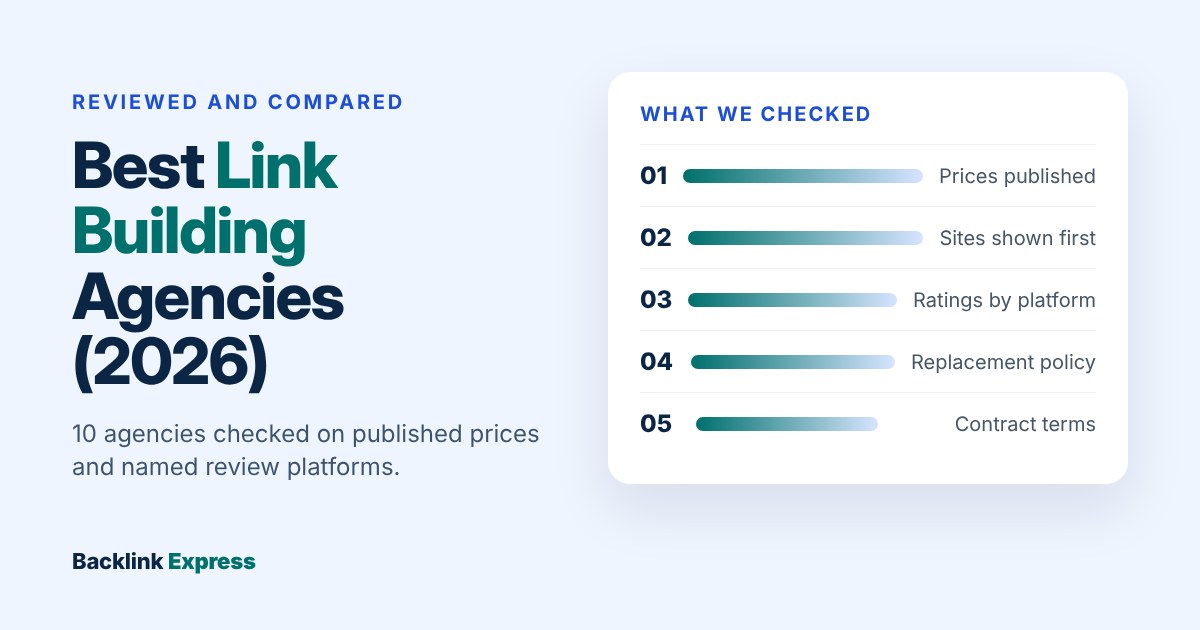
There is no best model. A founder with a small budget who wants control should buy per link or through a marketplace. A team without time should pay a retainer and hold the agency to clear numbers. If you are weighing an agency, our review of the best link building agencies compares published prices and terms.
What should a link building package include?
Two packages at the same price can deliver very different things. Before you compare prices, line up what each one actually includes. A complete offer should cover these items, each listed separately so you can see where the money goes.
| Item | What good looks like | What to question |
|---|---|---|
| Site list | You see and approve every site before it is used | “Sites revealed after delivery” |
| Site data | Organic traffic trend, topic and country for each site | DR only, with no traffic |
| Content | Original article written for the site’s readers, with your review before publishing | Spun or bulk AI text, no revisions |
| Anchor text | Agreed with you, mostly branded or natural phrases | Exact-match keyword anchors on every link |
| Placement | In the body of a relevant article | Footer, sidebar, author bio or a page of links |
| Labelling | The publisher’s own policy on sponsored content stated up front | A promise that paid links are “undetectable” |
| Replacement | Written replacement period, often 6 to 12 months | No answer, or “links are permanent” |
| Reporting | Live URL, date, anchor and target page for every link | A monthly summary with no URLs |
A package that leaves out content or replacement is not cheaper. It just moves that cost onto you. Add the missing pieces to its price before you compare it with a complete offer.
How much does link building cost per month?
Monthly cost is just links per month times the all-in cost per link. The hard part is choosing how many links you need, and that depends on who already ranks for your keywords.
Here is how a monthly budget looks at three levels. These are planning examples built from the per-link ranges above, not quotes.
| Stage | Links per month | Mix | Rough monthly budget |
|---|---|---|---|
| New or small site testing link building | 3 to 5 | Mainstream guest posts and insertions at around $150 to $300 | $500 to $1,500 |
| Growing site going after competitive keywords | 6 to 10 | Mostly $250 to $500 links, a few stronger placements | $2,000 to $5,000 |
| Established brand in a hard niche | 10+ | Strong niche sites, editorial outreach and digital PR | $5,000 to $15,000+ |
Before you pick a row, look at the pages you need to beat. Count their referring domains, check how fast they gain new ones and plan to close the gap over six to twelve months. Our guide on how many backlinks you need to rank walks through that count step by step.
Spend steadily rather than in bursts. A site that gains 40 links in one month and none in the next three looks less natural than one that grows at a consistent pace. It also teaches you less, because you can’t tell which links moved rankings.
Example budgets by business type
The stage table above is generic. Here is how the same logic plays out for four common types of business. Again, these are planning examples with stated assumptions, not quotes.
| Business | What it usually needs | Assumed mix per month | Rough budget |
|---|---|---|---|
| Local service business | A handful of links from local news, local directories with real traffic and industry sites in the same country | 2 to 4 links at $100 to $300 | $200 to $1,200 |
| Ecommerce store | Links to category pages and buying guides from sites its shoppers read | 5 to 8 links at $200 to $500 | $1,000 to $4,000 |
| B2B SaaS | Links from software, marketing and industry publications to feature pages and comparison content | 6 to 10 links at $300 to $700, plus occasional digital PR | $2,000 to $8,000 |
| Affiliate or finance site | Links in a niche where many sites refuse or charge a premium | 5 to 10 links at $350 to $1,000 | $2,000 to $10,000 |
The ranges overlap on purpose. Two businesses in the same category can need very different budgets depending on how strong their competitors’ link profiles are. The competitor count, not the business type, should set your final number.
The all-in cost per link: the number vendors don’t quote
Here is the model I use. It turns the sticker price into what a link really costs you.
All-in cost per link = (placement fee + content cost + vetting cost) ÷ survival rate
- Placement fee: what the site or vendor charges.
- Content cost: what you pay to write the article or the paragraph around the link. Zero only if the fee already includes it.
- Vetting cost: the time someone spends checking the site, multiplied by what that time costs.
- Survival rate: the share of links still live, indexed and unchanged after 12 months. If 8 out of 10 survive, the rate is 0.8.
The survival rate is the part almost nobody prices. Links get removed when sites are sold, redesigned or deindexed. Some publishers quietly swap a dofollow link for a nofollow one. Each lost link raises the real cost of the ones that stay.
Worked example
Two quotes for the same keyword. The inputs below are assumptions I chose to show the method; swap in your own.
| Input | Quote A: cheap bulk links | Quote B: vetted niche links |
|---|---|---|
| Placement fee | $60 | $300 |
| Content | $40 | $100 |
| Vetting (1 hour vs 0.5 hours at $50 per hour) | $50 | $25 |
| Cost before losses | $150 | $425 |
| Assumed survival after 12 months | 40% | 90% |
| All-in cost per surviving link | $375 | $472 |
On the sticker, Quote B is five times the price. After losses, the gap is about 26%. And Quote B’s links come from relevant sites with real traffic, which is what actually moves rankings. The cheap option was never cheap.
Notice that vetting costs more on the cheap quote. Bulk lists need more checking because more of the sites are weak. That is a hidden cost of low prices that rarely shows up in a pricing table.
How to estimate survival before you buy
- Ask the vendor how long they guarantee links and what happens if one drops. A free replacement within 6 or 12 months is a common answer.
- Check the site’s history in Ahrefs or Semrush. Big drops in traffic or sudden spikes in referring domains are warning signs.
- Look at how many outbound links its recent posts carry. A site linking out to dozens of unrelated sites per article will not stay healthy for long.
- Check whether older sponsored posts on the site are still live and still indexed. Search Google for
site:example.complus the topic.
Is it cheaper to build links yourself?
Sometimes. Doing it yourself cuts the vendor markup, but you pay in time and tools instead.
A DIY link still has a placement fee if the site charges one, which most sites with real traffic do. On top of that, you pay for prospecting, outreach, follow-ups, negotiation, writing and tracking. You also pay for at least one SEO tool to check traffic and links.
Use the same formula. Add up the hours one link takes you, from finding the site to seeing the link live, and multiply by what an hour of your time costs. If one link takes six hours and your time is worth $50 an hour, that is $300 of labour before any fee. That is roughly the price of a vendor-sourced link with the work done for you.
DIY makes sense when you have time, a clear niche and relationships with sites in it. It makes less sense when your time is better spent on product, sales or content.
| Approach | Cash cost | Time cost | Best for |
|---|---|---|---|
| Do it yourself | Placement fees plus tools | High: prospecting, outreach, writing | Founders with time and niche contacts |
| Freelancer | Hourly or per link | Medium: you still manage and check | Small, steady campaigns |
| Agency | Retainer or per link, highest per link | Low: they run the campaign | Teams that need strategy and reporting |
| Marketplace | Listed price per site | Low to medium: you choose and approve | Buyers who want control without outreach work |
What about journalist request links like HARO?
Journalist request platforms connect experts with reporters looking for quotes. When a reporter uses your answer, you can earn a link from a news or industry site without paying the publisher. That makes them one of the few ways to get strong links where the cash cost is close to zero.
The history matters, because a lot of pricing guides get it wrong. HARO, the best-known service, was rebranded as Connectively by its owner Cision and then shut down on December 9, 2024. Featured.com bought the brand and announced the relaunch of HARO in April 2025. Other platforms run on the same idea.
The cost here is time. Someone has to read requests every day, write fast, useful answers with real expertise, and accept that most pitches will not be used. If you price that time with the same formula as DIY links, journalist links often end up costing as much as a good paid placement. The difference is that they come from sites you could never buy a link on.
What do cheap links actually buy?
You will see offers for links at $10, $20 or $50. Some come from small, honest blogs that simply charge little. Most do not.
Here is what usually sits behind a price far below the ranges above:
- Private blog networks (PBNs). Sites built only to sell links, often on expired domains with no real readers.
- Link farms. Sites that publish anything from anyone, with dozens of unrelated outbound links per post.
- Inflated metrics. High DR built from spam links, with little or no organic traffic.
- Mass-produced AI content. Thin articles written only to hold a link.
- Hidden site lists. You pay first and find out where the link lands afterwards.
If a seller won’t show you the site, its traffic and a sample of its recent posts before you pay, walk. A cheap link from a network like this is at best worthless and at worst something you’ll need to clean up later. Cleanup costs money too, so it belongs in the all-in cost.
Red flags at the expensive end
High prices can be a problem too. Some sellers charge premium rates for links that are not worth it. Watch for these:
- Big-name placements on contributor sections. A link on a famous domain can sit in a section the main site doesn’t stand behind. Some large publishers mark those links nofollow or sponsored, so check how the section links out before you pay a premium for the name.
- DR priced, traffic ignored. A DR 70 site with falling or tiny traffic is priced like a strong site and performs like a weak one.
- Pages nobody can find. A post buried several clicks deep with no internal links to it may never be crawled often. Ask where the article will be linked from on the site.
- “Guaranteed” results. No one can promise rankings, AI citations or that Google will count a link. Price that promise at zero.
- Retainers with no link count. A monthly fee for “authority building” with no number of links, no site list and no reporting is a fee for nothing you can measure.
Paying more makes sense when you can point to what the extra money buys: a real newsroom, a hard-to-reach niche site, a page with strong traffic or a campaign that earns links from many sites at once.
Are paid links against Google’s rules?
Paying for a link to manipulate rankings is link spam under Google’s spam policies. Google gives “exchanging money for links, or posts that contain links” as an example.
The same page says buying and selling links is a normal part of advertising and sponsorship, and is not a violation when the paid link carries rel="sponsored" or rel="nofollow". Google’s guide to qualifying outbound links explains how publishers should mark them.
Here is the honest position. A paid placement on a good site still gets your brand in front of real readers, can send referral traffic and helps search engines and AI tools connect your brand to a topic. What it should not be is a hidden link scheme on a network of fake sites. The publisher decides how to label its sponsored content. A vendor who promises “Google-safe” paid links is promising something nobody can guarantee. Our guide to dofollow and nofollow links covers what each attribute does.
How to read a link building quote
Use this checklist on every quote before you pay. It takes 15 minutes and saves you from most bad deals.
- Can you see the exact site before you pay? If not, you can’t judge the price.
- What is its real organic traffic, and is it stable? Check a 12-month trend, not one month.
- Is the site about your topic? A strong link from an unrelated site is a weak link for you.
- Who writes the content, and who approves it? Ask whether the publisher’s editor reviews it.
- Where will the link sit? In the body of a relevant article, not a footer, sidebar or “partners” page.
- How will the link be labelled? Ask whether the publisher marks sponsored content and how.
- What happens if the link disappears? Get the replacement period in writing.
- What does the price include? Placement, content, revisions and reporting should be listed separately.
- Is there a contract term? Retainers with long lock-ins and no link count favour the seller.
- What is the all-in cost per surviving link? Run the formula above with your own assumptions.
How much should you spend on one link?
Spend in proportion to what the page you are linking to can earn. A link pointing at a page that will never convert is expensive at any price.
A simple way to set a ceiling:
- Estimate the monthly organic traffic the target page could get if it ranks, from the keyword’s search volume and current click-through rates.
- Estimate what that traffic is worth per month, using your conversion rate and value per conversion, or the cost-per-click you’d otherwise pay for it.
- Decide how much of that value you are willing to spend to get there, and over how many months.
- Divide by the number of links you think the page needs. That is your ceiling per link.
Example, with assumed numbers: a page that could bring in traffic worth $2,000 a month, needs about 10 links to rank, and you are happy to pay back the investment within 12 months. That gives a total budget of up to $24,000 and a ceiling of $2,400 per link. In practice you will pay far less, but now you know when a $1,500 digital PR link makes sense and when it doesn’t.
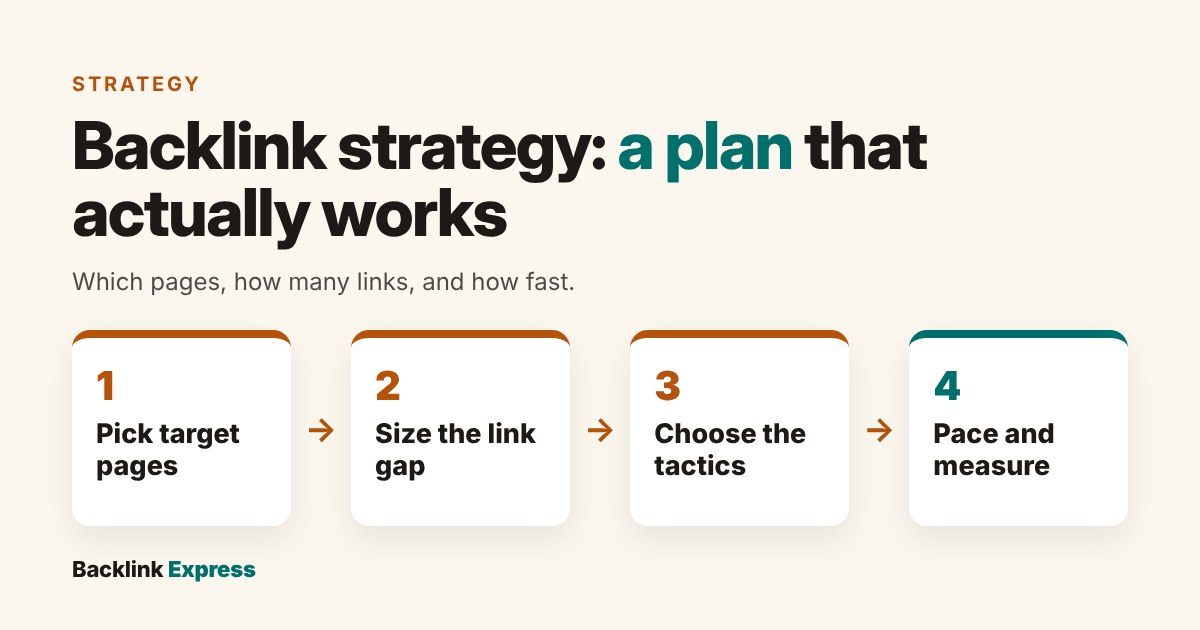
For a money page in a competitive niche, spending more per link can be the cheaper route. For a blog post with low commercial value, stick to mainstream links or earn them with better content. Our backlink strategy guide covers how to decide which pages deserve links first.
How long before paid links pay off?
Not on the day they go live. A new link only counts once search engines crawl the linking page, and then your rankings move as the new signals are processed alongside everything else on your site and your competitors’ sites. That takes weeks to months, and the timeline varies by site.
Plan your budget around that delay. Commit to a steady pace for at least two quarters before you judge the results, and track the right things while you wait:
- Is each link still live and indexed?
- Is the linking page itself getting crawled and ranking for anything?
- Are the target pages gaining impressions in Google Search Console, even before clicks rise?
- Are rankings moving for the keywords you built links for, compared with keywords you didn’t?
If links stay live and target pages still don’t move after two quarters, the problem is usually the page itself, the keyword choice or too few links compared with competitors. More money on the same plan rarely fixes it.
Where a marketplace fits
A marketplace sits between doing it yourself and hiring an agency. On Backlink Express, you pick the site, you see its traffic and price up front, and the publisher’s editor decides what goes live. The fee covers the placement and the content.
That model fixes the two problems that make link pricing so hard to judge: hidden site lists and prices you can’t compare. It does not remove the need to check sites yourself, and it does not change Google’s rules on paid links. Use the quote checklist and the all-in formula here too.
The bottom line on link building pricing
Expect a few hundred dollars for a normal, relevant link in 2026, more for hard niches, editorial outreach and digital PR, and far less only if you accept far more risk. Don’t compare prices across studies; compare quotes for the same kind of link. And judge every offer on its all-in cost per surviving link, because that is the number your budget actually pays.
Ready to compare real sites with their traffic and price shown before you buy? Browse vetted publishers on Backlink Express.