Last updated: 13 November 2026
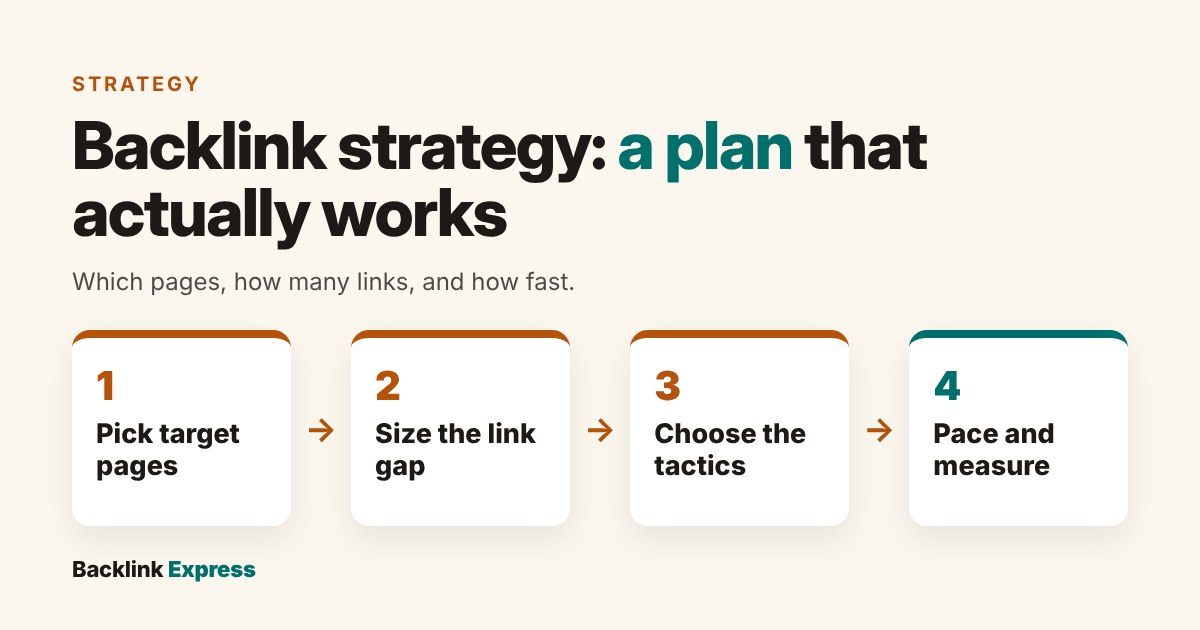
A backlink strategy is a written plan that decides which pages on your site need links, how many relevant referring domains each page needs to compete, which kinds of links you will go after, what you will spend, how fast you will build and how you will measure whether any of it moved rankings or revenue.
Here is my position after working in SEO and link building since 2012: most of what ranks for “backlink strategy” is a list of tactics. Broken link building, digital PR, guest posts, unlinked mentions. Those are ways to get links. They are not a strategy. A strategy is a list of pages, a number and a budget and without those three, every tactic turns into busywork.
This guide gives you the seven decisions that make up a real backlink strategy, a link gap calculation you can run this week and the mistakes that waste most link budgets.
What is a backlink strategy?
A backlink strategy answers one question: which links, to which pages, at what pace and cost, will close the gap between you and the pages that outrank you? Tactics sit underneath it. You pick them last, once you know what the plan needs.
The difference matters in practice. Two teams can both “do guest posting.” The one with a strategy sends every placement to five pages that sit on page two of Google for keywords that make money. The one without it sends links to the homepage and whatever blog post was published that week. Same tactic, very different outcome.
| Backlink strategy (the plan) | Link building tactics (the methods) |
|---|---|
| Which pages need links and why | Guest posts, digital PR, broken link building |
| How many referring domains each page needs | Unlinked brand mention reclamation |
| The mix of link types and sources | Resource page and partner outreach |
| Budget, cadence and who does the work | Linkable assets, data studies, tools |
| What success looks like and when you review it | Podcast and interview appearances |
If you want the methods, we cover them in our guide to strategies for creating awesome backlinks. This article is about the plan those methods should serve.
Are backlinks still important in 2026?
Yes, but not in the way most link sellers suggest. Google states that it “uses links as a signal when determining the relevancy of pages and to find new pages to crawl” (Google Search Central). That is a confirmed signal, not a promise that more links equal higher rankings.
Google’s own people have also played links down. At SERP Conf in Bulgaria in April 2024, Google’s Gary Illyes said “we need very few links to rank pages”, as Search Engine Journal reported on 22 April 2024. He later posted that he should not have said it. Read that correctly: a page with strong content and a handful of relevant links can rank. It does not mean links stopped mattering in competitive results, where nearly every page has good content and links are one of the few things left that separate them.
That is exactly why a strategy beats volume. You are not trying to collect links. You are trying to give specific pages the few relevant links they are missing.
The 7 decisions in a backlink strategy
Every plan we would sign off on answers these seven questions in writing, in this order. Skip one and the plan leaks money.
1. Goal: what must change, by when?
“More backlinks” is not a goal. A goal names a business result and a page: move the pricing comparison page from position 14 to the top 5 for its main keyword within two quarters, or lift organic sign-ups from three feature pages. Links are an input. Rankings, traffic and conversions on named pages are the output.
Write one primary goal and at most two secondary ones. If the goal can’t be measured in Google Search Console or your analytics, rewrite it.
2. Target pages: which URLs get the links?
This is the decision most plans skip and it is where the 80/20 rule in SEO actually applies. On most sites, a small share of pages drives most of the revenue. Those pages, plus the pages one push away from page one, are where links pay off.
Build a short list of five to fifteen URLs using three filters:
- Commercial value: the page targets a keyword that leads to a sale, sign-up or lead.
- Striking distance: it already ranks somewhere between positions 5 and 20, so Google sees it as relevant and links can tip it.
- Content is not the problem: it matches search intent and is at least as useful as what ranks above it. Links will not rescue a page that answers the wrong question.
Then add one or two linkable pages (a data study, a free tool, a definitive guide) that can earn links on their own and pass value to the money pages through internal links. That is how you build links to pages nobody would link to naturally, like a pricing page, without forcing it.
3. Link gap: how many referring domains is each page missing?
This is the number that turns a wish into a plan. For each target page:
- Search the page’s main keyword and take the top five ranking URLs.
- In any backlink tool, record how many referring domains point to each of those exact URLs (not the whole domain).
- Take the median. Ignore outliers like Wikipedia or a brand with a famous homepage.
- Subtract the referring domains your page already has.
The result is a rough gap, not a target to hit exactly. Then check relevance: if competitors’ links come from industry publications and yours come from general directories, your real gap is bigger than the count says. Domain-level scores like DR help you sort prospects quickly, but they are third-party estimates, not Google metrics. Our explainer on DR and UR in SEO covers how to read them without over-trusting them.
This is also the honest answer to “how many backlinks are good for a website?” There is no site-wide number. The right number is page by page, keyword by keyword, set by whoever already ranks. We go deeper on that in how many backlinks you need to rank.
4. Link mix: which types of links, from which sources?
Which type of backlink is most beneficial for SEO? A followed, in-context link from a relevant page that real people read, on a site that covers your topic. Everything else is a step down from that. A healthy plan blends four buckets:
| Bucket | Examples | What it does for the plan | Watch out for |
|---|---|---|---|
| Earned editorial | Digital PR, data studies, expert quotes, tools people cite | The strongest, most natural links; builds brand and AI search mentions | Slow and uneven; hard to point at money pages directly |
| Placements and outreach | Guest posts and contributed articles on relevant sites, resource pages, partner content | Predictable volume to chosen pages; topical relevance you control | Paid links must be qualified with rel="sponsored"; low-quality sites |
| Foundation | Business profiles, real industry associations, partners, suppliers, event pages | Trust and a normal-looking profile; often already owed to you | Mass directory submissions with no audience |
| Reclamation | Unlinked brand mentions, broken links to your old URLs | Cheapest links you will ever get; value you already earned | Small pool; runs out quickly |
Match the mix to the goal. A new site with no brand needs foundation and placements first. An established brand with a PR team should lean on earned links and use placements to fill specific page gaps. Plan anchor text at the same time: mostly branded, URL and descriptive natural phrases, with exact-match anchors kept rare. Our anchor text guide shows how to spread them across pages.
5. Budget: what does the plan cost?
Every link costs something: money, staff hours or both. Earned links cost time (research, design, pitching). Placements cost a fee plus content. Reclamation costs a few hours. Price the plan in one of two ways:
- Bottom up: total link gap across target pages, times the share you expect to fill with paid placements, times your average cost per placement, plus staff hours for the rest.
- Top down: a fixed monthly amount, then calculate how many months it takes to close the gap. If the answer is three years, either the budget or the target pages are wrong.
Whichever way you do it, compare the cost to what one extra ranking is worth. A link budget that is larger than the revenue the target page could produce in a year is a bad plan, however good the links are.
6. Cadence: how fast do you build?
Build at a steady pace you can keep up for months, not in bursts. Google does not publish a safe number of links per day or per month and anyone who quotes one is guessing. What gets attention is the pattern: a sudden spike of links that all look alike, from sites that all sell links, with optimized anchors, is what Google’s link spam policy describes.
In practice, a monthly rhythm works for most teams: a set number of placements and outreach pushes each month, one larger earned-link campaign per quarter and a review at the end of each quarter. Consistency also makes measurement possible. If you build 30 links in one week and nothing for three months, you will never know what worked.
7. Measurement: how do you know it worked?
Track at three levels and don’t judge the plan on the first one:
| Level | Metric | Where to see it | Review |
|---|---|---|---|
| Inputs | New referring domains to each target page, link relevance, anchor spread, links lost | Your backlink tool; the Search Console Links report | Monthly |
| Search outcomes | Positions and clicks for each target page’s keywords | Search Console Performance report, filtered by page | Monthly, judged quarterly |
| Business outcomes | Organic sign-ups, leads or sales from target pages; referral traffic from linking sites | Your analytics | Quarterly |
Give links time. New links must be crawled and the linking pages indexed before they can count and rankings in competitive results move slowly. We judge a target page after roughly a quarter, not a week. If a page has closed most of its gap and still hasn’t moved, the problem is usually the page itself, not the links.
How do you build a backlink strategy step by step?
If you are starting from nothing, run the seven decisions as a two-week project:
- Days 1 to 2: export your backlinks and the Search Console Links report. Note which pages already attract links and which have none.
- Days 3 to 4: pull your pages ranking in positions 5 to 20 from the Performance report. Filter for commercial value. That is your target page shortlist.
- Days 5 to 7: run the link gap for each target page against the current top five.
- Days 8 to 9: choose the link mix and list prospect sites by relevance first, metrics second.
- Day 10: price the plan and set the monthly cadence.
- Days 11 to 14: set up tracking per page, write the plan on one page and start the first month.
Then pick tactics from the tactics guide linked above that fit the mix you chose, not the other way round.
What is a bad backlink and how does a strategy avoid them?
A bad backlink is one built mainly to manipulate rankings, or one from a site with no real audience or topic fit. Google’s spam policies list examples of link spam, including buying or selling links that pass ranking credit, excessive link exchanges, automated link building and guest posts or advertorials with optimized anchors that pass ranking credit (Google spam policies).
The same page also says that buying and selling links is “a normal part of the economy of the web,” and that such links are fine when they are qualified with rel="sponsored" or rel="nofollow" (how to qualify outbound links). If you buy placements, plan for that. Buy them for audience, topical relevance and the editorial standards of the site, not as a shortcut around Google’s rules. Our post on SEO risks to take and avoid covers where the line sits.
A strategy protects you because it forces the questions a link seller won’t ask: is this site relevant to the target page, do real people read it, would the link make sense if search engines didn’t exist? Red flags to reject at the prospect stage:
- No visible traffic or a traffic chart that collapsed after a Google update
- Every article on the site is a sponsored post on an unrelated topic
- The seller won’t show you the site before you pay, or offers a hidden “network”
- Guaranteed rankings, guaranteed permanent links, or prices that make no sense for the site
- Thin, mass-produced AI content around the links
Common backlink strategy mistakes
These are the mistakes that waste most link budgets and every one of them is a planning failure, not a tactic failure.
- Linking to the homepage by default. The homepage rarely ranks for the keywords that need help.
- Chasing a metric instead of a page. A plan to “raise DR by 10” can succeed while every money page stays where it was.
- Building links to a page with an intent problem. If the page answers the wrong question, links push it nowhere.
- Bursts instead of a rhythm. Big monthly swings make the plan impossible to measure.
- Ignoring links you lose. Lost links widen the gap you just paid to close. Check them monthly.
- No review date. Without a quarterly check, a plan runs on autopilot long after it stops working.
When a backlink strategy is not the answer
Sometimes the right link plan is no link plan yet. If your target pages have technical problems (not indexed, slow, broken), fix those first. If your content is thinner than what ranks, rewrite it first. If you are in a low-competition niche where the top results have almost no links, a handful of relevant links and good internal linking may be all you need. A strategy should tell you when to stop building links as clearly as when to start.
Turn the plan into placements
Once you know your target pages, the gap and the monthly cadence, the placement part becomes a matching job: find relevant sites with real audiences, check them and point each link at the page that needs it. On a marketplace, you choose the site and see its details up front and the publisher’s editor decides what goes live. Browse vetted publishers on Backlink Express and shortlist the sites that fit your target pages.