A niche edit is a link added to an article that is already published and indexed on another website, instead of a new guest post written to hold the link. It is also called a link insertion or a curated link. A real niche edit costs roughly $180 to $360 on average in published studies, and its value depends almost entirely on the page it sits on.
Here is my position after a decade in SEO and link building: buy the page, not the domain. Most niche edit offers sell you a site’s Domain Rating. The link actually lives on one page, and that page’s traffic, topic and outbound links decide whether it helps you. This guide shows you how niche edits work, what they cost, where the risks are and how to check a page before you pay.
What is a niche edit?
A niche edit is an outbound link placed inside an existing piece of content. The site owner or editor opens an article they published months or years ago and adds a link to your page, usually inside a sentence that already talks about your topic or a short new sentence written to fit.
You will see three names for the same thing:
- Niche edit: the term most link sellers use.
- Link insertion: the term most publishers and marketplaces use.
- Curated link: an older term some agencies still use.
What a niche edit is not: a link injected into a site without the owner’s knowledge. Some cheap services place links on hacked websites or on sites they control through a network. That is not a niche edit in any honest sense. Google lists hacked content as spam in its own right, and those links tend to vanish as soon as the owner cleans up the site.
How does a niche edit work?
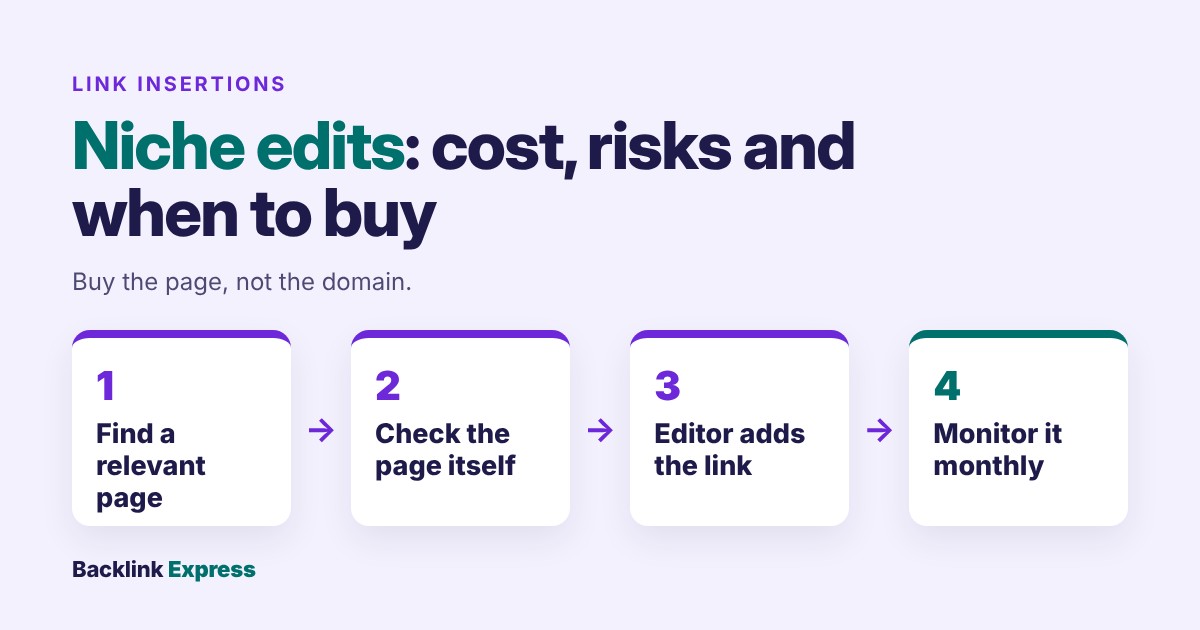
Whether you do it yourself or buy through a vendor or marketplace, the process follows the same five steps.
- Find a relevant page. Look for an article on another site that covers your topic and would naturally mention a resource like yours. Search for your topic in Ahrefs, Semrush or Google and filter for pages with real traffic.
- Check the page, not just the site. Look at the page’s own organic traffic, the keywords it ranks for, how many outbound links it already carries and when it was last updated.
- Ask the site owner. Explain what your page adds for their readers and suggest where the link fits. Many owners will ask for a fee. Some will add a useful resource for free, especially if it replaces a broken link.
- The editor adds the link. The site’s editor places the link and, if needed, adds a sentence so the link reads naturally. A good editor will refuse links that don’t fit.
- Verify and monitor. Check the link is live, in the body text, on the agreed page, with the agreed anchor. Then keep checking it every month.
The main advantage is speed. There is no new article to pitch, write, edit and schedule. The page already exists and is already indexed, so search engines can find the link the next time they recrawl it. How soon that happens depends on how often the page is crawled, which is one more reason to prefer pages that get real traffic.
Niche edits vs guest posts: what is the difference?
A guest post creates a new page that carries your link. A niche edit adds your link to a page that already exists. That single difference changes cost, speed, control and risk.
| Niche edit | Guest post | |
|---|---|---|
| Where the link sits | An existing, already indexed article | A new article written for the site |
| Content needed | A sentence or two, sometimes none | A full article, usually written by you |
| Time to go live | Usually faster: no writing or publishing slot | Slower: pitch, write, edit, schedule |
| Page strength on day one | Can already have traffic, rankings and links | Starts with none and has to earn them |
| Your control over context | Low: the article was written before you | High: you write the surrounding content |
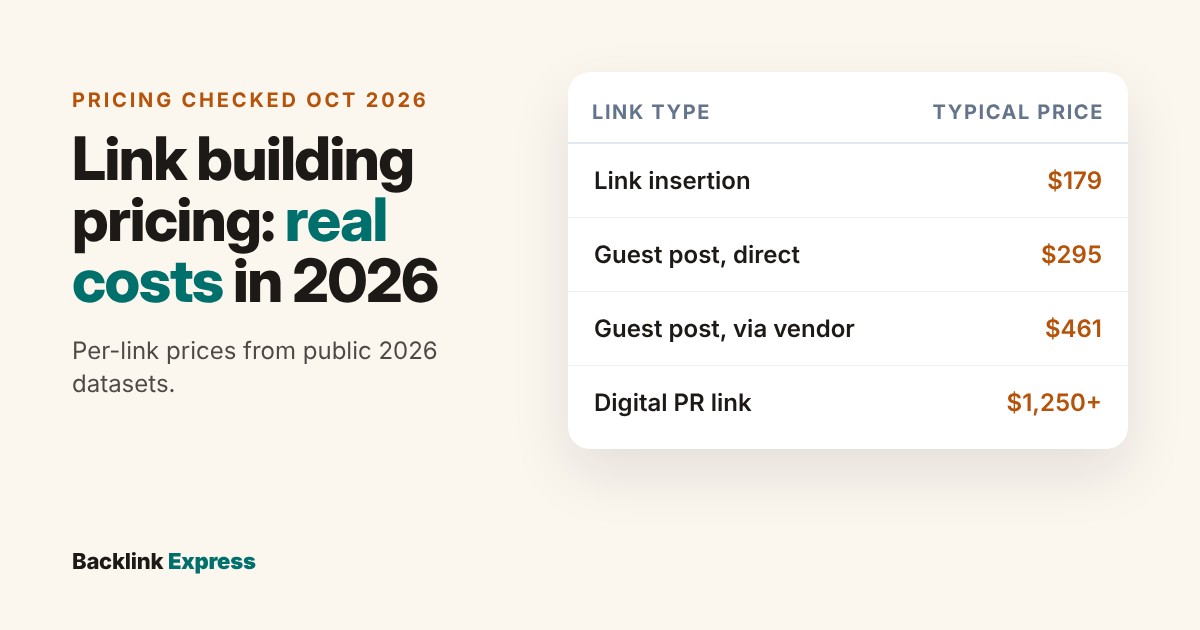
| Typical price | $179 average (BuzzStream); $361.44 average (Ahrefs study) | $295 direct, $461 via vendor (BuzzStream) |
| Main risk | Crowded or irrelevant pages; link quietly removed | New page never gets traffic or links |
| Best for | Supporting pages that need strength quickly | Building topical authority with content you control |
Neither is better in general. Strong campaigns use both. Use niche edits when a strong, relevant page already exists. Use guest posts when you need to explain something in your own words or no suitable page exists. Our guide to writing guest posts editors accept covers the other side.
How much do niche edits cost?
Published data puts the average niche edit between about $180 and $360. Pricing checked October 2026.
| Source | What was measured | Average or median price |
|---|---|---|
| BuzzStream (data updated Oct 2026) | Listed link insertion prices across 62,916 sites | $179 average |
| Ahrefs study | 450 sites in nine competitive niches asked to sell a link on an existing page; 12.6% agreed | $361.44 average |
| Backlink Outreach Agency (2026) | Its own campaign quotes, link insertions vs guest posts | $175 median insertion vs $150 guest post |
Why the spread? The Ahrefs test cold-pitched sites that had not advertised links for sale, and only one in eight agreed. Sites that rarely sell can name a higher price. BuzzStream’s figure comes from sites that already list a price, which pulls the average down.
Two things push the price of a single niche edit up or down more than anything else:
- The page’s own traffic. BuzzStream’s data shows insertion prices rising with the site’s monthly organic traffic. A link on a page that ranks and gets visits is worth more than one on a page nobody reads.
- The niche. Finance, legal, SaaS and similar niches charge more because fewer sites accept links at all.
Be careful with very cheap offers. A niche edit at $20 to $50 usually means a site that sells links to anyone, a page stuffed with outbound links or a network built for the purpose. For the full picture, including how to work out the all-in cost of a link, see our breakdown of link building pricing.
Are niche edits safe?
A niche edit is a link like any other, so Google’s rules on links apply in full. There is no special category that makes it safer or riskier. What matters is how it was obtained and how it is marked.
Google’s spam policies list “exchanging money for links, or posts that contain links” as link spam. The same page says paid links are fine for advertising and sponsorship as long as they carry rel="sponsored" or rel="nofollow". That applies to a paid niche edit exactly as it applies to a paid guest post.
That puts a lot of niche edit sales copy in an awkward spot. Some vendors advertise “permanent dofollow links, never labelled sponsored” as a selling point. Others call niche edits “harder for Google to detect.” Neither is a quality feature. Both describe a link the seller hopes Google won’t notice.
Here is the honest way to think about risk:
- A free niche edit that an editor adds because your page genuinely helps their readers is a normal editorial link.
- A paid niche edit is a paid link. The publisher decides how to label its sponsored content. Paid placements still have value: real readers, referral traffic and brand association with a topic. Just don’t buy them on the promise that they are invisible.
- A link on a hacked or network site is spam. Expect it to be ignored or removed, and expect to waste the money.
Our guide to dofollow and nofollow links explains what the rel attributes do and how Google treats them.
What makes a good page for a niche edit?
This is where most buyers go wrong. They check the domain and forget the page. A DR 70 site can have thousands of pages that get no traffic and have never earned a single link. Your link only benefits from the page it sits on.
Check every page against these signals before you pay:
| Signal | Good sign | Warning sign |
|---|---|---|
| Page traffic | The page itself gets steady organic visits | Zero or falling traffic, even if the domain is strong |
| Rankings | Ranks for keywords related to your topic | Ranks for nothing, or for unrelated terms |
| Topic fit | The article already discusses what your page covers | Your link needs a forced sentence to make sense |
| Outbound links | A handful of useful, relevant links | Dozens of unrelated commercial links |
| Freshness | Updated or maintained, facts still current | Abandoned, with broken links and old dates |
| Placement | Inside a body paragraph near related text | Footer, sidebar, author box or a list of links at the end |
| Site behaviour | Editor reviews and sometimes refuses requests | Every page carries recently added paid links |
A quick way to spot a link farm: open three or four recent articles on the site and look at the outbound links. If each one links to a casino, a loan site, a CBD shop and an SEO agency in the same paragraph, every link on that site is for sale. Yours would just be one more.
Anchor text matters too. A niche edit sits inside someone else’s sentence, so an exact-match keyword anchor often reads badly and stands out. Branded anchors, your page title or a natural phrase are safer and read better. Our guide on exact match anchor text explains how to keep your anchor mix natural.
Can you get niche edits without paying?
Yes, and the free ones are often the best. An editor who adds your link because it improves their article has given you a real editorial link. These are the three most reliable ways to earn one.
Replace a broken link
Find relevant articles that link to a page which no longer exists. Tell the editor about the broken link and suggest your page as a replacement if it covers the same thing. You are fixing a problem on their site, which makes the request easy to accept. Backlink tools can list broken outbound links for any site you enter.
Turn unlinked mentions into links
Search for articles that mention your brand, product or founder by name but don’t link to you. A short, polite email asking the editor to add a link to the page they mentioned is one of the highest-converting requests in link building, because they already chose to write about you.
Offer an update the article needs
Older articles go stale. If you have newer data, a better example or a tool that replaces something the article recommends and that no longer exists, offer it as a correction. Editors care about accuracy. A link that keeps their article current is a fair trade.
None of these work at scale the way paid placements do. Expect most emails to go unanswered. But each link you earn this way is one nobody can take back as easily, because the editor wanted it there.
Do niche edits still work in 2026?
They work when the link is one a reader would find useful on that page. Google’s systems are built to ignore or discount links that look placed only to manipulate rankings, and in its December 2022 link spam update Google said its SpamBrain system can detect both sites buying links and sites used to pass outgoing links. A link on a relevant page with real readers is much more likely to count than one squeezed into an off-topic article.
Niche edits also matter beyond Google. AI answer engines and AI Overviews pull from pages that already rank and get read. A mention of your brand on an established, relevant article puts it in the content those systems draw on. That is one more reason to choose pages with real traffic and a clear topic.
Red flags when buying niche edits
If you buy niche edits from a vendor or marketplace, walk away from any offer that shows these signs:
- You can’t see the page before you pay. A domain name is not enough. You need the exact URL.
- Prices set only by DR. Traffic and topic matter more. A price list with no traffic data is a list of guesses.
- Bulk packages at very low prices. Ten niche edits for less than the price of one real one means the sites are not real publications.
- “Undetectable” or “never labelled” as a feature. That is a promise about hiding links, not about quality.
- No replacement policy. Links on existing pages get removed during redesigns, site sales and content cleanups. Ask what happens if yours disappears.
- No live report. You should get the exact URL, the anchor and the date for every link.
When should you buy niche edits, and when not?
Niche edits are a tool, not a strategy. Use this rule to decide.
Buy niche edits when:
- A specific page on your site needs more authority to move from page two to page one, and strong, relevant articles already exist that could reference it.
- You need links to a commercial page, such as a product or service page, that bloggers rarely link to in a new guest post.
- You want to test whether links move a keyword before committing to a bigger content campaign.
Choose something else when:
- Your page isn’t good enough yet. No link fixes a page that doesn’t answer the search.
- You need to explain a new idea, product or study. A guest post or digital PR does that; a sentence in an old article can’t.
- The only pages available are off-topic or have no traffic. A weak niche edit is worse than no link, because you paid for it.
If you are new to choosing link types, our guide to spotting high quality backlinks covers the signals that apply to every link, not just niche edits.
How do you check a niche edit after it goes live?
The biggest hidden cost of niche edits is removal. The page existed before you and it will be edited after you. Track every link from day one.
- Confirm the placement. Open the page, find the link and check the URL, anchor text and
relattribute match what was agreed. - Check the page is still indexed. Search Google for the page’s URL. If it has dropped out of the index, the link is not helping.
- Record it. Keep a sheet with the page URL, target URL, anchor, date, price and vendor.
- Monitor monthly. Use a backlink tool’s lost links report or a simple crawler to check every link is still live and still in the body.
- Claim replacements fast. If a link disappears inside the replacement period, ask for a new one straight away, with the evidence.
- Measure the target page. Watch impressions and rankings for the page you built links to in Google Search Console, not just total site traffic.
If a vendor’s links keep disappearing, that tells you more about their sites than any metric on their price list.
Where a marketplace fits
On Backlink Express, the buyer picks the site, sees its traffic and price up front, and the publisher’s editor decides what goes live. The fee covers the placement and the content. That model fixes the worst problem with niche edit offers, which is buying blind.
It doesn’t replace your own checks. Apply the page signals above to every placement, ask about removal and keep monitoring your links after they go live.
The bottom line on niche edits
A niche edit is a link added to a page that already exists. Done well, it puts your link on a relevant page with real traffic, faster and often cheaper than a guest post. Done badly, it is a paid link on a crowded page nobody reads. Judge the page, not the domain. Know that a paid niche edit is still a paid link under Google’s rules. And track every link after it goes live.
Want to choose the exact site and see its traffic before you pay? Browse vetted publishers on Backlink Express.