Last updated: 13 November 2026
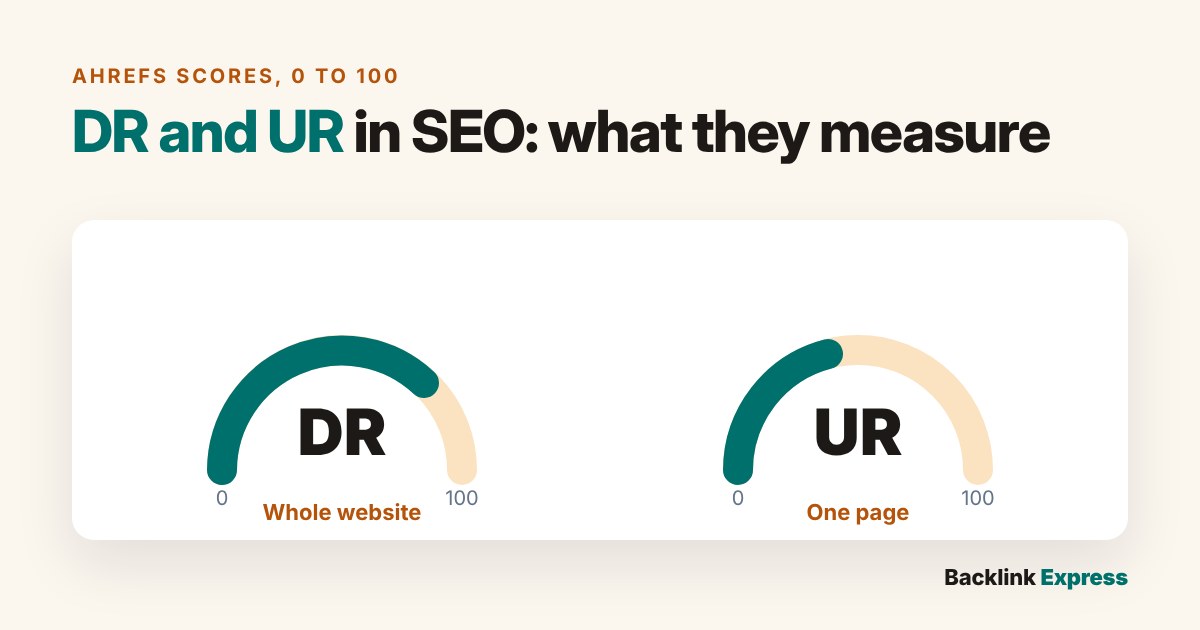
Domain Rating (DR) is Ahrefs’ 0 to 100 score for the strength of a whole website’s backlink profile, compared with every other site in Ahrefs’ index. URL Rating (UR) is the same idea for one single page and it counts internal links as well as external ones. Both are third-party estimates. Google does not use either.
Here is my position after working in SEO and link building since 2012: when you buy a guest post, you pay for the domain’s DR, but your link lives on a page with its own UR and on the day it goes live that page usually has no backlinks of its own. DR tells you about the house. UR tells you about the room you are renting. Most buyers check the first and never ask about the second.
This guide explains what each score measures, how Ahrefs calculates them, what counts as a good DR, how DR differs from Moz’s Domain Authority and a three-number check you can run before you pay for any placement.
What is Domain Rating (DR) in SEO?
Domain Rating is a metric created by Ahrefs. In its Help Center, Ahrefs describes it as a score that shows the strength of a website’s backlink profile on a 100-point scale. Three facts define it:
- It runs from 0 to 100, on a logarithmic scale. Some tool pages and even Google’s AI Overview describe DR as “1 to 100”. Ahrefs’ own documentation says 0 to 100. Because the scale is logarithmic, going from DR 20 to 30 is far easier than going from 70 to 80.
- It is relative. Your DR is your position against every other site Ahrefs has crawled. If the rest of the web gains links faster than you, your DR can fall even when you lost nothing.
- It is purely link-based. Ahrefs says DR ignores search traffic, domain age and brand popularity. It also says DR does not account for backlink spam. That last point matters most to anyone buying links.
DR is not the same as “authority” in Google’s sense. It is one company’s model of link popularity, built on its own crawl. Ahrefs even feeds DR to its own crawler to decide how deep to crawl a site. Useful, yes. A Google signal, no.
What is URL Rating (UR)?
URL Rating is Ahrefs’ score for the strength of a single page’s link profile, also on a 100-point logarithmic scale. Where DR describes the whole domain, UR describes one exact URL. If you type a domain into Ahrefs’ Site Explorer, the UR you see is the homepage’s, not the site’s.
Ahrefs’ UR documentation lists how it is built:
- It uses basic PageRank principles: links between pages, a damping factor and a wide crawl of the web.
- Both internal and external links count. A page that its own site links to heavily gets a higher UR than an orphan page on the same site.
- It respects
nofollow, so nofollowed links do not pass UR. - Ahrefs cuts “linking loops” between sites and removes some links that would inflate the score artificially.
- The HTTP and HTTPS versions of a URL get the same rating.
One detail catches people out. Ahrefs rebuilt UR in August 2022 and historical UR graphs start there. Legacy reports still show the old metric, so an old screenshot and today’s number can disagree for reasons that have nothing to do with links.
DR vs UR: what is the difference?
DR rates a website. UR rates a page. That one difference decides how you should use them.
| Domain Rating (DR) | URL Rating (UR) | |
|---|---|---|
| What it scores | The whole domain’s backlink profile | One exact URL’s link profile |
| Scale | 0 to 100, logarithmic, relative | 0 to 100, logarithmic |
| Links counted | Followed links from other domains; only the first link from each domain counts | Internal and external links to that page; nofollow respected |
| Internal links | Do not count | Count |
| Best question it answers | How strong is this site’s link profile next to its competitors? | How strong is this specific page and will a link from it carry weight? |
| Used by Google? | No | No |
Ahrefs says DR correlates with Google rankings “pretty well”, but less well than UR. That fits Ahrefs’ own line in its guide to Domain Rating: “Google ranks pages, not websites.” A correlation is not a cause, but the direction is clear. The page-level number is the one closer to what search engines actually rank.
How is Domain Rating calculated?
Ahrefs does not publish the exact formula. It does explain the method and the method tells you more than the number does:
- Find every domain with at least one followed link to the target. If a site links to you only with
nofollow, it does not raise your DR. - Count each domain once. Only the first link from a domain counts. The fiftieth link from the same site adds nothing to DR.
- Weigh each linking domain by its own DR. A higher-DR domain has more to pass on.
- Split that value by the number of domains it links to. Each linking domain divides its rating equally among every domain it links out to.
- Repeat and scale. The calculation runs across the whole index, then the raw values are scaled into the 0 to 100 range.
Step 4 is the one every link buyer should memorise. Ahrefs’ own example: a DR 10 site that links to three domains can influence your DR more than a DR 80 site that links to a million. It also explains why a link from a huge news site sometimes barely moves your DR. That site links to so many domains that each one gets a thin slice.
Two more details from Ahrefs that matter in practice. Homepage links and deep links pass the same DR. And subdomains do not always share their root domain’s DR: Ahrefs gives the example that anyone can open a subdomain on wordpress.com, so those subdomains do not inherit the root’s score.
Why does DR drop when you did not lose links?
Because the scale is relative and the inputs move. Ahrefs lists the usual causes: other sites gained links and pushed you down; sites linking to you lost DR; or sites linking to you started linking out to many more domains, so each of their links passes less. A swing of a point or two is noise. A steady slide alongside lost referring domains is worth a look.
What is a good Domain Rating?
There is no universal good DR. Ahrefs’ own answer is that a DR is good if it is “higher than or comparable to similar sites”. That is the only benchmark with a source behind it.
You will see fixed bands such as “50 to 60 is good for less competitive niches” or “70 and above is elite”, usually with no source and often next to a reminder that DR is relative. Both cannot be the rule.
The useful way to set a target:
- Search your main keyword in the country you sell to.
- Check the DR of the sites in the top five organic results with one tool. Our free DR checker pulls Ahrefs’ DR for several domains at once.
- Note where you sit in that range. That gap, not a universal band, is your benchmark.
The same logic applies when you judge a publisher. A DR 35 site that ranks in your niche can be a better placement for you than a DR 70 site that publishes everything for everyone.
Domain Rating vs Domain Authority
DR is Ahrefs’ metric. Domain Authority (DA) is Moz’s. They answer similar questions with different link indexes and different maths, so the numbers will not match and should never be mixed in one comparison.
| Domain Rating (DR) | Domain Authority (DA) | |
|---|---|---|
| Made by | Ahrefs | Moz |
| What it is | A measure of backlink profile strength | A prediction of how likely a site is to rank, built mainly from link data |
| How it is built | PageRank-style flow between domains, split by outgoing domains | Machine learning model over Moz’s link index, trained against real rankings |
| Spam handling | Ahrefs says DR does not account for backlink spam | Moz uses its Spam Score as an input to judge link quality |
| Page-level version | URL Rating (UR) | Page Authority (PA) |
| Used by Google? | No | No |
Neither is “right”. DR is a cleaner read of link strength; DA is framed as a ranking forecast. Pick one, use it for every site you compare and treat a big gap between the two on the same site (say DR 60 and DA 15) as a question to answer before you pay. Our full guide to Domain Authority covers how Moz calculates DA and how it gets gamed.
Is DR a Google ranking factor?
No. DR is a number Ahrefs calculates from its own crawl. Google does not use it and no third-party authority score feeds Google’s ranking systems. Ahrefs’ checker page says the same: Google representatives deny that “domain authority” is a ranking factor.
What Google does use is links themselves, as one signal among many. That is why DR tracks loosely with traffic. It counts the same raw material Google looks at, but it weighs it with Ahrefs’ formula, not Google’s.
And no, you cannot pay Google to rank higher in the organic results. Ads are a separate, labelled product. Buying links to manipulate rankings is what Google’s spam policies call link spam and Google asks that paid links carry rel="sponsored". No DR score changes that.
How to check DR and UR
You have three options, from free to paid:
- Our free DR checker. It reads Ahrefs’ DR for up to five domains at a time, with no sign-up and exports a CSV for your prospect list.
- Ahrefs’ free Website Authority Checker. Shows a domain’s DR, one site at a time.
- Ahrefs Site Explorer (paid). The full picture: DR, UR for any URL, referring domains, linked domains and history. You need this for the UR checks below.
Whatever you use, check the number yourself. A DR figure in a seller’s spreadsheet can be months old and a screenshot proves nothing.
How link buyers should use DR and UR: the three-number check
DR is a good first filter. It is a bad price tag. Before you pay for a guest post or link insertion, read three numbers together, all from one tool.
1. The publisher’s DR
Use it to shortlist. Drop sites far below the sites that rank for your keywords, unless the topic fit is exceptional. Then stop treating DR as the deciding factor. Remember that Ahrefs says DR ignores traffic and spam: a high score can come from a link profile you would never want to be part of.
2. How many domains the publisher links out to
This is Step 4 of the DR formula working in your favour or against you. In Site Explorer, open the site’s outgoing “Linked domains” report. A site that links out to a modest number of relevant domains passes a meaningful share of its strength to each one. A site that links out to thousands of unrelated domains splits its value so thin that your share is close to nothing, whatever the DR says.
A huge, fast-growing outbound list across every niche is also the clearest sign of a site that exists to sell links. That is a quality problem before it is a maths problem.
3. The UR of the publisher’s older guest posts
This is the number almost nobody checks and it is the best predictor of what your page will become. Find three or four guest or sponsored posts the site published six to twelve months ago and check their UR.
Because UR counts internal links, those numbers tell you how the publisher treats guest content. If older guest posts have a decent UR, the site links to them from categories, related posts or its homepage feed. If they sit near zero, guest posts are dumped into an archive that nothing links to and your link will sit in the same dead end. Ask the publisher where new posts get linked from. A real editor will have an answer.
How to improve your Domain Rating
You raise DR one way: earn followed links from more unique domains that are themselves well linked. Ahrefs puts it plainly on its checker page: getting backlinks from more unique websites is “the only way to improve”. Everything else is a means to that end.
- Win new referring domains, not more links from old ones. The fiftieth link from the same site adds nothing to DR.
- Publish things people cite. Original data, free tools, clear definitions and expert commentary earn editorial links without asking.
- Get featured on real publications in your niche through digital PR, expert quotes and genuine guest contributions.
- Reclaim lost and unlinked mentions. Ask sites that mention your brand, or link to a moved page, to fix the link.
Then point that strength at the pages you want to rank. DR is site-wide, but rankings are page-level, so link equity has to reach the money pages through internal links. That is the job of a sound internal linking structure and it is also how you raise the UR of the pages that matter.
Do not chase DR with link spam. Ahrefs admits that large amounts of low-quality links can push DR up, not down and that black-hat SEOs found ways to inflate it before Ahrefs closed many of those gaps. A higher number built that way buys you nothing in Google and adds risk.
What DR and UR cannot tell you
Both scores are useful. Both are easy to misread. Keep these limits in front of you:
| DR and UR can tell you | DR and UR cannot tell you |
|---|---|
| How a site’s or page’s link profile compares with others in Ahrefs’ index | Whether real people read the site |
| Whether a page is well linked inside its own site (UR) | Whether the links behind the score are natural or manufactured |
| A fast way to shortlist link prospects | Whether the site fits your topic, market or audience |
| Trends over time, tracked in one tool | How many links your own page needs to rank |
That last question has a better answer than any domain score: compare your page with the pages already ranking, one keyword at a time. We show the method in how many backlinks you need to rank.
What this means for you
DR measures a website’s link strength. UR measures one page’s. Neither is a Google metric and neither tells you if anyone reads the site. Use DR to shortlist publishers, then decide on the numbers that describe your actual placement: how many domains the site links out to, the UR its older guest posts reach and whether its traffic is real and steady.
That is how we think a marketplace should work: you see the site, its traffic and the price before you order and the publisher’s editor decides what goes live. Browse vetted publishers on Backlink Express.