Last updated: 13 November 2026
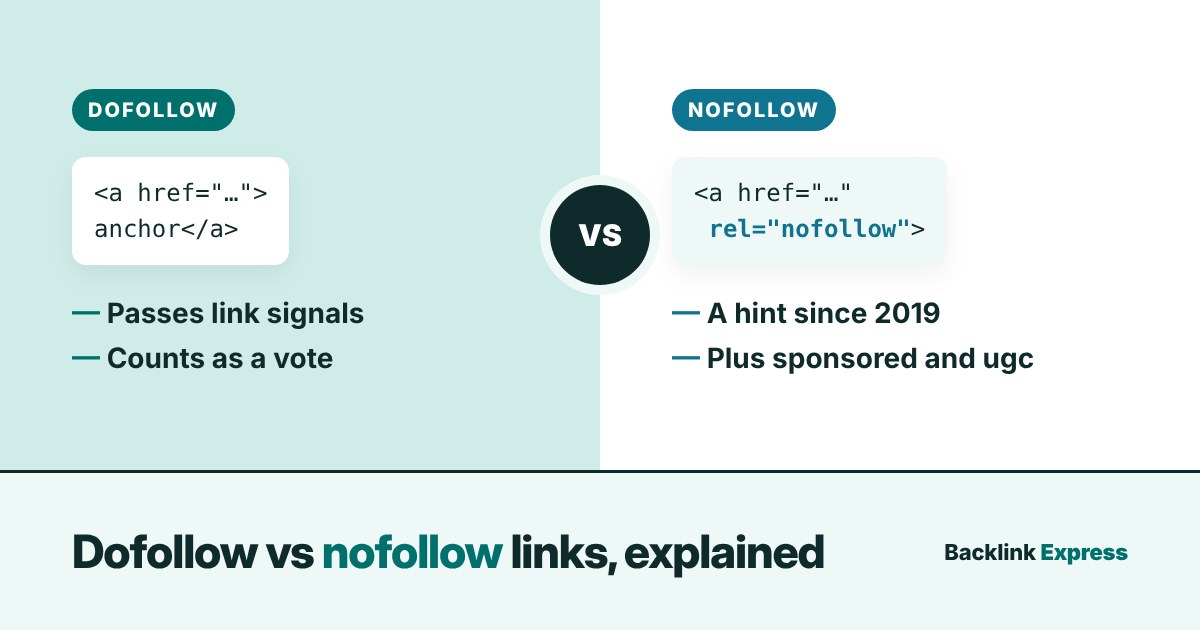
A dofollow link is a normal link with no rel value that limits it, so Google can use it as a ranking signal. A nofollow link carries rel="nofollow" and since 2019 Google treats it, along with rel="sponsored" and rel="ugc", as a hint rather than a hard block.
Here is my position after working in SEO and link building since 2012: stop shopping for the “dofollow” badge. Google decides which label a link should carry by why the link exists, not by what the seller promises. If money, goods or a deal sits behind the link, the honest label is sponsored and the value you are paying for is the page, its readers and its relevance.
This guide covers what each value means, what Google actually says about hints, how to check any link in two minutes, how publishers should label links on their own sites and what buyers should judge instead of the follow status.
What does dofollow link mean?
“Dofollow” is SEO slang, not HTML. There is no rel="dofollow" value that Google supports. A link is “dofollow” simply because nothing in its markup or on its page tells Google to hold back.
Google’s own guide to qualifying outbound links puts it plainly: for regular links you expect Google to fetch and parse without qualifications, you don’t need to add a rel attribute. This is what one looks like:
<a href="https://www.example.com/guide">link building guide</a>Ahrefs calls these “followed” links for the same reason. If a page or plugin tells you to add rel="dofollow", ignore it. It does nothing, because a link is followed by default.
If you are new to links in general, start with our explainer on what backlinks are and how Google uses them, then come back here for the labels.
Dofollow vs nofollow, sponsored and ugc at a glance
There are four states a link can be in and only three of them are real attribute values. Each one answers a different question about the link.
| Label | Markup | What it tells Google | Typical use |
|---|---|---|---|
| Followed (“dofollow”) | <a href="..."> |
Nothing extra; a normal link Google can use | Editorial citations, sources, resources you vouch for |
| Sponsored | rel="sponsored" |
The link is an ad or paid placement | Paid guest posts, sponsorships, advertorials |
| UGC | rel="ugc" |
The link sits in user-generated content | Comments, forum posts, community answers |
| Nofollow | rel="nofollow" |
Don’t associate my site with this page, or crawl it from here | Links you don’t vouch for, when the other two don’t apply |
You can combine values. Google’s guide accepts a space- or comma-separated list, such as rel="ugc nofollow". Combining is useful for backwards compatibility with services that only read nofollow.
What Google changed in 2019 and what “hint” really means
This is the part people most often get wrong, so read it closely.
When nofollow arrived in 2005, Google did not count nofollowed links as a signal at all. On 10 September 2019, Danny Sullivan and Gary Illyes announced in Evolving “nofollow” that this had changed. Sponsored and ugc were added and all three values became hints about which links to consider or exclude within Search.
The rollout came in two steps:
- Ranking: from the September 2019 announcement, all three values worked as hints for ranking purposes.
- Crawling and indexing: nofollow became a hint for crawling and indexing on 1 March 2020.
Now the line that matters for anyone buying or chasing links. In the same post, Google wrote that the move to a hint model would not, in most cases, change how it treats such links: it would generally treat them as before and “not consider them for ranking purposes.”
So a hint is not a loophole. It means Google keeps the information in the link (the anchor words, the pattern across the web) and reserves the right to use it. It does not mean a nofollowed or sponsored link quietly passes the same credit as an editorial one. Plan on zero ranking credit from labelled links and treat anything more as a bonus you cannot measure.
Today’s documentation frames it from the site owner’s side. Links with these values “will generally not be followed,” but the linked page can still be found and crawled through sitemaps or links from other sites. That is why nofollow was never a way to keep a page out of Google. To keep a page out of the index, Google says to allow crawling and use noindex.
Do nofollow links help SEO at all?
Yes, but not in the way most people hope. Here is what a nofollow, sponsored or ugc link can still do for you, ranked from most to least reliable:
- Referral traffic. A link on a page people read sends visitors regardless of its rel value. This is the only benefit you can measure directly, in your analytics.
- Brand exposure. Being cited on a respected page puts your name in front of the right readers, labelled or not.
- Discovery. Because nofollow is a hint for crawling, Google may find a URL through it. Your sitemap and internal links do this job far better.
- Possible ranking use. Google says it may use labelled links as hints. You will never know when, so never pay for this.
The YouTube case shows this clearly. Video description links carry nofollow and route through a YouTube redirect, so they are a traffic source, not ranking credit. We walk through that in our guide to checking YouTube video backlinks.
One claim you will see often: “a site with only dofollow links looks suspicious, so you need a mix.” I have not found Google say this anywhere. Building nofollow links on purpose to look natural solves a problem Google never described.
How do I know if a link is dofollow or nofollow?
Checking one link takes two minutes. Checking it properly means looking in four places, because the rel attribute is not the only way a page can hold a link back.
- Inspect the link itself. Right-click the link in Chrome, choose Inspect and read the
<a>tag. No rel value, or only values likenoopenerornoreferrer, means followed.nofollow,sponsoredorugcmeans labelled. Neithernoopenernornoreferreris among the values Google’s guide lists for qualifying links. - Check the page-level robots meta tag. Search the page source for
<meta name="robots". If it containsnofollow, Google’s robots meta tag documentation defines that as “Do not follow the links on this page,” which covers every link on it, however clean each tag looks. - Check the HTTP header. The same rule can be sent as an
X-Robots-Tagheader. Open DevTools, go to Network, reload, click the page request and read the response headers. - Compare source and rendered page. Some sites add rel values with JavaScript after load. Inspect shows the rendered version; View Source shows the raw HTML. If they differ, the rendered version is what a browser sees after scripts run.
For your whole profile, use a backlink tool with a follow filter (Ahrefs and Semrush both offer one). Do not rely on Google Search Console here. Google’s Links report help page says the report shows a sample of links and doesn’t specify whether a link is marked nofollow.
How publishers should label links on their own site
This section is for site owners who publish guest posts, sell placements or accept sponsorships. The rule is simple once you see it: the label follows the reason the link exists.
Google’s spam policies list “buying or selling links for ranking purposes” as link spam and spell out what that includes: money for links or posts with links, goods or services for links and sending someone a product in exchange for a write-up with a link. The same page says buying and selling links is a normal part of the web’s economy for advertising and sponsorship, as long as the links are qualified with nofollow or sponsored.
Use this table as your house policy:
| Situation on your site | Label | Why |
|---|---|---|
| Paid guest post or sponsored article | rel="sponsored" |
Money for a post with links is on Google’s list |
| Paid link insertion into an existing article | rel="sponsored" |
Same reason; the payment is for the link |
| Free product sent for a review that links to the brand | rel="sponsored" |
Google names product-for-write-up deals specifically |
| Affiliate links that earn you a commission | rel="sponsored" |
Our reading: Google’s 2019 definition of sponsored covers “compensation agreements” |
| Reader comments, forum posts, community answers | rel="ugc" (or ugc nofollow) |
Google’s recommended value for user-generated links |
| Trusted long-time community contributors | No label, if you choose | Google says you might remove ugc for consistently high-quality contributors |
| A source you cite but don’t vouch for | rel="nofollow" |
Nofollow is for when the other values don’t apply |
| Free, unpaid guest post where you chose the link on merit | Your editorial call | No payment, goods or deal; judge it like any citation |
| Your own sources, tools and references you recommend | No label | A normal editorial link |
Three details save publishers trouble:
- Nofollow still works for paid links. If your site already nofollows sponsored content, you do not need to rewrite it. Google says nofollow “is still an acceptable way to flag them, though sponsored is preferred.”
- Over-labelling is not a penalty risk. The 2019 FAQ says there is no wrong attribute except for sponsored links. Marking a non-ad link as sponsored at most means Google might not count it as credit. Under-labelling a paid link is the problem.
- Do not sign away the choice. Google’s list also includes requiring a link in a contract without letting the content owner qualify it. If a buyer’s terms say “must be dofollow, no rel attributes,” that clause is the issue, not you.
Anchor text matters on your side too. Google lists links “with optimized anchor text” in guest posts and articles as an example of link spam. Our guide to exact match anchor text covers what natural anchors look like.
What buyers should judge instead of the dofollow badge
This section is for SEOs and marketers paying for placements. If a seller promises that a paid link will pass ranking credit, they are selling the exact thing Google’s spam policy lists. That is a seller risk you inherit and it is the wrong thing to pay for anyway.
A placement is worth buying for what you can verify, whatever its rel value:
| What to check | Why it matters with any label | Red flag |
|---|---|---|
| Real organic traffic to the site and the section | Readers are the only value you can measure | No traffic data, or traffic that collapsed recently |
| Topic fit with your page | Relevant readers click; off-topic readers don’t | A site that publishes every niche on the same day |
| Editorial review before publishing | An editor who can say no is why the site is worth anything | “Any content accepted, live in an hour” |
| Outbound link load on past guest posts | A page with many paid links shares attention many ways | Posts stuffed with unrelated outbound links |
| How the seller talks about labels | An honest seller tells you how paid links are labelled | Guarantees of “dofollow forever” or ranking credit |
Our checklist for spotting genuinely high-authority links goes deeper on traffic and editorial signals and the spam score checker gives you a quick first look at a domain before you spend time on it.
As the founder of a marketplace, I will say it straight: a marketplace like Backlink Express lists the site and its price up front and the publisher’s editor decides what goes live. The buyer’s job is to pick the right page for the right readers. The label is the publisher’s call under Google’s rules.
A worked example: one article, four links
Here is how the rules work together on one paid article: a flooring brand’s sponsored post on a home improvement blog. The article contains four links:
- A link to the flooring brand’s product page, which the brand paid for. Label: sponsored. This is the paid placement.
- A link to a government energy-efficiency page the writer cited as a source. Label: none. It is an editorial citation the editor is happy to vouch for.
- A link to a retailer page with the blog’s affiliate tag. Label: sponsored. The blog earns a commission from it.
- A reader comment under the post linking to the commenter’s own shop. Label: ugc. Check whether your platform already adds a label to comment links automatically.
Now look at it from the flooring brand’s side. Its link carries sponsored, so it should not expect ranking credit from that tag. What it bought is a relevant article, on a site homeowners read, with a link those readers can click. If the blog has the traffic and the topic fit, that is a fair purchase. If it has neither, a missing rel attribute would not have fixed it.
Common mistakes with dofollow and nofollow links
- Adding
rel="dofollow". It is not a value Google uses. Delete it. - Using nofollow to hide a page from Google. Nofollow is a crawl hint. Use noindex to keep a page out of the index and robots.txt to stop crawling of your own URLs.
- Nofollowing your own internal links. Google’s guide says that for links within your own site, use a robots.txt disallow rule instead. Most internal links should simply be normal links, so they pass value around your site the way you intend.
- Treating every nofollow link as worthless. A nofollowed link on a page your buyers read can send more business than a followed link nobody sees.
- Trusting an old check. Publishers change link policies and plugins. A link that was followed at publication can be relabelled later. Recheck links you care about.
Which websites give dofollow backlinks?
There is no stable list and lists that claim to be one go stale fast. Any site can change its link policy, its CMS settings or its comment plugin at any time and many large publishers label outbound links site-wide.
The useful question is different: which sites in your niche cite sources with normal links when the link earns its place? You find those the same way you check any link. Inspect a few recent articles on the site, look at how they link to sources and check the page-level robots meta tag. Sites that cite freely on merit are the ones worth pitching with real expertise, as we explain in our guide to writing guest posts editors accept.
Comment sections, forums and social profiles are the classic “free dofollow” targets on old lists. Google recommends the ugc label for exactly these links and its spam policies list forum comments with optimized links as link spam. They are not worth your time for rankings.
Are dofollow backlinks still worth it in 2026?
Yes. Google’s 2019 post explains why it keeps reading links at all: they carry valuable information, such as how the words in a link describe the page it points to. In my view, a followed editorial link from a relevant site is still the most valuable kind of link you can earn.
What changed is the shortcut. Since 2019, the label is a hint, not a switch and the spam policy says clearly that paid links should be labelled. So the follow status alone tells you less than it used to. The page, the readers and the reason the link exists tell you more.
If you buy placements, judge the site and its readers and expect paid links to be labelled. If you publish, label by reason and keep your editorial standards. Buyers can browse vetted publishers on Backlink Express and site owners who want to earn from placements can list their site on Backlink Express.