You can buy backlinks, but Google’s spam policies treat paying for links that pass ranking credit as link spam, so what you are really buying is a disclosed placement on a real publisher’s page. The sticker price is the wrong number to judge it by. After a decade in SEO and link building, my position is simple: price the link you keep, on the part of the site that actually carries its reputation, with the attribute and the replacement terms agreed before you pay.
Most buying guides stop at “check DR and traffic.” That is the minimum. Below are the basics every guide covers, kept short, then the four things the top-ranking guides leave out and that change what you should pay.
What Google says about buying links
Google’s spam policies list “exchanging money for links, or posts that contain links” as link spam. The same policies allow paid links for advertising and sponsorship when the link is qualified with rel="sponsored" or rel="nofollow".
Detection is not theoretical. In its December 2022 link spam update, Google said SpamBrain can detect both sites buying links and sites used to pass outgoing links. The usual outcome is that Google ignores the links, which means the money is gone. The worse outcome is a manual action you will see in Search Console.
So never call a paid link “safe.” Call it what it is: an ad placement on someone else’s site, with a risk you manage through where you buy and how the link is marked.
What types of backlinks can you buy, and what do they cost?
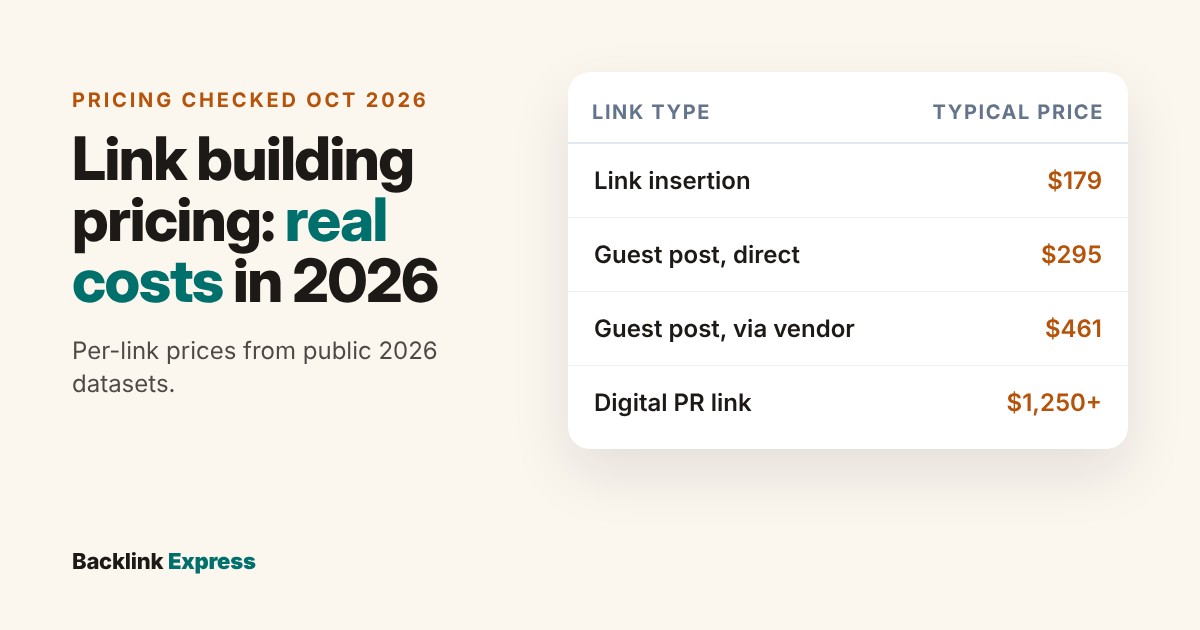
Three formats cover almost every paid placement. Prices below come from public datasets; pricing checked October 2026.
| Type | What you get | Typical price | Source |
|---|---|---|---|
| Guest post | A new article on the publisher’s site with your link in it | $295 direct, $461 via a vendor | BuzzStream pricing data, 257,267 sites (Oct 2026) |
| Link insertion (niche edit) | Your link added to an existing, indexed article | $179 average | BuzzStream pricing data, 62,916 sites (Oct 2026) |
| Digital PR link | Coverage earned through a campaign, not a fee per link | $1,250 to $1,500 per link | BuzzStream pricing data (Oct 2026) |
Older figures sit lower. Ahrefs’ 2022 outreach study found an average of $361.44 for a niche edit (450 sites, 12.6% agreed to sell) and $77.80 for a paid guest post (180 “write for us” blogs). A 2026 dataset of 526 placements from Backlink Outreach Agency puts the median paid price at $150, with finance sites at a $318 median. Niche matters more than any rule of thumb.
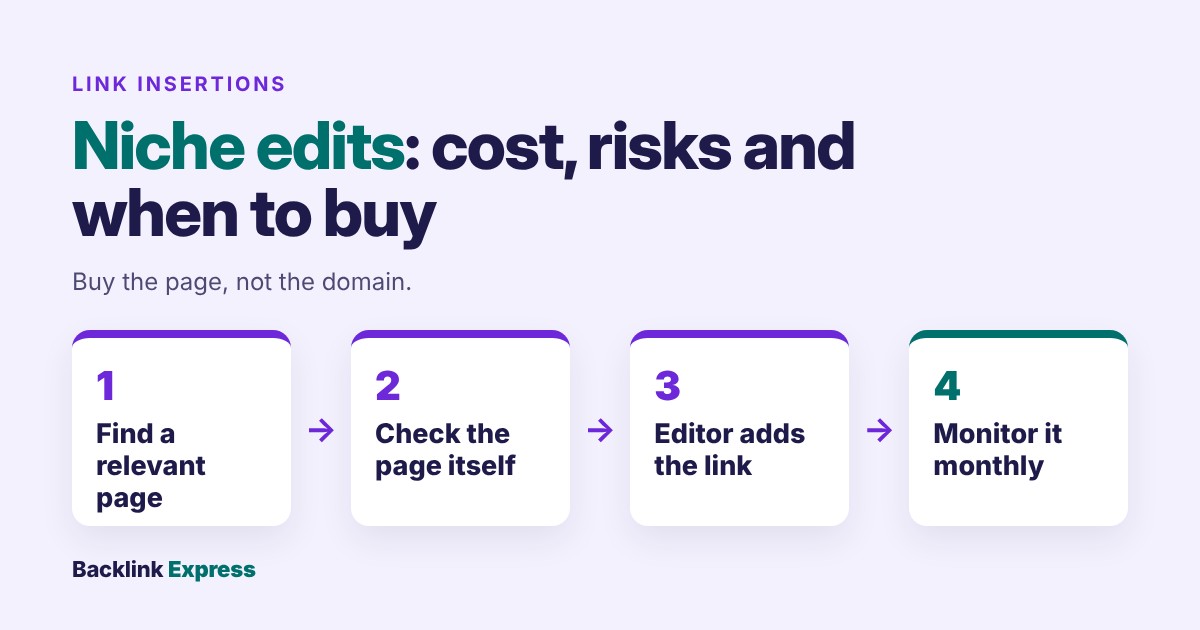
For the full cost model by link type, see our guide to link building pricing. If you are weighing edits against new articles, our breakdown of niche edits covers when an insertion beats a guest post.
How do you vet a site before you buy a link?
Every serious guide agrees on the same core checks. Run them on the exact page your link will sit on, not just the domain.
- Organic traffic, with history. Look for steady traffic over 12 months. A drop that lines up with a Google update is a reason to walk.
- Topic fit. The site and the page should be about your subject. A tech blog that also covers casinos, pets and crypto is selling, not publishing.
- Signs of selling. Published price lists, “write for us” pages in the main menu, and outbound links with exact-match commercial anchors.
- Anchor text. Use brand, URL and natural phrases. Our guide to exact match anchor text explains why there is no safe percentage to aim for.
- Third-party metrics, read with care. DR and DA are Ahrefs and Moz scores; Google does not use them. Our explainer on DR and UR shows what they can and can’t tell you.
If a seller won’t show you the site before you pay, won’t show traffic, or promises rankings, stop there.
Is buying backlinks illegal?
For most buyers the main risk is Google’s rules, not the law. The legal question that does come up is disclosure. In the US, the FTC’s native advertising guidance says advertisers are responsible for making native ads identifiable as advertising, and the advertiser is you. So ask every publisher how sponsored content is labelled before you pay. This is not legal advice; in a regulated niche such as finance or health, check with your own counsel.
Is buying backlinks a good idea?
It is a good idea only when you would still pay for the placement if Google gave it zero ranking credit. That test filters out almost every cheap package. A placement on a real, relevant site sends referral traffic and puts your brand in front of readers; those benefits survive whatever the algorithm decides. A $20 link on a site nobody visits has nothing left once Google ignores it.
Where can I buy high-quality backlinks?
You have three routes:
- Direct from the publisher. Cheapest per link, slowest per link, and you vet every site yourself.
- A marketplace. Marketplaces like Backlink Express list the site, its traffic and the price up front, so you choose the exact site and the publisher’s editor decides what goes live.
- An agency. You pay for strategy and outreach on top of placements. Useful at volume, but ask to see the site list before you pay.
Whatever the route, the vetting checks above apply to every single site.
Do backlinks still matter in 2026?
Yes, and in more than one place. Links still help Google find and judge pages, and the AI answer engines now draw on the same web. The twist, covered in the next section, is that brand mentions appear to matter more for AI answers than raw link counts.
What most backlink buying guides miss
I read the five guides ranking at the top of Google for “buy backlinks” in October 2026. None of them covers the four points below, and each one changes what you should pay or what you should ask for.
1. A big site’s sponsored section may not carry the big site’s reputation
Buyers pay premiums for famous domains. But Google updated its site reputation abuse policy in November 2024 to cover third-party pages published to exploit a host site’s ranking signals, “regardless of whether there is first-party involvement or oversight.” In the same post, Google said it has systems that treat a section that is “independent or starkly different from the main content” as if it were a standalone site.
Google adjusted enforcement again on 28 August 2026: outside the European Economic Area, a site reputation manual action hits the affected section of the site, and inside the EEA that section may be separated so it ranks on its own over time.
What to do differently: before paying a big-name price, look at where your link will live. If it goes into a “partner content,” “contributor” or coupon-style section that reads nothing like the rest of the site, you are not buying that site’s reputation. Pay for placements inside the publisher’s main editorial content, or pay a price that matches the section’s own traffic.
2. The link attribute is a hint, so agree it in writing
Google’s own AI Overview for this keyword in the UK claims a rel="sponsored" tag “prevents” a link from passing ranking weight. Google’s own words are different. Since its September 2019 change to nofollow, sponsored, ugc and nofollow “are treated as hints about which links to consider or exclude within Search.” Hints, not switches. Nobody outside Google can promise you what a tagged link is worth.
What to do differently: decide what you are paying for before you pay. Ask the publisher which attribute the link will carry and get it in writing. If it carries rel="sponsored", as Google’s policy expects for a paid link, price it for traffic, audience and brand exposure, not for ranking credit. Our guide to dofollow and nofollow links covers each attribute.
3. Links die, so price the link you keep
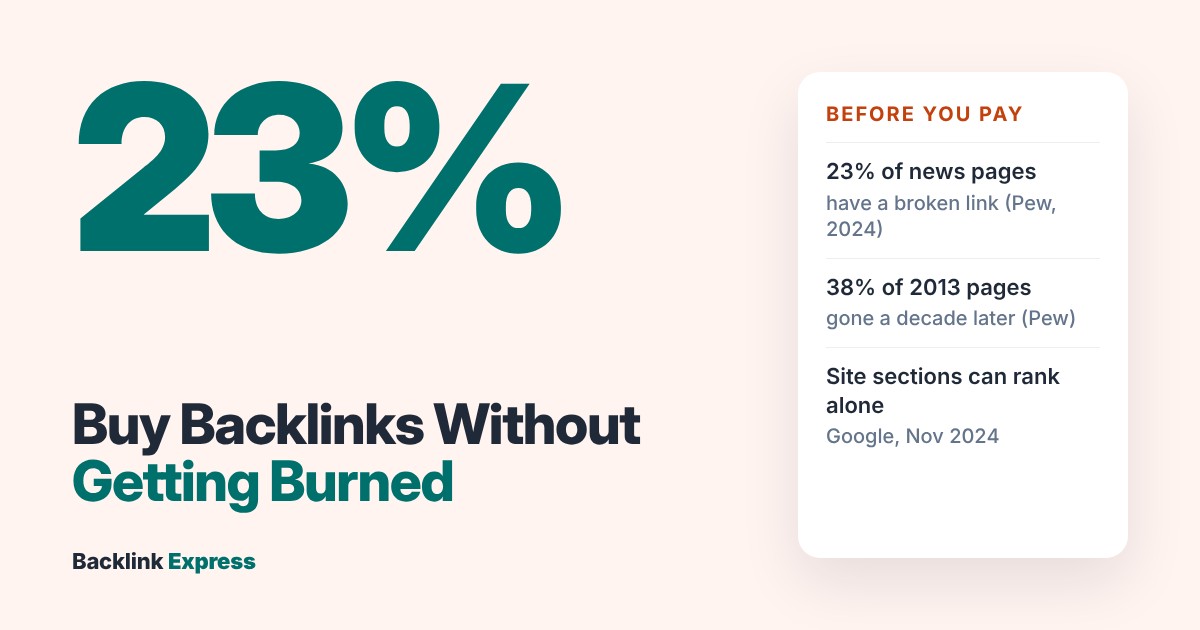
Every guide quotes a price per link. None budgets for losing it. Pew Research Center’s 2024 study of link rot found that 38% of webpages that existed in 2013 were no longer available a decade later, and that 23% of news webpages contain at least one broken link. Pew measured the web in general, not paid placements, but the lesson carries over: pages get deleted, sites get sold, and articles get edited.
Hypothetical example. Assume you pay $300 per placement and, over the period you care about, one in five placements is removed or its page goes offline. Your real cost per surviving link is $300 divided by 0.8, which is $375. If the seller replaces lost links free for 12 months, your real cost in that first year falls back toward $300. The assumptions are illustrative; plug in your own.
What to do differently: ask every seller three questions before you pay. How long is a lost link replaced or refunded? Who checks that it is still live? What happens if the page is edited and the link removed? Then check your live links monthly.
4. AI answers reward brand mentions more than raw link counts
Ahrefs studied 75,000 brands to see what predicts mentions in Google’s AI Overviews. Its May 2025 analysis found branded web mentions had the strongest correlation (0.664), well above backlinks (0.218), with brand-rich anchor text at 0.527. Correlation is not causation, and Ahrefs says so, but the gap is large.
What to do differently: make sure each placement names your brand in the sentence, not just in the link. Prefer placements where the article explains what you do in plain words. That value holds whatever attribute the link carries, which makes it the most durable part of what you buy.
My verdict: who should buy backlinks, and how
Buy placements if you have a real product, a real budget and pages worth linking to, and you are willing to judge each placement as an ad that must earn its keep. Don’t buy if you need fast rankings from a cheap package, or if you can’t say what you would do if every paid link were ignored tomorrow.
When you do buy, do four things: vet the exact page, agree the attribute in writing, budget for the links you will lose, and make sure your brand is named in the copy. That is how you buy backlinks without getting burned.
Ready to choose sites by traffic, topic and price you can see up front? Browse vetted publishers on Backlink Express.