Last updated: 13 November 2026
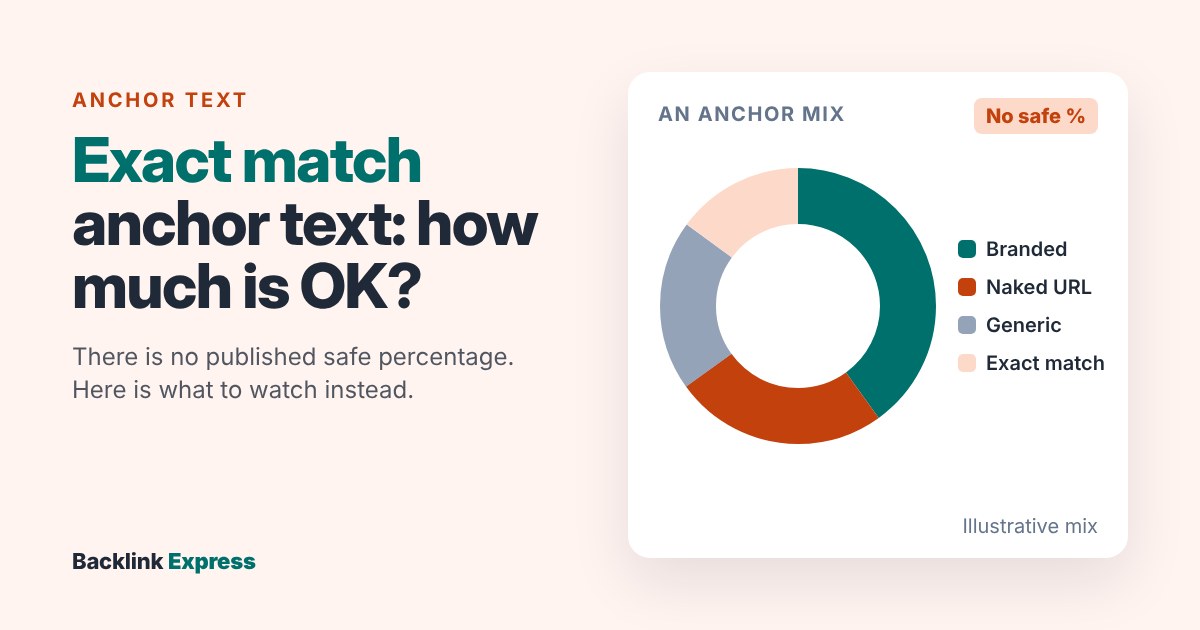
How much exact match anchor text is OK? Google has never published a safe percentage. The honest answer is: as much as the pages already ranking for your keyword show, measured page by page and only where an editor would have written that anchor without being asked.
Here is my position after working in SEO and link building since 2012: the ratio is the wrong question. Every “safe 5% to 10%” rule you have read comes with no published data behind it. What gets sites in trouble is not a percentage. It is who chose the anchor. An exact match anchor a journalist wrote is a citation. The same anchor you wrote into fifty guest posts is a pattern Google’s spam policies describe by name.
This guide covers what exact match anchor text is, what Google actually says, why the popular ratios do not hold up and a benchmark method you can run on your own target page.
What is exact match anchor text?
Anchor text is the visible, clickable text of a link. Exact match anchor text is link text that is the same as the keyword the linked page wants to rank for. If your page targets “payroll software for restaurants” and another site links to it with the words payroll software for restaurants, that is an exact match anchor.
It matters because anchor text tells people and search engines what the linked page is about. Google’s own link documentation says the text “tells people and Google something about the page you’re linking to.” That is why SEOs wanted keyword anchors in the first place and why they were abused.
Types of anchor text, with examples
To judge how much exact match is normal, you first need to sort every anchor into a type. These are the types we use, shown for a sample page targeting “payroll software for restaurants” on a brand called BrandX.
| Type | Example anchor | Who usually writes it |
|---|---|---|
| Exact match | payroll software for restaurants | Usually the site owner or a link seller; sometimes an editor naming a category |
| Partial match | handling payroll at a restaurant group | Writers paraphrasing what the page covers |
| Branded | BrandX | Journalists, reviewers, partners, directories |
| Brand plus keyword | BrandX payroll software | Reviewers and comparison pages |
| Naked URL | brandx.com | Forums, citations, resource lists |
| Generic | this guide, read more, here | Casual writers and bloggers |
| Title or descriptive | How restaurants should run tip payroll | Editors citing an article by its headline |
| Image (alt text) | An image link whose alt text acts as the anchor | Logos, badges, infographics |
The third column is the one that matters. A link profile reads as natural when its anchors match who would plausibly have written them.
Is there a safe percentage of exact match anchors?
No. Google has not published one and none of the numbers in circulation come with data. We checked where the popular ratios come from on 25 October 2026.
| Where we saw it | What it claims | What it is based on |
|---|---|---|
| Google AI Overview for “exact match anchor text” | “typically around 5% to 10% (and generally under 15%)” | Cites a Reddit thread, a blog post, YouTube videos and SEO blogs; no study |
| Lucid Media | 5% to 10% “safe threshold”, risk rising above 10% | “Based on analysis of sites that rank well”, with no data, sample or method shown |
| ClickRank glossary | Under 5 to 10% of the link profile | Attributed to unnamed “SEO experts” |
| Perplexity answer | 1% to 5% conservative, above 10% worth investigating, above 20% to 25% elevated risk | Agency and tool blogs; it also says there is “no guaranteed safe percentage” |
| Gemini answer | Exact match 1% to 5%, rarely above 10% | No sources returned |
Notice the pattern. The numbers drift between 1% and 15% and not one source shows a dataset. Some guides refuse to give a number at all. Elite Strategies puts it plainly: “there is no magic number.”
So if a seller, a tool or an AI answer tells you “keep exact match under 5% and you are safe”, treat that as folklore. It might be a reasonable rule of thumb for some sites. It is not a Google threshold and it can be badly wrong for yours.
What does Google actually say about anchor text?
Three Google documents cover this and none of them mention a ratio. Read them together and the rule is clear: descriptive anchors are good, anchors you engineer on other people’s sites are the problem.
1. Write anchors that describe the page
Google’s link best practices (last updated 10 December 2025) say good anchor text is “descriptive, reasonably concise and relevant to the page that it’s on and to the page it links to.” The same page warns against cramming keywords: “If it feels like you’re forcing keywords into the anchor text, then it’s probably too much.” It also reminds you that keyword stuffing violates its spam policies.
That answers the question of what a good anchor text is. It reads naturally in the sentence, it makes sense out of context and it tells the reader what they will get when they click.
2. Optimized anchors on other sites are link spam
Google’s spam policies (last updated 28 August 2026) list examples of link spam. One of them is “links with optimized anchor text in articles, guest posts, or press releases distributed on other sites.” Others include keyword-rich links embedded in widgets distributed across sites and forum comments with optimized links in the post or signature.
Read that carefully. The policy does not say exact match anchors are spam. It says optimized anchors placed in content you distribute on other sites are spam. The issue is who placed the anchor and why.
3. Penguin is part of the core system now
Google’s guide to its ranking systems lists Penguin as a retired system “designed to combat link spam” that was “integrated into our core ranking systems in 2016.” Many guides still describe a separate “Penguin penalty” triggered by crossing a percentage. That framing is out of date. What still exists as a separate, human step is the manual action for unnatural links, which describes “a pattern of unnatural, artificial, deceptive, or manipulative links pointing to your site.” A pattern, not a percentage.
Why a site-wide percentage misleads you
Even if a magic ratio existed, a single percentage across your whole site would hide most of the risk. Here is why we stopped looking at it.
- Anchors point at pages, not domains. A homepage collects brand and URL anchors. A category or guide page collects descriptive ones. A 4% exact match share site-wide can hide one money page where most of its links use the same commercial phrase.
- Small numbers swing wildly. A page with 20 referring domains and two exact match anchors is at 10%. One more editorial mention moves it again. Ratios on small profiles are noise.
- Concentration matters more than share. Ten domains using ten different descriptive phrases that contain your keyword look like writers. Ten domains using the identical commercial phrase look like a brief someone sent out.
- Brand names blur the categories. If your brand contains your keyword, many of your branded anchors also count as exact match in a tool. That is normal and no ratio rule accounts for it.
- The source decides the risk. An exact match anchor in a news story, chosen by the reporter, is not the same thing as an exact match anchor you specified in a paid placement. A percentage counts them both as one.
This is why we treat anchor text as a page-level question with a source check, not a site-wide number.
How much exact match is OK for your page: the benchmark method
Instead of borrowing a ratio, measure what is normal for the exact search result you want to win. The pages ranking for your keyword today are the best available picture of what a natural profile looks like in your niche. This is our method, not a Google rule. Google does not say it compares you to competitors; we use the comparison to calibrate what “normal” looks like.
- Pick the target page and its main keyword. One page, one keyword. Do not run this on your whole domain.
- List the top 5 ranking pages for that keyword. Use the ranking URLs, not their homepages. Skip forums, videos and huge brands whose links come mostly from their name (they distort the picture).
- Export each page’s anchors with referring domain counts. Any major backlink tool has an anchors report. Count referring domains, not total links, so one sitewide link does not count a thousand times.
- Sort every anchor into a type using the table above. Mark brand anchors that happen to contain the keyword as branded and note them.
- Record two numbers per page: the share of referring domains using the exact keyword and the share held by the single most repeated non-brand anchor.
- Do the same for your page and compare it with the range you found.
- Check the source of your exact match anchors. For each one, ask: did an editor choose this, or did we? Any exact match anchor you supplied in a guest post, press release or paid placement is a risk regardless of the percentage.
The output is a range, not a target. If your page already sits at the top of that range, stop asking for keyword anchors entirely. If you are well below it, that still is not permission to go and buy keyword anchors; it means you have room for editors to use descriptive phrases when they cite you.
When exact match anchor text is fine
Exact match anchors are not banned and avoiding them completely can look as odd as overusing them. They are fine in these cases.
- An editor chose them. If a writer cites your page because it is the best resource on “payroll software for restaurants” and links those words, that is a normal editorial link.
- The keyword is the plain name of the thing. Some topics have only one natural name. A link to a page about “anchor text” will often use the words anchor text.
- Your brand contains the keyword. Branded anchors that also match a keyword are expected.
- Internal links on your own site. Google’s link documentation says that paying attention to internal anchor text helps people and Google make sense of your site. The spam policy example is about anchors in content distributed on other sites. Descriptive internal anchors, including exact ones, are standard practice. Our guide to why internal links are important for SEO covers how to use them well.
The common thread: the anchor helps the reader and nobody had to be paid or briefed to write it.
When exact match anchors become a problem
These are the patterns we treat as red flags when we look at a profile. None of them needs a percentage to spot.
| Red flag | Why it matters |
|---|---|
| The same commercial phrase across many unrelated domains | Independent writers do not all pick identical words; a brief does |
| Keyword anchors in guest posts, advertorials or press releases you supplied | Named in Google’s link spam examples |
| Keyword anchors in footers, widgets, templates or forum signatures | Also named in Google’s link spam examples |
| A burst of exact match links in a short window | Looks like a campaign, not organic citation |
| A homepage receiving mostly commercial keyword anchors | Homepages are normally cited by brand or URL |
| Sellers offering “any anchor” or “keyword anchor guaranteed” | The site lets buyers dictate links, so its outbound links carry little editorial judgement |
The last row matters to buyers. A publisher whose editor never pushes back on anchors is a publisher whose links mean less. Our post on how to land high authority links covers how to spot sellers like that before you pay.
How to check your anchor text
Start with Google’s own data, then use a third-party tool for the competitor side.
- Google Search Console Links report. The Links report has a “Top linking text” table that shows the link text used in backlinks to your site, from outside your property only. It groups identical text regardless of case and is a sample, not every link. You can export up to 100,000 rows to a CSV or Google Sheet.
- A backlink tool’s anchors report. You need this for the benchmark method, because Search Console only shows your own site. Filter by the target URL, not the domain and count referring domains.
- Check the linking sites, not only the words. An exact match anchor from a spammy site is a bigger problem than one from a respected publication. Our free spam score checker is a quick first pass on the domains behind your keyword anchors.
If you are new to the wider topic of how links are counted and judged, start with what backlinks are and how Google treats them.
What to do if your anchor profile is over-optimized
Do not panic and do not mass-disavow. Work from the links you control outward.
- Stop adding keyword anchors today. Every new link should use your brand, your URL, the article title or a natural descriptive phrase chosen by the editor.
- Fix the links you placed. If you wrote keyword anchors into guest posts or paid placements, ask those publishers to change the anchor to your brand, or to mark the link
rel="sponsored"if it was paid. - Leave genuine editorial links alone. A reporter who chose your keyword as the anchor did nothing wrong.
- Use the disavow tool only for a real problem. If you have a manual action for unnatural links, Google’s process is to review your links, remove what you can, disavow what you cannot, then request a review. Google’s own manual actions help says that “Blindly adding all backlinks to the disavow file is not considered a good-faith effort.”
- Re-run the benchmark in three months. As new branded and descriptive links come in, the share of exact match drops on its own.
Then plan anchors as part of the campaign rather than as an afterthought. Our guide to building a backlink strategy shows where anchor planning fits.
What this means when you buy guest posts
If you buy placements, the anchor is the part you should care about least and control least. Pick the site carefully, then let the editor decide how to link you. In practice that means your brand name, your URL or a descriptive phrase inside a sentence that explains why the reader should click.
Paid links should carry rel="sponsored". Google’s spam policies list “exchanging money for links, or posts that contain links” as link spam and also say paid links marked rel="nofollow" or rel="sponsored" are not a violation. A followed, exact match anchor in a paid post sits squarely inside the first part of that policy. Our guide to writing guest posts editors accept shows what a clean author link looks like.
As the founder, I would rather a buyer leave a placement with a branded link on a site with real readers than a keyword anchor on a site that will print anything. The first one still makes sense in a year.
If you want to choose the site and leave the editorial call to the publisher, browse vetted publishers on Backlink Express, where each listing shows the site, its traffic and the price before you order.