Last updated: 13 November 2026
Guest post outreach is pitching articles to other websites so they publish your content with a link back to you. Do it yourself when you have expertise editors want and hours to spare. Hire it out, or buy through a marketplace, when your hour costs more than the vendor’s markup and you can still approve every site before you pay.
That last condition is the whole decision. After working in SEO and link building since 2012, my position is simple: the real choice is not time versus money, it is who picks the sites. If you hand that over without seeing the list, you are not outsourcing outreach. You are buying a surprise.
Below: what DIY outreach involves, what it really costs in hours and dollars (with every assumption shown), what hiring out costs, a break-even rule, the questions to ask any provider and the red flags that should end the conversation.
What is guest post outreach?
Guest post outreach is the prospecting and pitching that gets a guest post accepted: finding relevant sites, reaching the right editor, proposing a topic and following up. The guest post itself is the article, written for the host’s readers and published under your name, usually with one link to your site.
Google’s AI Overview for this keyword describes the same process and cites a Reddit thread where people debate buying guest posts versus doing outreach themselves. It does not tell you how to decide. That is the gap this article fills. The pitching mechanics live in our guide to getting more responses from outreach and the writing in our guest blogging writing guide. Here we stay on the business question.
What does running guest post outreach yourself involve?
A DIY campaign has seven stages and every one of them takes your time. The summary below is enough to estimate effort; the linked guides cover how to do each stage well.
| Stage | What it takes | Where it usually breaks |
|---|---|---|
| 1. Baseline | Check which pages need links and whether your content deserves them | Building links to a page that is weaker than what already ranks |
| 2. Prospecting | Find relevant sites with real traffic that publish outside writers | Lists built on DR alone, full of sites nobody reads |
| 3. Contacts | Find the editor or content lead, not a generic inbox | Pitches sent to info@ addresses that nobody owns |
| 4. Pitching | A specific topic for that site, plus one or two follow-ups | Templates that could have gone to anyone |
| 5. Writing | An article good enough for the host’s audience, to its guidelines | Thin posts written around the link |
| 6. Editing and publication | Revisions, the bio, the link, the editor’s sign-off | Drafts stuck for weeks with no reply |
| 7. Measurement | Check the link, its rel attribute, referral traffic and the target page | Nobody checks, so nobody learns |
Stage 1 is the one most people skip. If your page is weaker than the pages above it, fix the page first. Links amplify good content; they do not rescue bad content.
Where can you submit free guest posts? Anywhere an editor accepts your pitch on merit. That is what DIY outreach earns: placements you do not pay for. Sites that publish anything sent to them, with no editing, are a different thing and the links they give are worth about what they cost.
What does DIY guest post outreach really cost?
DIY outreach is cheap in cash and expensive in hours. Most of the cost is labour and the labour depends on one number you do not know in advance: how many prospects turn into a published post.
The two AI answer engines we asked on 24 October 2026 (UTC) show the problem. Perplexity put DIY at about 2 to 3 hours per successful placement, under favourable assumptions. Gemini said 15 to 30 hours. Neither linked a study that measured it. When two answers differ by ten times, the honest move is to build the model yourself.
The tools (pricing checked October 2026)
| Tool | Used for | Price on the vendor’s page |
|---|---|---|
| Ahrefs Lite | Prospecting, traffic and backlink checks | $129 a month; a $29 Starter plan also exists |
| Hunter Starter | Finding editors’ emails, sending sequences | $49 a month, or $34 a month billed yearly; free plan with 50 credits |
| Pitchbox Pro | Outreach CRM for teams running volume | $300 a month billed monthly, $210 billed annually; one-year commitment on all plans |
Prices are from the Ahrefs pricing page, the Hunter pricing page and Pitchbox’s own pricing page. A small campaign can run on Ahrefs Lite plus Hunter Starter: $178 a month at monthly rates. Pitchbox is for teams sending thousands of emails, not for four links a month.
A cost model with the assumptions shown
The conversion benchmarks that circulate are thin. The ones we traced in our outreach guide range from about 1% to 5% of emails or prospects turning into links, from a self-reported poll and single practitioners’ campaigns. So here are three scenarios, not one answer. Every input is an assumption you should replace with your own.
Assumptions: goal of 4 published guest posts a month; 15 minutes per prospect for research, a personalised pitch and follow-ups; 4 hours to write and revise each accepted post; a loaded cost of $50 an hour for whoever does the work; tools at $178 a month.
| Prospect-to-post rate | Prospects needed | Outreach hours | Writing hours | Hours per post | Cost per post (labour + tools) |
|---|---|---|---|---|---|
| 5% (known brand, strong angle) | 80 | 20 | 16 | 9 | about $495 |
| 2% (typical new campaign) | 200 | 50 | 16 | 16.5 | about $870 |
| 1% (new site, generic pitch) | 400 | 100 | 16 | 29 | about $1,495 |
How we got the 2% row: 4 posts at 2% means 200 prospects. 200 times 15 minutes is 50 hours, plus 16 hours of writing, is 66 hours, or 16.5 hours per post. At $50 an hour that is $825, plus $178 of tools divided by 4 posts (about $45).
This explains the AI disagreement. At a 5% hit rate DIY looks fast; at 1% it eats a month of someone’s time. The variable that moves cost most is not the tool bill. It is how good your pitch and your content are, which is why the founder with real expertise and the junior marketer with a template get such different results from the same process.
There is a second cost the table cannot show: time to first result. A DIY campaign often needs weeks before the first post goes live, because editors reply slowly and publish on their own calendars.
How much does a guest post cost if you hire out?
Paid placements usually cost a few hundred dollars each and the spread is wide. The best independent figure we found is BuzzStream’s link building pricing study, updated 20 October 2026: an average of $295 for a guest post bought directly from the publisher and $461 through a vendor, with a range from $150 to about $10,000. The same page compiles agencies’ published retainers at $2,500 to $10,000 a month, with entry tiers of $2,500 to $3,500 for roughly 4 to 10 links.
Vendor list prices sit in the same band. FatJoe’s blogger outreach page, read on 13 November 2026, lists prices from $72 per placement for DR 10+ sites up to $456 for DR 60+, with delivery from 14 days. Its prices have moved since we compiled our link building agency roundup, which is a good reminder to check the vendor’s own page on the day you buy. That roundup compares published per-link and retainer prices across ten agencies.
The difference between $295 and $461 is what you pay a vendor for prospecting, writing and managing the publisher. Put it next to the DIY table: at a 2% hit rate, DIY costs about $870 a post in time and tools. On those assumptions, a vendor charging under that is cheaper, if the sites are as good as the ones you would have chosen. That “if” is the rest of this article.
One more cost to price in: risk. Google’s spam policies list “buying or selling links for ranking purposes” as link spam, including “exchanging money for links, or posts that contain links”. The same page says paid links are fine for advertising when they are qualified with rel="nofollow" or rel="sponsored". Any paid guest post, from any provider, should carry that label. Nobody can sell you a paid link that is “Google-approved”.
DIY, a service or a marketplace: which should you choose?
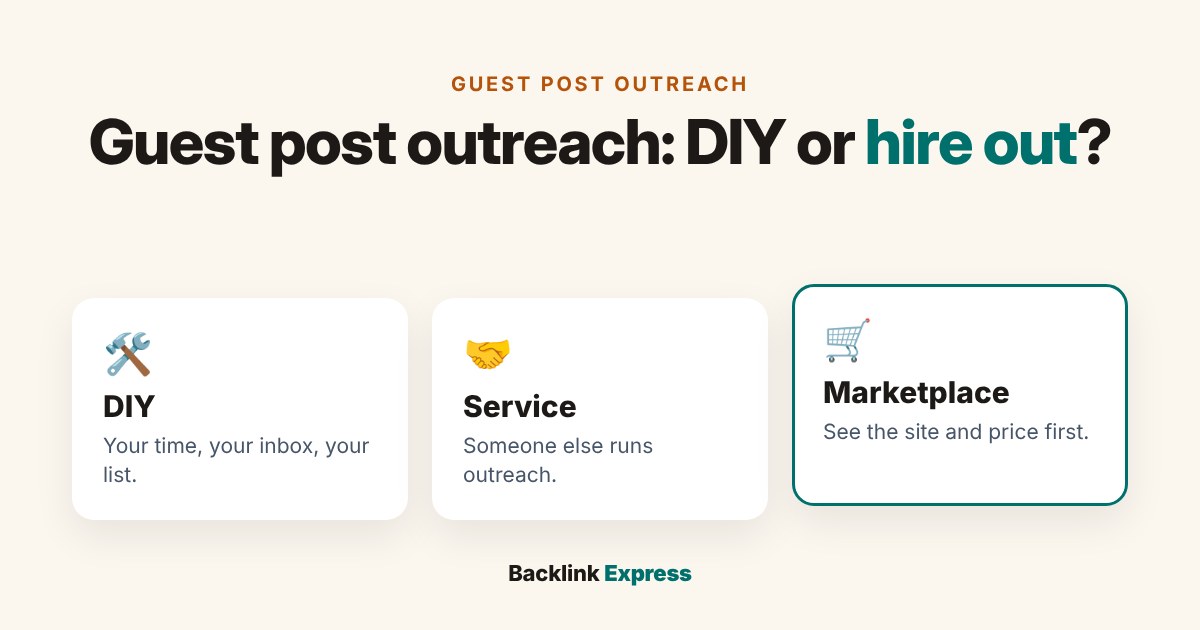
The three models trade the same three things: cash, your hours and control over which sites you appear on.
| DIY outreach | Managed service or agency | Marketplace | |
|---|---|---|---|
| Cash cost | Tools only; free placements | Highest per link; vendor margin included | Listed price per site |
| Your time | Highest | Lowest, if you trust the provider | Low: choose sites, brief, review |
| Who picks the sites | You | The provider, with or without your approval | You, from listed sites |
| What you see before paying | Everything | Depends on the provider | Site, traffic and price |
| Best when | You have expertise or data editors want and time | You need volume and strategy and have no time | You know which pages need links and want to choose each site |
Control is not a footnote. FatJoe’s own page says plainly that you will not be able to pre-approve its blogger outreach placements; you see them in a dashboard once secured. That is a legitimate model with its own stated guarantees. But it is a different product from one where you approve each site first and you should know which one you are buying.
The break-even rule we use
Hire out when both of these are true:
- The provider’s price per post is below your DIY cost per post. DIY cost per post = hours per post times your hourly cost, plus tools divided by posts. Use your real hit rate if you have one, 2% if you do not.
- You can see and approve every site before you pay. If you cannot, the price comparison is meaningless, because you are not comparing like with like.
Stay DIY when your hit rate is high (you have a known name, original data or an expert who can write), when the sites that matter most in your niche do not sell placements, or when you are learning what a good placement looks like. Many teams end up with a hybrid: DIY for the handful of publications that only accept earned pitches and a service or marketplace for the rest, with the same vetting standard applied to both.
How do you choose a guest posting service?
Judge the provider by what it shows you, not what it promises. Ask these eight questions before you pay anything. If you prefer to pick sites yourself, the same questions apply to every listing on a marketplace such as our guest post marketplace.
| Ask | A good answer | Walk away if |
|---|---|---|
| 1. Can I see and approve every site before I pay? | Yes, with the domain named, not a description | “Our network is confidential” |
| 2. What traffic does each site have and from which tool? | Organic traffic and trend from a named tool, which you can check | Only DR or DA, with no traffic figure |
| 3. Can I see three posts from the last 90 days on these sites? | Live URLs you can open and read | Screenshots, logos or a list of domains only |
| 4. Who writes the content and who approves it? | A named writing process and the publisher’s editor reviews it | Content goes live with no editor involved |
| 5. How will the link be marked? | Paid placements carry rel="sponsored" or nofollow, as Google asks |
“Guaranteed dofollow” on a paid post |
| 6. What happens if the post or link disappears? | A replacement or refund policy in writing, with a time period | A verbal “don’t worry” |
| 7. Do you own or control any of these sites? | A straight answer, either way | Evasion, or many sites with the same design and author pool |
| 8. What exactly is guaranteed? | Placement, live period, the site you approved | Rankings or traffic |
Question 5 deserves a sentence of its own. Google’s guidance on qualifying outbound links says to mark advertisements or paid placements with the sponsored value. A provider that promises the opposite is selling you exactly the pattern Google’s spam policy describes.
For checking the sites themselves, run every candidate through the checks in our guide to spotting genuinely high-authority links: traffic trend, topical fit, what else the site links to and whether real readers would land on your post. Our free DR checker handles the first pass.
What are the red flags in a guest posting service?
Walk away from a provider, agency or listing that shows any of these:
- Hidden site lists. If you only learn the domains after paying, you cannot check relevance or traffic.
- DR with no traffic. DR and DA are third-party scores, not Google metrics. A high score on a site with no organic visitors is a warning, not a bargain.
- Guaranteed rankings. Nobody controls Google’s results.
- “Dofollow guaranteed” on paid posts. That is a promise to leave a paid link unlabelled.
- Hundreds of unrelated sites at one price. Same price, every niche, instant delivery usually means a network built to sell links.
- Mass-produced content. Posts that read as unedited AI text on sites publishing dozens of them a week.
- No replacement terms in writing. Links get removed. A serious seller says what happens next.
Watch out for per-site “editorial review fees” presented as a normal part of DIY costs. If money changes hands for a post with a link, that is a paid placement and the link should be qualified as sponsored, whatever the fee is called. A “Sponsored” label on a post is not the warning sign; a paid post with an unlabelled, followed link is.
Is guest post outreach still worth it in 2026?
Yes, when the post would be worth publishing even if Google ignored the link: it reaches readers you want, on a site they trust. It is not worth it when the link is the only point, because that is the pattern Google’s policies target. We set out the benefits and risks, with Google’s current wording, in guest blogging benefits.
What about the “top 10 guest posting sites”? There is no universal list worth having. The right site depends on your niche, your readers and the page you want to help. A list of ten famous domains is useful only if your audience reads them and their editors would accept your pitch.
What this means for your next campaign
Start by writing down three numbers: your hourly cost, your realistic hit rate and how many posts you need a month. That gives you your DIY cost per post. Compare it with what a provider charges and only count providers that let you see and approve every site first. If DIY wins, run it properly with the outreach guide linked above. If it loses, buy, but vet each site as hard as you would have vetted it yourself.
If you want to choose each site yourself, see its traffic and price before you order and leave the final say on content to the publisher’s editor, browse vetted publishers on Backlink Express.