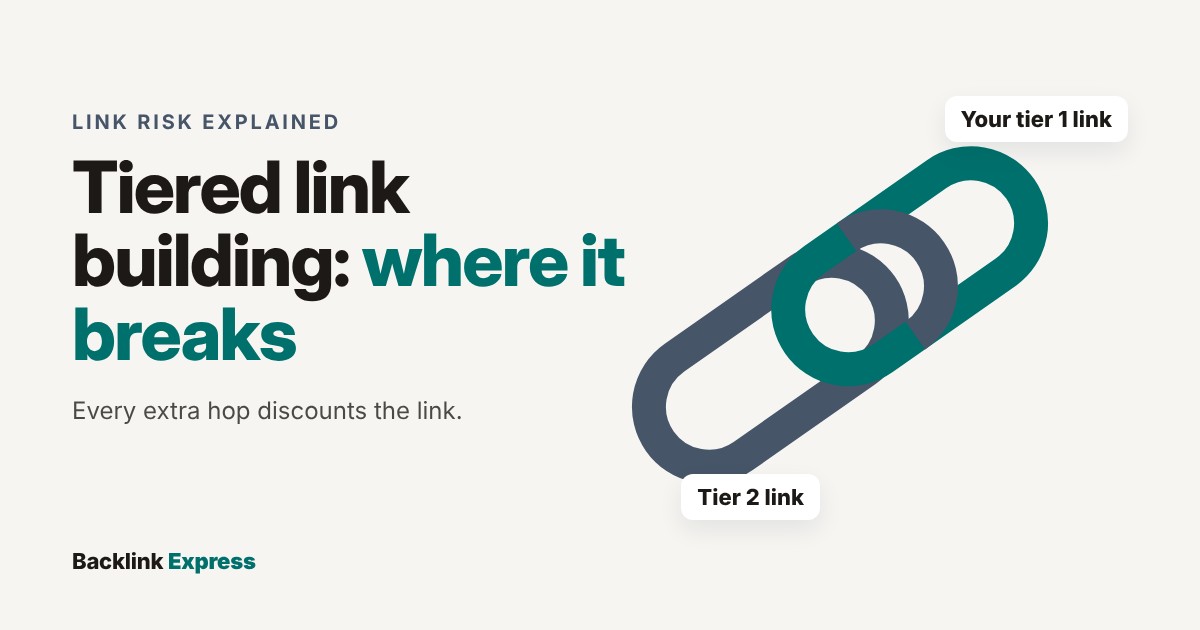
Tiered link building means building links to the pages that already link to you: tier 1 points at your site, tier 2 points at tier 1, and tier 3 points at tier 2. The tier 1 link can still help you. The layers below it get discounted twice before they reach you: once by the extra hop, and once by Google’s SpamBrain, which since December 2022 has been trained to spot sites that exist to pass outgoing links.
My position after working in SEO and link building since 2012: skip tier 2. Put that budget into the tier 1 link that actually touches your site.
How tiered link building works
The structure is a pyramid. Every guide on page one draws it the same way, and they are right about the shape.
| Tier | Links to | What sellers usually put there | What it is meant to do |
|---|---|---|---|
| Tier 1 | Your page | Editorial guest posts, niche edits on relevant sites | Pass authority and topical relevance straight to you |
| Tier 2 | Your tier 1 pages | Cheaper articles, profiles, blog networks, free blogging platforms | Push more authority into the tier 1 page |
| Tier 3 | Your tier 2 pages | Bulk, often automated links | Get tier 2 crawled and add volume |
The top-ranking guides agree on three more points. Tier 1 has to be relevant and high quality. Quality drops as you go down the tiers. Risk rises as quality drops. Most also tell you to vary anchors so the pattern looks less planned; our exact match anchor text guide covers why repeated money anchors are a footprint.
Where the guides go soft is the rulebook. You don’t need to guess. Google’s spam policies (last updated 28 August 2026) define link spam as “creating links to or from a site primarily for the purpose of manipulating search rankings”, and they list “using automated programs or services to create links to your site” as an example. Tier 2 and tier 3 exist for one reason: to make a link rank better. That is the definition.
Does tiered link building still work in 2026?
The tier 1 part works the way any good link works. A relevant editorial placement on a site with real traffic still passes value. Everything below it is where the money leaks, for four reasons the top guides skip. They are laid out in the “What most guides miss” section below.
If you are evaluating a tiered campaign that “worked”, ask a simple question: would the tier 1 links alone have produced the same result? Most case claims never separate the two.
Are backlinks still relevant in 2026?
Yes. Google would not run an AI system to cancel the effect of unnatural links, or keep a full link spam section in policies it updated in August 2026, if links had stopped counting. Links matter enough to police.
One correction while we’re here: DR and DA are third-party scores from Ahrefs and Moz. Google doesn’t use them. A tier 2 seller who promises to “raise DR” is selling you a tool metric, not a ranking. Our explainer on DR and UR shows what those numbers do and don’t measure.
Is buying backlinks illegal?
Buying a link is a commercial deal, not a crime in itself. The rule that bites is Google’s. Its spam policies say paid links are fine for advertising or sponsorship when they carry rel="sponsored" or rel="nofollow". Exchanging money for links that pass ranking credit is link spam.
That matters for tiered offers. A tier 2 package is paid links bought to pass ranking credit, by design. There is no version of it that is “sponsored” and still does its job. If you want to see what honest placements cost, our link building pricing breakdown uses public 2026 datasets.
What should you avoid in link building?
Avoid anything whose only purpose is to move a ranking signal without a reader ever seeing it. In practice:
- Tier 2 and tier 3 networks built to feed other links
- Automated link programs of any kind
- Link exchange schemes run at scale
- Repeated exact-match anchors across many sites
- Sellers who won’t show you the site, its traffic and its price before you pay
The common thread: if you would be uncomfortable explaining the link to a Google reviewer, don’t build it.
What most tiered link building guides miss
I read the five top-ranking guides for this keyword in full. None of them mentions SpamBrain, Google’s 2024 spam policies, the disavow tool or the math of a second hop. Those four gaps change the decision.
1. SpamBrain targets the exact sites tier 2 is built on
In its December 2022 link spam update, Google said SpamBrain “can now detect both sites buying links, and sites used for the purpose of passing outgoing links.” It also said “spammy links are neutralized and any credit passed by these unnatural links are lost.”
Read that against the tier 2 menu: blog networks, throwaway articles and profile pages whose job is to pass a link onward. Those are “sites used for the purpose of passing outgoing links.” The likely outcome is not a dramatic penalty. It is quieter: the links get neutralized and pass nothing, and you never get an invoice refund for links that count for zero.
What to do differently: price any tier 2 offer as if part of it will pass nothing. If the tier 1 link only “works” once tier 2 is added, the tier 1 link was the wrong buy.
2. Google’s 2024 spam policies name the usual tier 2 hosts
Several guides still describe tier 2 hosts in pre-2024 terms. On 5 March 2024, Google announced three new spam policies. Two of them map straight onto what tiered sellers build:
| Common tier 2 host | Google policy since March 2024 | What the policy says |
|---|---|---|
| Mass-produced articles, spun or AI-written, on free platforms | Scaled content abuse | Many pages generated to manipulate rankings “no matter how it’s created”; it builds on the old automatically-generated content policy |
| Blogs on bought expired domains | Expired domain abuse | An expired domain “purchased and repurposed primarily to manipulate search rankings” |
One of the top guides still links readers to Google’s older “automatically generated content” guideline. Google replaced that framing in March 2024: the scaled content policy applies “no matter whether content is produced through automation, human efforts, or some combination.” Paying humans to write tier 2 filler doesn’t move it outside the policy.
What to do differently: if you are vetting a tiered link building service, ask what the tier 2 pages are and where they live. If the honest answer is “lots of short articles” or “our network of aged domains”, you now know which Google policy covers it.
3. The two-hop math: a tier 2 link passes a small fraction of a direct link
Every guide says tier 2 sends “link juice” up the pyramid. None shows how much survives the trip. The original PageRank paper by Brin and Page at Stanford (The Anatomy of a Large-Scale Hypertextual Web Search Engine) gives the shape: a page’s vote is split by its number of outgoing links, then multiplied by a damping factor, which the authors “usually set” to 0.85.
Hypothetical example. Assumptions: the simplified 1998 formula, a tier 2 page with 10 outbound links, and your tier 1 article with 20 outbound links.
| Path | Calculation | Share of the tier 2 page’s score that reaches you |
|---|---|---|
| Tier 2 page links straight to you | 0.85 × 1/10 | 0.085 |
| Tier 2 page links to tier 1, tier 1 links to you | 0.85 × 1/10 × 0.85 × 1/20 | about 0.0036 |
Under those assumptions, the same tier 2 page sends you about 4% of what it would send if it linked to you directly. The second hop divides the value again by the tier 1 page’s outbound links. Google’s live systems are not public and are far more complex than the 1998 formula, so treat this as a model of the shape, not a measurement. The direction holds: every hop loses value, and a neutralized link (gap 1) passes zero.
What to do differently: compare cost per useful link, not cost per link. A tier 2 bundle can be cheap per link and still expensive per unit of value that reaches your page.
4. You can’t disavow tier 2 links
Google’s disavow tool works on “the URLs of the questionable pages or domains that link to your website.” Tier 2 links don’t link to your website. They point at someone else’s page: the publisher who hosts your tier 1 article.
So if a tiered campaign goes wrong, your disavow file has no lever on the layer that caused it. Your only clean exit is removing the tier 1 link, which is usually the most expensive link in the whole stack. Google also says that “in most cases, Google can assess which links to trust without additional guidance,” and reserves disavow for sites with a manual action, or a likely one, for unnatural links.
What to do differently: before you approve a tier 2 plan, know there is no undo button except deleting the link you paid most for. If a vendor offers to “boost” placements you bought, get in writing what will point at them.
Verdict: who tiered link building suits, and who it doesn’t
It doesn’t suit anyone running a site they plan to keep: SaaS, ecommerce, agencies, affiliates with a brand. The upside is a fraction of a direct link. The downside sits on your best link, and you can’t clean it up from your side.
What I’d do instead is simple. Spend the tier 2 budget on one more tier 1 placement: a relevant site, real organic traffic, a real editor, and a link that a reader might click. If an existing guest post needs support, support it the way any publisher would welcome: share it, cite it from your own content, send readers to it.
If you are vetting a tiered link building service anyway, walk if you hear “automated”, “thousands of links”, “drip-fed” or “aged domain network”. Each one maps to a line in Google’s spam policies.
If you’d rather put the budget where it counts, browse vetted publishers on Backlink Express. You pick the site, you see its traffic and price up front, and the publisher’s editor decides what goes live.