Link popularity is the number and quality of links pointing to a page or a website. Google has never ranked pages by a raw link count: the PageRank paper that launched Google weighted every link by the importance of the page it came from and split that weight across the page’s outgoing links.
That is my position after working in SEO and link building since 2012: stop measuring link popularity by counts or by a third-party score. Measure the links Google would actually count, because Google still uses links and it openly discards the ones it treats as unnatural.
What link popularity means in SEO
Every guide on this topic agrees on the basics, so here they are in one place.
- Quality beats quantity. One link from a relevant, trusted site is worth more than many links from weak or unrelated ones.
- Unique referring domains matter more than total backlinks. Fifty links from one site are not fifty votes.
- Relevance counts. A link from a site in your niche tells search engines more about your page than a link from an off-topic site.
- Placement and anchor text count. A link inside the body of an article, with descriptive anchor text, carries more meaning than a footer or sidebar link.
The usual ways to grow it are the usual ways to earn links: publish something worth citing (original data, tools, clear guides), promote it to people who write about your topic, fix broken links that used to point to you, and place relevant guest content on real sites. If you need the fundamentals first, start with what backlinks are and how they work.
To see your own link popularity, Google Search Console’s Links report shows your top linking sites, your most linked pages and your anchor text. Third-party tools such as Ahrefs, Semrush and Moz crawl the web separately and show more links, plus their own scores.
Is link popularity the same as PageRank, DR or DA?
No. Link popularity is the general idea. PageRank is Google’s own link analysis system. DR and DA are third-party estimates.
| Term | Who makes it | What it is | Does Google use it? |
|---|---|---|---|
| Link popularity | Nobody owns it | The general idea of how many good links point to a page or site | As a concept, through its link systems |
| PageRank | A link analysis system that weights links by the importance of the linking page | Yes, Google says it is still part of its core ranking systems | |
| Domain Rating (DR) / URL Rating (UR) | Ahrefs | The strength of a site’s or page’s backlink profile, scaled to 0 to 100 | No, it is Ahrefs’ own metric |
| Domain Authority (DA) | Moz | A score from 1 to 100 that predicts how likely a site is to rank compared with competitors | No, Moz says it is not a direct ranking factor |
DR and DA are useful for comparing two sites quickly. They are not Google’s numbers, and later in this post I explain the specific reason they can drift away from what Google counts. For how Ahrefs’ two scores differ, see DR and UR in SEO.
Are backlinks still relevant in 2026?
Yes. Google’s own documentation states that it “uses links as a signal when determining the relevancy of pages and to find new pages to crawl.” Its guide to Google Search ranking systems (last updated December 2025) lists link analysis systems and PageRank, and says how PageRank works “has evolved a lot since then, and it continues to be part of our core ranking systems.”
What has changed is how much Google filters. The same guide says Penguin, the system built to combat link spam, was folded into the core ranking systems in 2016. Links still matter. Bad links simply stopped being a shortcut.
Are backlinks good or bad?
Backlinks are good when another site chose to link to you because your page helps its readers. They become a risk when they exist mainly to manipulate rankings.
Google’s spam policies list “exchanging money for links, or posts that contain links” as link spam. Paid placements are allowed for advertising and sponsorship when the link is qualified with rel="sponsored" or rel="nofollow". If you buy a placement, expect that attribute, and judge the placement on what it can still do for you: real readers, referral traffic, brand visibility and topical association. Private blog networks, automated link tools and link exchange schemes are where most damage comes from. For a deeper look at the exchange side, read link exchanges in SEO.
How expensive are backlinks?
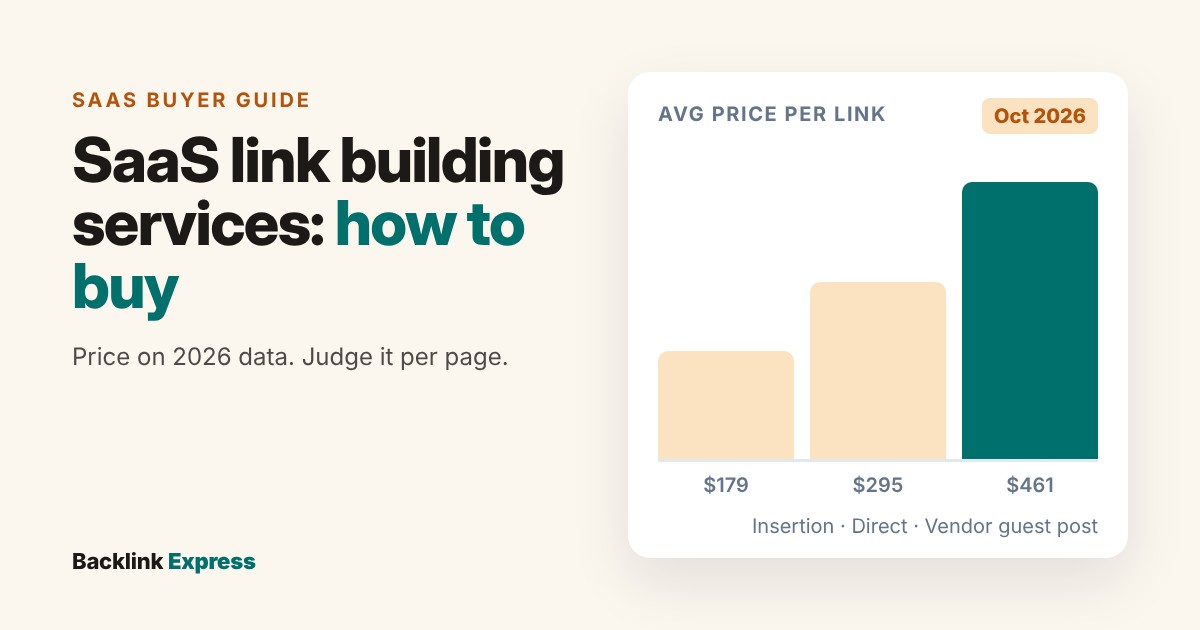
It depends on the link type and the site. BuzzStream’s pricing data (pricing checked October 2026) puts the average link insertion at $179 across 62,916 sites, and the average guest post at $295 when bought directly versus $461 through a vendor, across 257,267 sites. Digital PR links run $1,250 to $1,500 each in the same data. The full breakdown, including the hidden costs per live link, is in our link building pricing guide.
What are the three types of links?
For link popularity, the useful split is internal links (between pages of your own site), outbound links (from your site to others) and inbound links or backlinks (from other sites to yours). Only inbound links from other sites build link popularity. Internal links decide how that value moves around your own site once it arrives.
What most link popularity guides miss
The pages ranking for this term define it well and list the same tactics. Three things that change how you should measure it were missing from every top-ranking page reviewed for this post.
1. PageRank was never a link count, and the original formula shows why
The 1998 paper by Sergey Brin and Lawrence Page, “The Anatomy of a Large-Scale Hypertextual Web Search Engine”, notes that citation analysis applied to the web had worked “largely by counting citations or backlinks to a given page.” PageRank was built to do something different: it works by “not counting links from all pages equally.”
The formula is short: PR(A) = (1 − d) + d (PR(T1)/C(T1) + … + PR(Tn)/C(Tn)). Each page T that links to page A passes a share of its own PageRank, divided by C(T), the number of links going out of T. The damping factor d was usually set to 0.85, which the authors explain with a “random surfer” who keeps clicking links and now and then jumps to a random page.
Two practical rules come straight out of that formula:
- The linking page’s own links matter. A link from a page that nobody links to passes little, whatever the domain’s score says.
- Outbound link count dilutes each link. The vote a page gives is split across every link on it.
Hypothetical example (using only the 1998 formula, with stated assumptions): page X and page Y have equal PageRank. X has 10 outbound links, Y has 100. Under the original formula, each link on Y receives one tenth of the share each link on X receives. Google says PageRank has evolved since 1998, so treat this as direction, not arithmetic.
What to do differently: before you accept a placement, open the exact page your link will sit on. Count the outbound links, and check whether that page itself has any links pointing to it. A page stuffed with 80 outbound links on a high-DR domain is a weaker vote than its domain score suggests.
2. Google publishes no weight for links, so ignore anyone who quotes one
One of the top-ranking guides for this keyword cites an estimate that backlinks make up as much as 13% of Google’s ranking factors. Google has never published a percentage for links or for any other signal. Its documentation says links are a signal and PageRank is a core ranking system. That is the full extent of what Google states publicly.
Leaked internal documents and correlation studies can hint at how systems behave, but they are not Google’s statement of how ranking works, and neither gives you a reliable weight.
What to do differently: when a vendor, a tool or a report gives you a ranking-factor percentage, treat it as marketing. Plan link work against what you can observe instead: the referring domains of pages that outrank you, and the gap between them and you. Our guide on how many backlinks you need to rank walks through that comparison.
3. Your tools count links Google may ignore
This is the main reason DR and DA only approximate link popularity. They measure links that exist. Google measures links it chooses to use, and two of its public changes widen that gap.
- Link attributes are hints, not switches. In September 2019 Google introduced
rel="sponsored"andrel="ugc"and said all three attributes, sponsored, ugc and nofollow, are treated as hints for ranking, with nofollow also becoming a hint for crawling and indexing from March 1, 2020. Some guides still say nofollow links “will not pass authority”. Google’s own wording is that it decides case by case. - Unnatural links are neutralized, not just penalized. In its December 2022 link spam update, Google said SpamBrain “can now detect both sites buying links, and sites used for the purpose of passing outgoing links”, and that “any credit passed by these unnatural links are lost.”
Put those together and a site can gain DR or DA from links that pass nothing in Google. Moz itself describes Domain Authority as a comparative metric that “is not a direct ranking factor”, and Ahrefs’ DR is a score scaled into a 0 to 100 range from its own crawl. Neither can see which links Google has discarded.
What to do differently: audit link popularity in three passes.
- Start from referring domains, not backlinks or a score.
- Mark each domain as editorial and relevant, qualified (sponsored, nofollow or ugc), or likely to be discounted (sitewide links, link networks, sites that exist to sell outgoing links).
- Compare only the first group against the pages that outrank you. That number is your real link popularity gap.
The verdict
Link popularity is still worth measuring, but not the way most tools present it. PageRank weighted links from the start, Google still calls it a core ranking system, and Google openly throws away links it sees as unnatural. A bigger count or a higher DR can hide a weak profile.
If you build or buy links, judge every placement on the page it sits on, the site’s real audience and topic fit, and whether it would survive Google’s spam policies. If a seller can’t show you the page, its traffic and its topic, walk. That standard suits in-house SEOs, agencies and founders alike. It does not suit anyone still buying volume to move a third-party score.
When you’re ready to add links that pass that test, browse vetted publishers on Backlink Express: each listing shows the site, its traffic and the price up front, and the publisher’s editor decides what goes live.