Last updated: 13 November 2026
A high quality backlink is a link an editor chose to place in the body of a relevant page that real people read, on a site that does not link out to everyone who pays, with a rel attribute that matches how the link was obtained. Authority scores help you shortlist sites. They do not tell you whether a link is any good.
Here is my position after working in SEO and link building since 2012: every quality signal a buyer can check has a cheap counterfeit. DR can be inflated, traffic can be propped up, a “tech” category can be bolted onto a blog about everything. The signals worth trusting are the ones that are expensive to fake and the way to spot a high quality backlink is to check those first.
This guide covers what makes a link high quality, how sellers fake each signal and how to catch it, the dealbreakers that should end a deal before price comes up, the questions to ask a seller and where paid and sponsored links fit.
What makes a backlink high quality?
Start with an honest admission. Ahrefs’ own help article on high quality backlinks opens by saying that no one can tell you exactly how search engines measure link quality. Everything below is what Google has published plus what the industry broadly agrees on. Nothing here is a secret formula and anyone selling one is guessing.
What Google does say is that links matter. Its guide to ranking systems says it has “various systems that understand how pages link to each other” and that PageRank “continues to be part of our core ranking systems.” So the question is not whether links count. It is which ones.
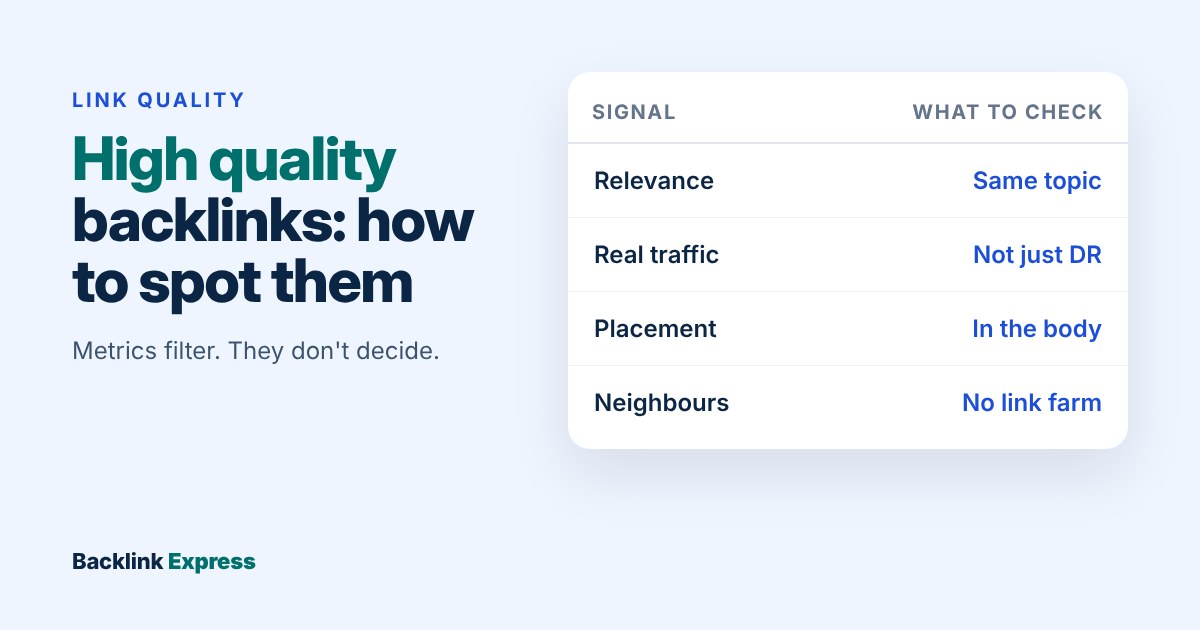
Six traits separate a link worth having from a link that only looks good in a report:
| Trait | What it means | Why it matters to a buyer |
|---|---|---|
| Relevance | The site and the exact page cover your topic or a close neighbour | Google uses links to understand what pages are about. A link from a page with no reason to mention you tells it nothing. |
| Real audience | The site earns steady organic traffic from your market, on keywords related to its topic | Readers are the one thing a link seller cannot cheaply manufacture. They also click. |
| Editorial standards | An editor reviews, edits and sometimes rejects what gets published | A site that publishes anything for a fee is a link seller first and a publication second. |
| Placement | The link sits inside the body of the article, near text that explains it, in a normal <a href> element |
Widely distributed footer and template links appear in Google’s own link spam examples. |
| Outbound link pattern | The site links out sparingly, mostly to sources that fit its topic | A page that links to hundreds of URLs shares its value thinly and a site linking to every niche is a footprint. |
| Honest rel attribute | Earned links are plain links; paid placements carry rel="sponsored" or rel="nofollow" |
This is about compliance, not quality. More on that below. |
Notice what is not on the list: a DR or DA threshold. We cover those metrics in depth in our guides to DR and UR and to Domain Authority. The short version: they are third-party estimates of link popularity, Google does not use them and they are the easiest signal of all to inflate.
Which backlinks are best?
The best backlink is a followed, editorially placed link in the body of a relevant article, on a site with a real audience in your market, pointing at a page that deserves it. Everything else is a step down from that.
In practice, the ladder looks like this. An in-body link from a respected publication in your niche beats an in-body link from a general blog. Both beat a link in an author bio. All three beat a link in a sidebar, footer, sitewide blogroll or directory listing. Links on pages Google never indexes sit at the bottom, because an unindexed page is unlikely to pass anything.
Anchor text matters less than buyers think and more than sellers admit. Google’s own link best practices say good anchor text is “descriptive, reasonably concise and relevant to the page that it’s on and to the page it links to,” and that “the words before and after links matter.” A brand name or a descriptive phrase in a sentence that explains the link is what a high quality placement looks like. The same exact commercial keyword in every placement is what a bought one looks like.
Why metrics should filter, not decide
People ask for lists of “high DA and PA sites for blog submissions” because a list feels like a shortcut. It is not. A site lands on those lists because it accepts submissions from anyone, which is the opposite of an editorial standard. The moment a site is known as an easy place to get a link, the links it gives out are worth less.
Use DR, DA and traffic estimates for one job: removing sites that are clearly too weak or clearly fake from a long list. Once a site passes that filter, stop looking at the score and start looking at the site. Our DR checker is fine for the first pass. The decision needs your eyes.
How sellers fake quality and how to catch each fake
A list of the traits of a good link is not enough. Anyone selling links knows that list too and every trait on it has a cheap imitation. The table below pairs each signal with its counterfeit and the check that exposes it. The right-hand column is the version that costs real time and money to produce, which is why you can trust it.
| Signal | The cheap counterfeit | How to catch it | The expensive-to-fake version |
|---|---|---|---|
| High DR or DA | Score pumped with links from link farms, networks or spammy directories | Look at who links to the site. Compare the score with organic traffic: a high score with little or falling traffic is the classic mismatch. | Links from real publications that cover the same topic |
| Organic traffic | Traffic from one lucky keyword, from countries outside your market, or from junk queries | Open the site’s top pages and keywords in your SEO tool. Check the country split and the 12-month trend. | Steady traffic across many topic-relevant pages, in your market |
| Relevance | A “tech” or “business” category added to a blog that covers everything | Look at the whole site, not the category. What share of its top pages are about your topic? | A site whose identity is your topic |
| Editorial standards | A “write for us” page that accepts anything with a fee attached | Read the guidelines. Ask what they rejected recently. Read three recent posts: are they edited? | Named editors, real rejections, posts that read like the site wrote them |
| Clean outbound links | Sold links removed or hidden on the posts the seller shows you | Sample the last 20 posts yourself, not the samples you were sent. Count the commercial outbound links and the niches they cover. | Few outbound links, mostly to sources a writer would cite anyway |
| Placement | Your post published in an archive or category nothing links to | Find guest or sponsored posts from 6 to 12 months ago. Are they indexed? Are they linked from anywhere on the site? | Guest content that gets internal links like the site’s own articles |
| Domain history | An expired domain bought for its old links and filled with new content | Check the site’s history in an archive service. A sudden change of topic or owner is a warning. | Years of consistent publishing on the same subject |
| “Permanent dofollow” | A paid link sold as a plain followed link with a commercial anchor | Ask how they mark paid placements. Read Google’s policy below before you answer for them. | A publisher that labels paid links and still has buyers, because the audience is worth it |
The domain history row is not a theoretical risk. Google’s spam policies name “expired domain abuse” directly: an expired domain “purchased and repurposed primarily to manipulate search rankings.” The same page describes site reputation abuse, where third-party content is published on a host site mainly to borrow the host’s ranking signals. A placement in a section like that can look like a link from a big brand and still be the kind of content Google’s policies target.
One nuance on outbound links. Links to casino, crypto or finance sites are not a red flag on their own. On a site that covers those topics, they are normal. The warning sign is a site that links to casino, CBD, pet food and SaaS in the same week, because no editor has that range. Our spam score checker can flag a messy profile, but the 20-post sample is the real test.
How do you check if a backlink is high quality or spammy?
Split your checks into two groups. Dealbreakers end the conversation. Adjusters only change what the placement is worth. Most buyers do the reverse: they negotiate hard on DR and price and never check the things that should have stopped the deal.
Dealbreakers: any one of these, walk away
- No editor. The site publishes whatever arrives with a payment, on any topic.
- No real audience. Organic traffic has collapsed, or most of it comes from countries and keywords that have nothing to do with the site’s subject.
- Outbound links to everything. Recent posts carry commercial links across unrelated niches.
- Old guest posts are not indexed. Search for the exact URLs of a few guest posts from last year. If Google does not have them, it will not have yours.
- The domain is not what it was. The archive shows a different business, language or topic until recently.
- The seller promises what Google prohibits. A paid, followed link with an exact-match anchor, sold as a ranking product, is a description of link spam, not a feature.
Adjusters: these change the value, not the decision
- Authority score. Higher is better, within reason, once the site has passed the dealbreakers.
- Traffic volume. More relevant readers means more potential clicks and more value.
- Position in the article. A link in the first half of the body, next to text that explains it, beats one buried in the last paragraph.
- Page type. A new guest post starts with no links of its own. An existing, already-ranking article with your link added carries more from day one, if the addition is editorially honest.
- Anchor and target. A descriptive anchor pointing at a genuinely useful page is worth more than a keyword anchor pointing at a sales page.
Run the dealbreakers first. They take a few minutes per site and remove most of a bad list. Only then spend time comparing the adjusters and only then talk about price.
Questions to ask a seller before you pay
A real publisher answers these without hesitation. A link seller dodges them. The answers tell you as much as any metric.
| Ask | A good answer | A bad answer |
|---|---|---|
| Can you show me three guest posts you published 6 to 12 months ago? | Live URLs, indexed, linked from the site’s own pages | Only fresh samples, or posts that are no longer live |
| What did your editor reject or change recently? | A specific example | “We publish everything that meets the word count” |
| How do you mark paid placements? | A clear policy, including rel="sponsored" |
“All our links are dofollow and permanent” |
| Where will my post be linked from on your site? | Category pages, related posts or the homepage feed | No answer |
| What happens if the post or link is removed? | A written replacement or refund policy | No policy |
Does a sponsored link count as a high quality backlink?
Yes, it can and this is where I disagree with much of the common advice. Quality and the rel attribute answer two different questions. Quality asks whether the site, the page and the audience are real. The rel attribute asks whether the link is honest about how it got there.
Google is precise about the second question. Its spam policies list “buying or selling links for ranking purposes” as link spam and include “advertorials or native advertising where payment is received for articles that include links that pass ranking credit.” The same page says paid links are “not a violation of our policies” as long as they are qualified with rel="nofollow" or rel="sponsored". Google’s guide to qualifying outbound links tells publishers to mark “advertisements or paid placements” with the sponsored value.
So be clear about what you are buying. A correctly marked sponsored link on a strong, relevant publication buys you placement in front of that audience, referral visits and brand exposure. It is not sold as ranking credit and you should not price it as if it were. A paid link that hides its nature is a policy violation, however good the site looks. Our guide to dofollow and nofollow links explains what each attribute does.
That is also the honest answer to “are paid backlinks worth it?” They are worth it when the publication would be worth appearing on even if the link passed nothing. If the only value is the link itself, you are buying the exact thing Google’s policy describes.
How much does a quality backlink cost and where do you get one?
Price follows the publisher’s audience and editorial effort, not the result you hope for. A site with a real editor, real readers and a narrow topic costs more to publish on because it is harder to get into. A flat price for “any DR 50+ site” is a red flag on its own, because real publications do not price that way.
You can get quality links three ways: earn them, buy placements directly from publishers, or go through a marketplace or agency. The quality test is the same in every case. A marketplace should show you the site, its traffic and its price before you order, so you can run the dealbreakers yourself. If you want to earn links instead, our guide to strategies for getting backlinks covers the tactics, from unlinked mentions to digital PR.
How many high quality backlinks do you need?
There is no fixed number. The right count is the gap between the page you want to rank and the pages already ranking for that keyword, measured in relevant referring domains to the ranking pages, not the whole domain. We walk through that calculation in how many backlinks you need to rank. What matters here is that five links that pass the dealbreakers will do more than fifty that fail them and the fifty carry risk the five do not.
Do backlinks still matter in 2026?
Yes. Google’s ranking systems guide, last updated in December 2025, still lists link analysis and PageRank among its core ranking systems. What has changed is the cost of getting it wrong. Google’s link spam examples include paid links that pass ranking credit, guest posts with optimized anchors distributed across sites, widely distributed footer and template links and low-value content created to manipulate links. A high quality link is the one that still makes sense after you read that list.
What this means for you
Stop asking “what is the DR?” first. Ask whether the site has an editor, a real audience in your market and a topic that matches yours and whether its old guest posts are alive and indexed. Treat every signal a seller shows you as a claim to verify, starting with the ones that are expensive to fake. Then decide what the placement is worth, knowing that a paid link should be labelled and priced for its audience, not for ranking credit.
If you buy placements, look for a marketplace that shows you the site, its traffic and its price before you pay, so you can run these checks yourself. Browse vetted publishers on Backlink Express.