Last updated: 13 November 2026
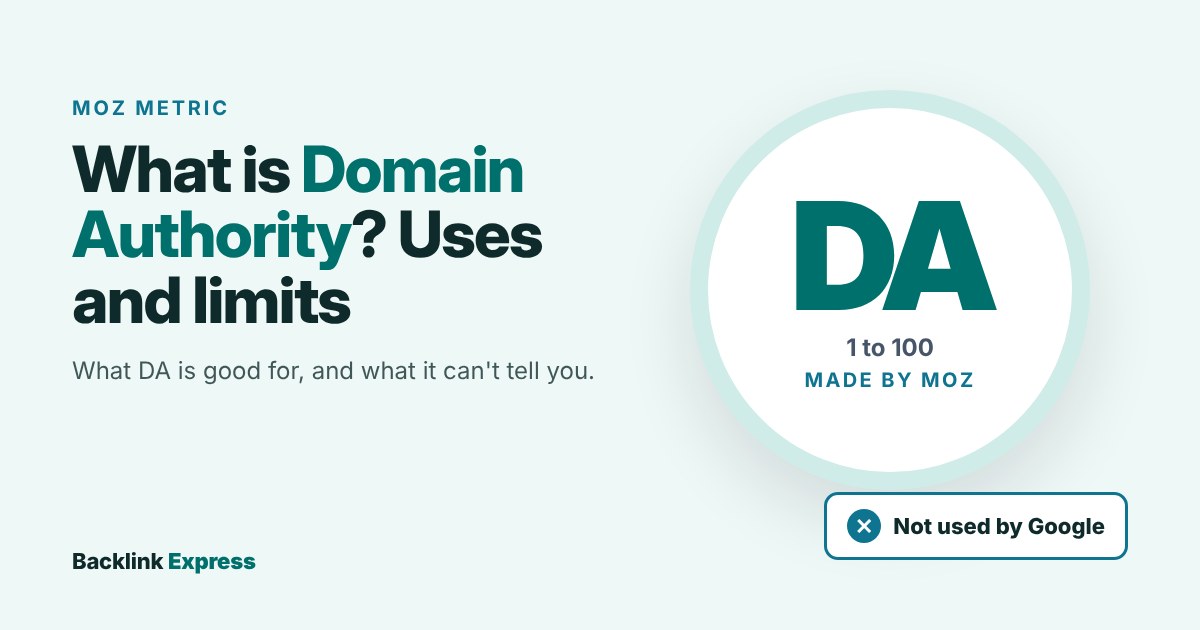
Domain Authority (DA) is a 1 to 100 score made by the SEO software company Moz that predicts how likely a website is to rank in search results compared with other sites. It is built mostly from backlink data and Google does not use it.
That second sentence is the one that costs link buyers money. DA is a decent filter and a terrible price tag. If a seller prices a placement by DA alone and cannot show you real traffic, walk away.
Below: what DA measures and how Moz calculates it, what a good score looks like, how it compares with Ahrefs DR, how it gets gamed and a vetting routine you can run before you pay for any link.
What is Domain Authority in simple words?
Domain Authority is Moz’s estimate of how strong a website’s backlink profile is compared with every other site in Moz’s index. The higher the number, the more Moz expects the domain to compete in Google results.
Three things define it, straight from Moz’s own documentation:
- It is Moz’s metric. “Domain Authority” is a Moz trademark. Other tools have their own versions with different names and different maths.
- It runs from 1 to 100 on a logarithmic scale. Going from 20 to 30 is far easier than going from 70 to 80.
- It is relative. A score only means something next to the scores of the sites you compete with.
Moz also scores single pages with Page Authority (PA). DA describes the whole domain or subdomain; PA describes one URL. When you buy a guest post, the page your link sits on starts with almost no page-level strength, so the domain’s overall profile and its internal linking matter more than the PA of the homepage.
How is Domain Authority calculated?
Moz runs a machine learning model over its Link Explorer index. The model looks at dozens of link signals, with the number of unique linking root domains and the quality of those links carrying the most weight. It is trained against real Google results, so the score is a prediction of ranking ability, not a measurement of it.
The current model dates from Domain Authority 2.0, which Moz rolled out in 2019. According to Moz’s own explanation of that update to Search Engine Land, it moved from linear regression to a neural network, added its Spam Score to judge link quality and started devaluing link patterns that did not lead to better rankings.
Notice what is not in the formula: your organic traffic, your content quality, your page speed, your conversion rate. Some guides list site structure, UX or social signals as DA “factors”. Those things can help you earn links, which then move DA, but they are not direct inputs. DA is a link metric.
Why your DA changes when you did nothing
Moz lists several reasons a score moves on its own:
- Moz’s crawl found more or fewer of your linking domains than last time.
- You gained or lost links.
- Other sites gained links. Because the scale is relative, a huge jump at the top end pushes everyone else down a little.
- Some of your links come from sources that do not correlate with rankings, so the model counts them for little.
- Moz changed the model itself, as it did with DA 2.0.
A drop of a few points with no traffic change is noise. A drop alongside falling traffic is worth investigating.
Is Domain Authority a Google ranking factor?
No. Google does not use Moz’s DA in crawling, indexing or ranking. Google’s John Mueller has said so publicly many times between 2016 and 2022, including that Google does not use Domain Authority “at all” in its algorithms. Search Engine Journal keeps a record of those statements.
Google has also said it does have some site-level signals. That is not the same thing as Moz’s score and nobody outside Google can see those signals. Treat any claim that “Google uses DA” as a red flag about the source.
The same goes for AI search. There is no public evidence that ChatGPT, Perplexity or Google’s AI Overviews read third-party authority scores. They cite pages they can find and trust, which usually means pages that already rank and get linked to.
What is a good Domain Authority score?
There is no universal “good” DA. Moz says this itself: a score of 30 can be excellent in one niche and weak in another. The only useful benchmark is the sites that rank for the keywords you want.
Use this as a working guide, not a law:
| DA range | What it usually means | How to read it as a link buyer |
|---|---|---|
| 1 to 20 | New site or small site with few linking domains. Every new site starts at 1. | Can still be useful if the topic fits and it has real readers. Low link value on its own. |
| 20 to 40 | Established niche blogs, local businesses, specialist publications. | Often the sweet spot for relevant placements. Judge on traffic and topic, not the number. |
| 40 to 60 | Strong niche publishers and well-known brands in smaller markets. | Check that traffic matches the score before you pay a premium for it. |
| 60 and above | Major brands, national media, large platforms. | Real editorial links here are hard to get. A cheap “DA 70” offer deserves extra scrutiny. |
Is 30 a good Domain Authority? For a focused niche site, yes, it can be. If the sites ranking on page one for your target terms sit between 25 and 40, a DA 30 publisher in your topic is a strong prospect. If they all sit above 60, a DA 30 link is a small contribution, not a game changer.
Domain Authority vs Domain Rating (DR) and other scores
Every major SEO tool has its own authority score. They measure similar things from different link indexes, so the numbers do not match and should never be mixed in one comparison.
| Metric | Tool | What it is built on |
|---|---|---|
| Domain Authority (DA) | Moz | Machine learning model over Moz’s link index, trained to predict rankings |
| Domain Rating (DR) | Ahrefs | Strength of a site’s backlink profile relative to others in Ahrefs’ index, 0 to 100 |
| Authority Score (AS) | Semrush | Combines link data with organic traffic and spam signals |
The practical difference for buyers: DR is a purer link-strength measure, while DA is framed as a ranking prediction. Neither looks at whether real people visit the site. We cover Ahrefs’ scores in detail in our guide to DR and UR and you can check any domain’s DR with our free DR checker.
Pick one tool and stay with it. A site that shows DA 55 but DR 12, or the reverse, is not a bargain. It is a question you need answered before you pay.
How to check Domain Authority
You check DA in Moz’s own tools:
- Link Explorer or the free Domain Authority checker. Enter the domain. A free Moz account gives limited lookups.
- MozBar. Moz’s free browser extension shows DA and PA on any page and in Google results.
- Moz Pro or the Moz API. For checking long prospect lists in bulk.
Always check the number yourself. Seller spreadsheets go stale and a screenshot proves nothing.
How Domain Authority gets gamed
DA is a link metric, so anything that piles up links can push it up without making the site any more useful. Moz’s DA 2.0 devalues some manipulation, but not all of it. These are the most common patterns to watch for when vetting publisher sites:
- Link farms and private blog networks. Networks of sites linking to each other or to a “money” site to raise scores. Google’s spam policies name these as link spam.
- Expired domains with old link profiles. A dropped domain with strong historical links gets rebuilt as a guest post site. The DA comes from the old site; the new content has no audience.
- “DA boost” services. Cheap packages that promise a higher DA in weeks by blasting low-quality links. They raise the number and nothing else.
- Sites that exist to sell links. High DA, every topic from crypto to pet food, several sponsored posts a day, almost no organic traffic.
The common thread is a gap between the score and the audience. That gap is exactly what your vetting has to catch.
How link buyers should use Domain Authority
As the founder of a link building marketplace, working in SEO and link building since 2012, my position is simple: use DA to sort a list, never to make the final call. The decision should rest on whether real people in your market read the site.
Here is the vetting routine we recommend. DA is step one of seven, not the whole test.
- Screen by DA (or DR) against your competitors. Drop sites far below what your ranking competitors earn, unless the topic fit is exceptional.
- Compare DA with organic traffic. Look at 12 months of estimated organic traffic in Ahrefs, Semrush or a similar tool. A high score with tiny or collapsing traffic is the clearest sign of an inflated site.
- Check where the traffic comes from. Countries and ranking keywords should match your market. Traffic from unrelated countries or junk keywords is not an audience.
- Read the outbound links. Open the last 20 posts. If they link out to every niche at once, or carry sponsored links in nearly every post, the site is a link seller first and a publication second.
- Look at who links to the site. Real publications earn links from real sites. A profile full of spammy anchors, foreign-language directories or obvious networks is a warning, whatever the DA says. Moz’s Spam Score is a useful supporting flag here.
- Confirm the posts get indexed. Search a few recent guest post URLs in Google. If they are not indexed, your link will not be either.
- Check the editorial standards. Is there an editor? Are guest posts edited and linked internally, or dumped in a category nobody visits? Does the site label paid links properly?
The quick way to read steps 1 and 2 together:
| Real, steady organic traffic | Little or falling organic traffic | |
|---|---|---|
| High DA | Strong prospect. Check topic fit and price. | Most likely inflated. Skip unless you can explain the gap. |
| Low or mid DA | Often underpriced and worth it if the topic fits. | Weak link value. Only for very specific relevance. |
The limits of Domain Authority
DA is useful. It is also easy to misread. Keep these limits in mind every time you look at one:
| What DA can tell you | What DA cannot tell you |
|---|---|
| How a site’s link profile compares with others in Moz’s index | Whether anyone actually reads the site |
| A rough sense of ranking potential for the domain | How a specific new page with your link will perform |
| Trends over time when you track one site in one tool | Whether the links behind the score are natural or manufactured |
| A fast way to shortlist prospects | Whether the site fits your topic, market or audience |
DA also says nothing about link attributes. A link marked nofollow or sponsored from a DA 70 site passes different signals than an editorial link, a point we cover in our guide to dofollow and nofollow links.
Does Domain Authority still matter?
Yes, as a comparison tool. No, as a goal. DA is still one of the fastest ways to size up a site’s link profile against competitors and to shortlist prospects. It stops being useful the moment it becomes the target or the price list.
Chasing DA for its own sake leads straight to the tactics in the gaming section. Moz itself warns against buying links to raise the score and Google’s spam policies treat buying or selling links to manipulate rankings as link spam. If you buy a placement, it should be on a real publication and the link should be qualified with rel="sponsored", as Google explains in its guidance on qualifying outbound links. No DA score makes a paid link “safe”. The broader trade-offs are in our guide to SEO risks worth taking and avoiding.
How do you improve your own Domain Authority?
You improve DA the same way you improve rankings: earn more links from more relevant, trusted websites. The score follows the links. There is no shortcut that raises DA and also helps your site.
- Publish things people want to cite: original data, tools, clear explainers, expert commentary.
- Get featured on real publications in your industry through digital PR, guest contributions and partnerships.
- Reclaim unlinked brand mentions and fix broken links pointing at your site.
- Track your score against two or three direct competitors in one tool, monthly and ignore small swings.
Expect slow movement. Because the scale is logarithmic, each point gets harder as you climb.
What this means for you
Domain Authority is a Moz estimate of link strength, scored 1 to 100, useful for comparison and useless as a Google signal. As a link buyer, use it to shortlist, then decide on traffic, topic fit, link profile and editorial standards. A relevant DA 30 site with real readers is worth more to you than an empty DA 70 site.
That is how we think a marketplace should work: you see the site, its traffic and the price before you order and the publisher’s editor decides what goes live. Browse vetted publishers on Backlink Express.