Last updated: 13 November 2026
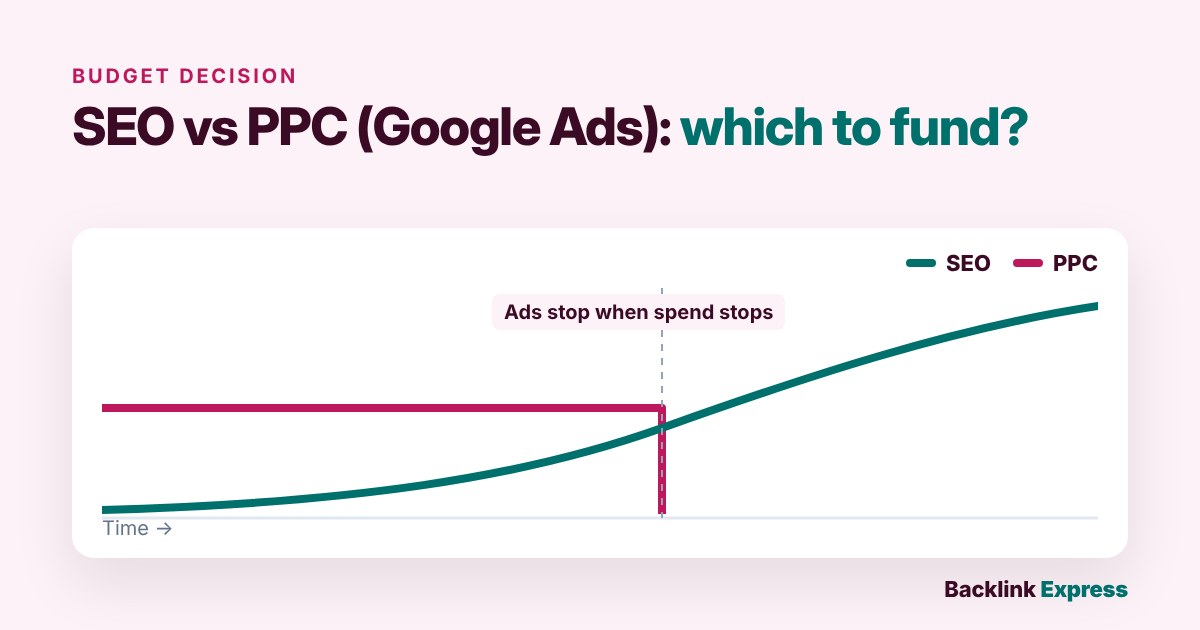
SEO earns you unpaid listings in Google’s organic results over months; PPC (pay-per-click, mostly Google Ads) buys a sponsored spot today and charges you for every click. PPC is faster and stops when the money stops. SEO is slower and keeps working after the work is done.
Here is my position after working in SEO and link building since 2012: “SEO or PPC?” is the wrong question at the budget level. The right question is per keyword. Rent the clicks you cannot earn within your runway and own the ones where the gap to page one is closeable.
Below: the real differences, what each one actually costs in 2026, what AI Overviews changed, a break-even formula you can run on any keyword and a decision table for founders and marketers who have to split one budget.
What is the difference between SEO and PPC?
Both put you on the same search results page. They get there by different routes and you pay for them in different ways.
| SEO (organic) | PPC (Google Ads) | |
|---|---|---|
| Where you appear | Organic results and as a possible source in AI Overviews | Ad slots above and below organic results, labelled “Sponsored” |
| How you pay | Up front: content, technical work, links, people or an agency | Per click, every click, through an auction |
| Time to first results | Usually months and longer for competitive terms | Hours to days after launch |
| What happens when you stop paying | Rankings decay slowly; traffic often continues for a while | Traffic stops the same day |
| What decides your position | Relevance, content quality, links and many other ranking systems | Ad Rank: bid, ad and landing page quality, context, competition |
| Control | Low: Google picks the page and the snippet | High: keywords, copy, location, schedule, budget |
| Biggest risk | Spending for a year on a keyword you never rank for | Paying for clicks that never convert |
One rule sits underneath the whole comparison: money spent on ads does not buy organic rankings. Google says so in its own SEO vs. PPC guide, which explains that paid ads will not help your SEO. The two channels share a results page, not a ranking system.
If someone asks what “SEO PPC marketing” means, they usually mean search engine marketing (SEM): using both channels together on search engines.
Is PPC just Google Ads?
No. PPC is a pricing model, not a platform. Google Ads is the largest search PPC platform, which is why most people use the terms interchangeably and why this article does too.
Microsoft Advertising runs the same model on Bing and Amazon, Meta and LinkedIn all sell ads that can be bought per click. For the “SEO vs PPC” decision, the comparison that matters is search ads against organic search, because both capture people who are already looking for what you sell.
How Google decides where your ad shows
Most comparison pages say the highest bidder wins. That is wrong. Google’s help page on Ad Rank lists six inputs: your bid, the quality of your ad and landing page, Ad Rank thresholds, how competitive the auction is, the searcher’s context (such as location and device) and the expected impact of ad assets. It also says you often pay less than your maximum bid.
This is where SEO and PPC quietly help each other. A fast, clear, relevant landing page is good for organic rankings and good for the “landing page quality” part of Ad Rank. Fixing the page lifts both channels. Fixing the bid lifts only one.
What does SEO cost compared with PPC in 2026?
PPC is easy to price because Google shows you the bill. The most recent large benchmark I trust is WordStream’s 2026 Google Ads benchmarks, built from 13,474 US search campaigns between April 2025 and March 2026. Its medians across all industries:
| Metric (all industries, US search ads) | 2026 median |
|---|---|
| Cost per click | $5.42 |
| Click-through rate | 6.64% |
| Conversion rate | 8.18% |
| Cost per lead | $66.69 |
| Highest CPC industry | Attorneys and legal services, $9.87 |
| Lowest CPC industry | Arts and entertainment, $1.63 |
Treat these as a starting point, not a quote. Your own keywords can cost far more than the median, especially in legal, finance, insurance and B2B software.
SEO is harder to price because the clicks are free and the work is not. Your SEO bill has three lines:
- Pages. Writing or improving the page that should rank, plus design and editing.
- Technical work. Making sure Google can crawl, index and understand the site.
- Links. Earning or placing enough relevant links to compete with the pages already on page one.
Most comparisons stop at “SEO is free per click”. That hides the line that usually decides whether a commercial keyword is winnable: links. For informational keywords, good content can rank with few links. For “best”, “pricing”, “near me” and “software” keywords, the sites on page one tend to have far more referring domains than a new site and closing that gap is where most of the SEO budget goes. Our guide on how many backlinks you need to rank shows how to size that gap for a single keyword.
Is SEO or PPC better?
Neither, until you name the keyword, the deadline and the margin. Then one of them is almost always better for that keyword.
PPC is better when you need revenue inside the next quarter, when the offer is time-limited, or when you do not yet know which keywords convert. Paying for a month of clicks is the cheapest market research in digital marketing.
SEO is better when the keyword will still matter in two years, when the click cost is high relative to your margin and when the sites on page one are beatable with the budget and runway you have.
Most businesses that can afford both should run both, but not on the same keywords forever. Ads should cover the gap while organic catches up, then step back where organic holds.
The per-keyword break-even rule
This is the part I wish every founder ran before signing an SEO retainer or an ads budget. It turns the debate into arithmetic.
For one keyword, estimate what the organic clicks would cost if you bought them as ads, then compare that with what it costs to earn the ranking:
- Monthly organic value = expected organic clicks per month × the keyword’s CPC.
- Monthly net value = monthly organic value minus ongoing SEO upkeep for that page.
- Payback months = one-off cost to rank (page + links + technical fixes) ÷ monthly net value.
- Time to break even = months until you rank + payback months.
If the time to break even is shorter than your runway and the period you expect the keyword to stay valuable, fund SEO for it. If it is longer, buy the clicks for now and revisit in six months.
A worked example (illustrative assumptions)
Every input below is an assumption chosen to show the method. None of them are quotes and none are Backlink Express prices. Replace each one with your own data.
| Input | Assumed value | Where you would get the real number |
|---|---|---|
| Monthly searches | 1,000 | Your keyword tool |
| CPC | $9.87 | Google Ads Keyword Planner (here: the 2026 legal median) |
| Organic click share if you reach the top 3 | 8% | Your Search Console data for similar pages |
| One-off cost to rank (page, fixes, links) | $4,000 | Your writer, developer and link quotes |
| Ongoing upkeep | $150 per month | Refreshes and occasional new links |
| Months until you reach the top 3 | 6 | The link gap to the current top 3 |
The maths:
- Organic clicks: 1,000 × 8% = 80 per month.
- Monthly organic value: 80 × $9.87 = $789.60.
- Monthly net value: $789.60 minus $150 = $639.60.
- Payback: $4,000 ÷ $639.60 = about 6.3 months.
- Time to break even: 6 + 6.3 = about 12 months.
Read the result honestly. If your runway is 18 months, this keyword is an SEO investment and ads should cover months one to six. If you need it to pay back this quarter, it is a PPC keyword for now. If the top 3 pages have so many more referring domains than you that six months is fantasy, double the time to rank and run it again.
Two adjustments make the model more realistic. First, do not take all the value in month one: rankings usually climb over several months. Second, if an AI Overview shows for the keyword, lower your organic click share. More on that below.
Did AI Overviews change the SEO vs PPC maths?
Yes and the comparison pages ranking today mostly ignore it. In a Pew Research Center study of 900 US adults’ real browsing in March 2025, users clicked a traditional search result on 8% of visits when an AI summary appeared, against 15% when none appeared. They clicked a link inside the summary on just 1% of visits.
What that means for your budget:
- Question-style and informational keywords are the most exposed. Lower the click share in your break-even model for any keyword that triggers an AI Overview.
- Being cited still counts. Google’s documentation on AI features says there are no special requirements beyond normal SEO: the page must be indexed and eligible to show with a snippet. Pages that rank and get linked to are the pages AI answers can draw on.
- Ads keep their speed advantage. Ads still sit at the top for commercial queries, so PPC remains the fastest way to appear for buying-intent searches.
Is SEO dead now with AI? No. It shifted. Organic search now pays you in two currencies: clicks and being the source an AI answer repeats. The second one is harder to measure, but it is built with the same work: useful pages, a crawlable site and links from sites people trust.
When to fund PPC, SEO or both
Use this as a decision table, keyword by keyword:
| Situation | Fund first | Why |
|---|---|---|
| You need leads or sales within 90 days | PPC | SEO cannot deliver on that timeline for a competitive term |
| Launch, seasonal sale or limited offer | PPC | The page may not exist long enough to rank |
| You do not know which keywords convert yet | PPC test, then SEO | Ads tell you which terms are worth months of SEO work |
| High CPC, thin margin, long-lived keyword | SEO | Paying per click for years erodes the margin; ranking does not |
| Informational and comparison queries | SEO | Ads on research queries rarely convert at the price |
| Page one held by big brands with a link gap you cannot close in a year | PPC (for now) | Break-even falls outside your runway |
| Your money keywords, with a closeable link gap | Both | Ads now, page and links in parallel, ads step back when organic holds |
| Your site does not convert | Neither, yet | More traffic of either kind just costs more |
How to use SEO and PPC together
The pages reviewed list the usual combinations: retargeting organic visitors, promoting content with ads, owning more of the results page. Those are fine. Three are worth more than the rest:
- Let PPC choose your SEO targets. Run ads on 10 to 20 candidate keywords for a month. The ones that convert at an acceptable cost per lead go to the top of your SEO list. You stop guessing which pages deserve link budget.
- Use ad copy tests to write titles. The headline that wins the ad test is a strong candidate for the page’s title tag and H1. Search Console will tell you whether organic CTR follows.
- Step ads back on keywords you rank for. When a page holds a top 3 position, test lowering bids on that keyword and watch total conversions from both channels. If they hold, move that ad budget to the next keyword in the queue.
Underneath all three: if your SEO plan includes links, plan them per page, not per domain. A backlink strategy that points links at the exact pages your PPC data proved will convert is worth far more than links spread across the homepage.
Where paid links fit (and where they do not)
This is the point where many founders mix up the two channels. Buying a sponsored placement on a publisher’s site is not PPC and it is not a way to buy a ranking. Google’s spam policies treat links bought to manipulate rankings as link spam and its guidance on qualifying outbound links asks for paid links to be marked rel="sponsored".
So judge a paid placement the way you would judge an ad: by the publisher’s real audience, topic fit and editorial standards and the referral traffic and brand exposure it can bring. If a seller cannot show you traffic, or there is no editor deciding what goes live, walk away. Our explainer on dofollow, nofollow and sponsored links covers how each attribute works and the link building guide covers how to earn editorial links alongside paid ones.
Common mistakes when splitting the budget
- Pricing SEO as free. The clicks are free. The pages, fixes and links are not. Put them in the model.
- Judging SEO after 60 days. On competitive terms, that is too early to tell. Judge it on leading signals first: indexing, impressions and rank movement in Search Console.
- Running ads to a weak page. Landing page quality is part of Ad Rank. A bad page costs you in both channels.
- Bidding on everything. Broad budgets on research queries burn money. Start with high-intent keywords.
- Ignoring volatility. Organic rankings move with Google updates. Keep a small ad budget ready for your most important keywords and know the usual causes of ranking drops so you can tell a fixable problem from an update.
The short version
PPC rents attention by the click. SEO builds an asset you own and for commercial keywords the price of that asset is mostly links. Run the break-even rule on each keyword you care about, fund ads where the payback falls outside your runway and fund SEO where it falls inside.
When the numbers say SEO, the next question is where your links come from. That is what a marketplace should make easy: you see the site, its traffic and the price before you order and the publisher’s editor decides what goes live. Browse vetted publishers on Backlink Express.