A link building package is a fixed bundle of backlinks sold for one price, usually per month, with prospecting, outreach, writing and a report folded in. The published tiers I checked cost $1,750 to $9,999. Here is my position after a decade in SEO and link building: the tier discount is the smallest number on a pricing page, so judge a package by what you pay per link you would actually keep, not by the tier name.
Vendors’ own pages show volume discounts of 7% to 20% per link. Four rejected links in a 20- or 27-link month wipe it out. The rest of this guide shows how to read a package line by line and strike the padding before you sign.
What is inside a link building package?
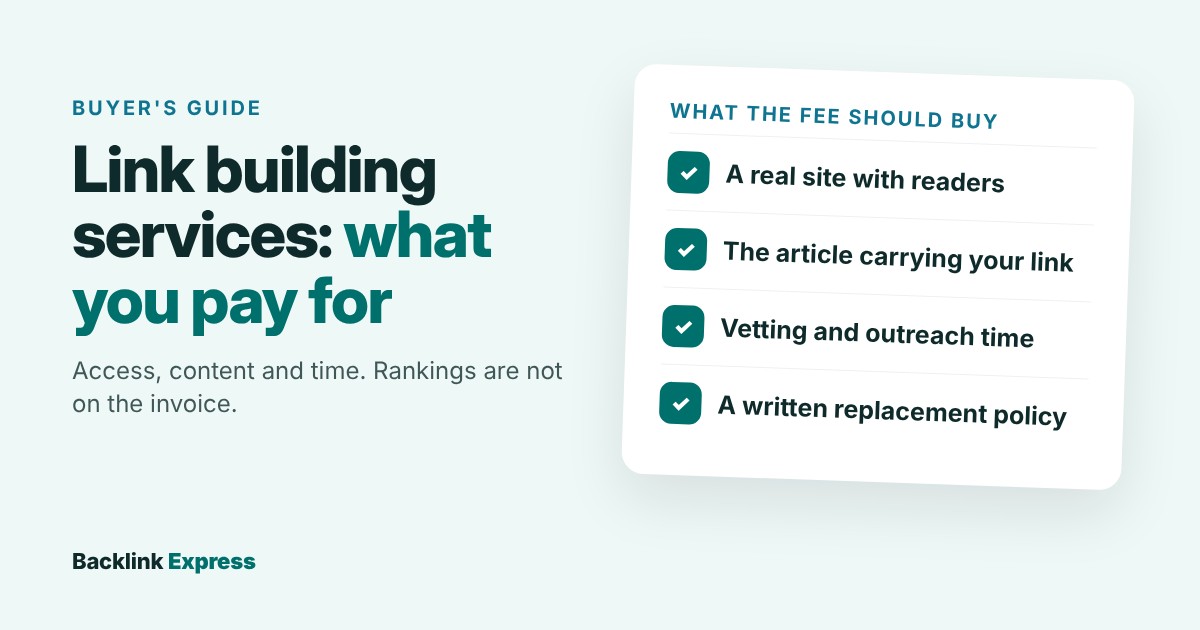
Strip the branding and almost every package sells the same six things. Some are real work. Some are there to make the page look full.
| Line item | What it should mean | What to ask |
|---|---|---|
| Prospecting | Finding sites in your niche that rank and get traffic | Can I see and veto the site list before anything goes live? |
| Outreach | Pitching editors and negotiating the placement | Is this outreach to real editors, or orders on a seller’s price list? |
| Content | Writing the guest post or the paragraph around an inserted link | Who writes it, and do I approve it? |
| Placement fees | The money the publisher receives | Is it inside the package price or billed on top? |
| Reporting | Live URL, anchor, target page and date for every link | Do I get a URL per link, not a summary chart? |
| Account management | A named person who answers for misses | What happens when a link goes missing? |
The link types inside are the familiar three: guest posts, links inserted into existing articles (see niche edits), and digital PR mentions. Cheap tiers lean on the first two. Expensive tiers sell the third.
How are link building packages priced?
Packages are priced by link count and a metric band, usually Ahrefs DR. Here are two vendors that publish their tiers, straight from their own pricing pages (pricing checked Oct 2026).
| Vendor and tier | Price | Links | Price per link | Stated spec |
|---|---|---|---|---|
| Editorial.link, single link | $375 | 1 | $375 | Base rate |
| Editorial.link Startup | $1,750 | 5 | $350 | Average DR 50 to 90, traffic 5k+, dofollow |
| Editorial.link Growth | $6,000 | 20 | $300 | Average DR 50 to 90, traffic 5k+, dofollow |
| OneLittleWeb Startup | $2,999/month | 7 | $428.43 | Average DR 50 to 90, dofollow |
| OneLittleWeb Growth | $5,999/month | 15 | $399.93 | Average DR 50 to 90, dofollow |
| OneLittleWeb Scale | $9,999/month | 27 | $370.33 | Average DR 50 to 90, dofollow |
Both list prior domain approval, which is the single most useful line on either page. Many agencies publish no tiers at all and quote after a call. That is not a red flag on its own, but it means you have to do the per-link math yourself. My breakdown of every pricing model is in link building pricing.
What are the red flags in a cheap link building package?
The pages ranking for this keyword agree on the basics, and they are right:
- Dozens of links for a few hundred dollars a month. That volume only comes from link farms or private blog networks.
- Ranking guarantees. Nobody controls Google’s ranking systems.
- No site list until after you pay.
- Sites with high DR and no organic traffic.
If a seller won’t show you the sites, walk. Everything else on this list follows from that one rule.
How much does link building cost?
Per link, the market sits in the low hundreds of dollars before any agency margin. The Ahrefs study of paid links found an average of $361.44 for a link inserted into an existing article and $77.80 for a paid guest post on “write for us” blogs. BuzzStream’s pricing data, updated Oct 2026, puts the average link insertion at $179 across 62,916 sites, and a guest post at $295 bought direct versus $461 through a vendor.
That last pair is the cleanest view of what a package adds: the same kind of placement costs about 56% more once a middleman packages it. Sometimes the service is worth it. Know that you are paying for it.
Are backlinks still relevant in 2026?
Yes. Google’s spam policies still give link spam its own section, and its December 2022 link spam update said SpamBrain “can now detect both sites buying links, and sites used for the purpose of passing outgoing links”. Google would not train a system to neutralize links that no longer mattered.
The purpose of link building has not changed either: links help Google find your pages and judge which ones other sites vouch for. What changed is that Google got better at ignoring the links that were bought to fake that vote.
How do you choose a link building agency or package?
Choose the model first, then the vendor. A package suits you when you want a predictable monthly volume and someone else to run outreach. It does not suit you if you need control over each site, or your niche has too few relevant sites to fill a monthly quota. I compare the models in link building services, and the agencies themselves in the best link building agencies.
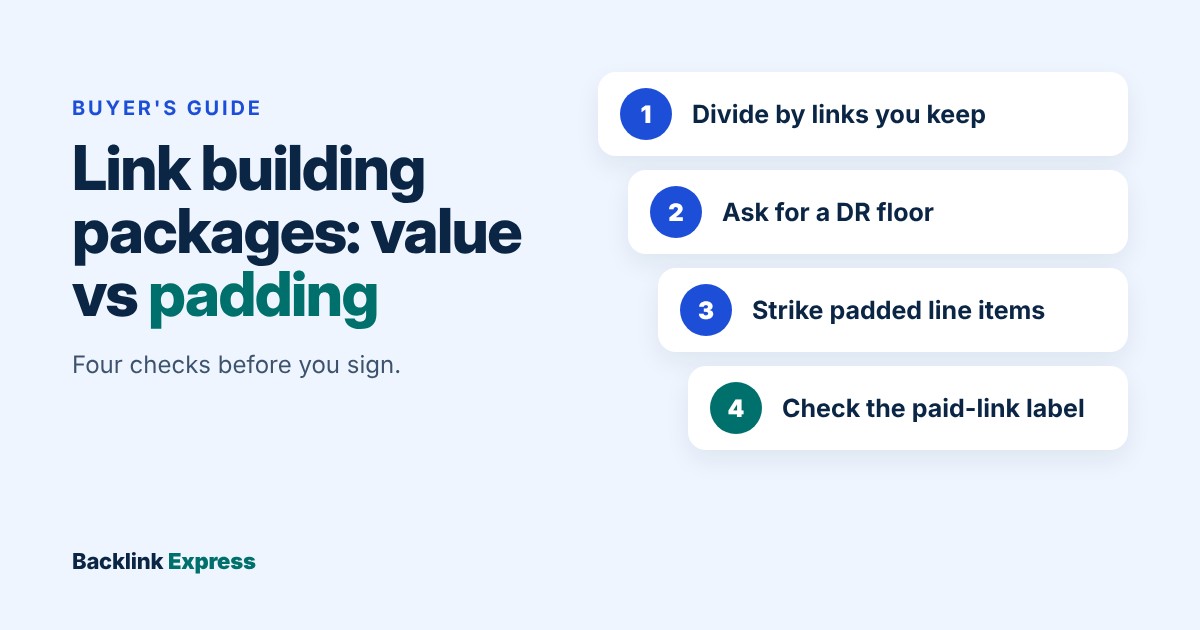
Then run every package through the four checks below.
What most link building package guides miss
The top-ranking pages explain what packages contain and what they cost. None of the five I reviewed does the arithmetic on a tier, reads the metric spec closely, checks the line items against Google’s own list, or says how a paid link should be labeled. Those four checks are where padding hides.
1. The tier discount is smaller than one bad month
Divide the package price by the links that pass your checks, not by the links promised. That is your real price per link.
Run it on the published tiers. Editorial.link’s Growth tier saves $1,500 against twenty links at the $375 base rate ($7,500 versus $6,000). Four links out of twenty that you would not have chosen, and the saving is gone: $6,000 divided by 16 kept links is $375, the base rate. OneLittleWeb’s Scale tier is $370.33 per link on paper. Lose four of its 27 links to sites you reject and you pay $434.74 per kept link, more than its Startup tier at $428.43.
Hypothetical example. Assume a $3,000 package promising 6 links. If all 6 pass your checks, you pay $500 a link. If 2 sit on sites with no organic traffic and the vendor won’t replace them, you paid $750 for each of the 4 you would keep. Same invoice, 50% more per useful link.
What to do: agree in writing that rejected sites are swapped before publication, and buy the smallest tier until the vendor has proved its site quality. A 7% to 20% discount is not worth a quota you cannot audit.
2. “Average DR 50 to 90” is not a floor
Both vendors above describe their links as “average DR 50 to 90”. Read that literally. An average inside a 40-point band tells you nothing about the weakest link in your order. A month of links at DR 92 and DR 15 can still average inside the band.
DR is also only Ahrefs’ view of the web. Ahrefs’ own documentation calls Domain Rating “a relative metric by definition” and says a domain splits its rating equally among the sites it links to. Google does not use DR or Moz’s DA at all. One vendor I checked quotes its trial in DA and its monthly plans in DR, which are two different companies’ scores. If you need a refresher, see what DR and UR measure.
What to do: ask for a minimum per link, not an average, and pair it with a floor on organic traffic to the linking site. A minimum you can check in five minutes beats an average you cannot check at all.
3. Some line items are on Google’s own link spam list
Package pages often pad the feature list with link work that sounds like effort. One published $2,700-a-month package lists “local online directories” and “social media profiles” as link work alongside its blog placements. Compare that with the examples of link spam in Google’s spam policies, last updated 28 August 2026:
- “Low-quality directory or bookmark site links”
- “Widely distributed links in the footers or templates of various sites”
- Links “with optimized anchor text in articles, guest posts, or press releases distributed on other sites”
- “Using automated programs or services to create links to your site”
A genuine local citation on a directory people use is fine for a local business. Bulk directory, bookmark, profile and press release links counted toward a monthly total are padding at best and link spam at worst.
What to do: ask the vendor to price each line separately. Anything that matches an item on Google’s list comes out, and the price should drop with it. If the vendor can’t say what share of the fee buys editorial placements, you are not buying a link building package. You are buying a busy report.
4. “All links dofollow” is the spec Google’s policy names
Package pages sell “dofollow” as a feature. Google’s spam policies say that “exchanging money for links, or posts that contain links” is link spam, and that paid links are acceptable for advertising and sponsorship when they carry rel="sponsored" or rel="nofollow". Google’s guide to qualifying outbound links shows how that label works.
So a package that guarantees paid, unlabeled, dofollow links is guaranteeing the exact thing the policy describes, and the December 2022 update says Google looks at the buying site as well as the selling one. Buying links is never “safe”, whoever sells them. What you can control is what you know you are buying.
What to do: ask every vendor, in writing, how a paid placement is labeled on the publisher’s page and who decides. A straight answer is a good sign. “Don’t worry about it” is not.
My verdict: when a link building package is worth it
A package earns its price when three things are true: you see and veto every site before it goes live, each line item is priced so you can strike the padding, and the vendor answers plainly on how paid links are labeled. Small sites with one or two target pages usually do better buying single placements on sites they chose themselves. Larger sites that need a steady monthly volume and have no one to run outreach are the people packages suit.
Whichever you pick, do the arithmetic on links you would keep, ask for a DR floor instead of an average, and treat a bigger tier as something a vendor earns after a clean first month.
If you would rather pick each site yourself, with its traffic and price shown before you order, browse vetted publishers on Backlink Express.