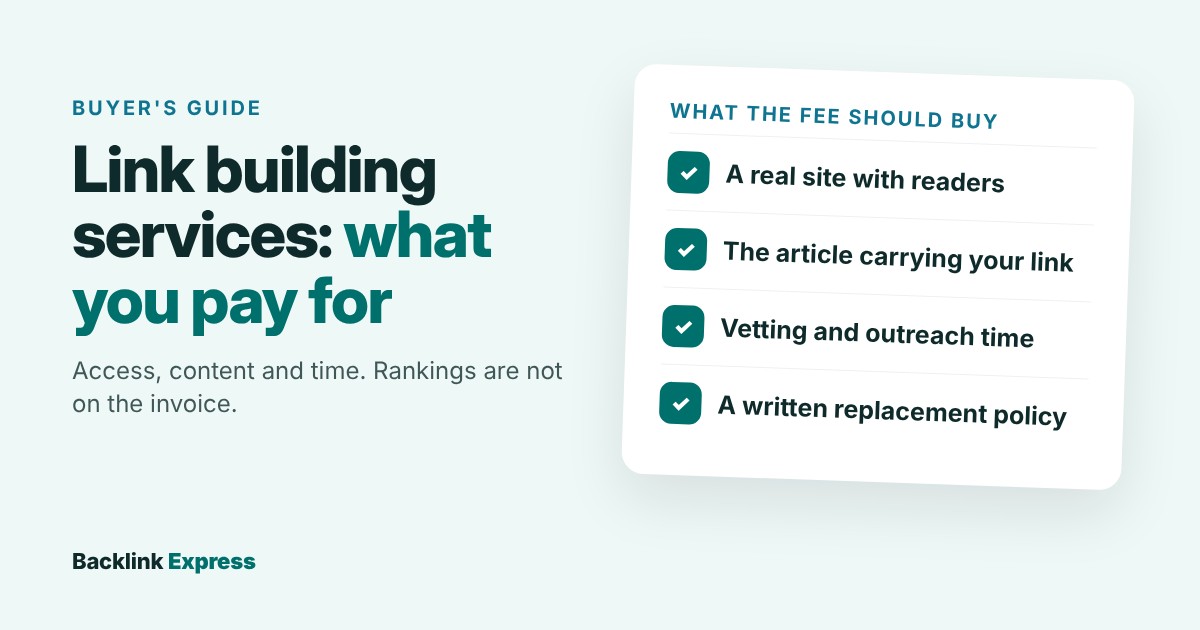
A link building service sells you three things: access to a site, the article that carries your link, and someone’s time to arrange it. Rankings are not on the invoice. After a decade in SEO and link building, my position is simple: price those three parts separately, and ask every provider how they handle Google’s rule that a paid link is an ad. The ones who dodge that question are the ones to drop.
Most pages ranking for this keyword are sales pages or vendor-written lists. None of the five I read mention rel="sponsored", the FTC’s disclosure rules or how much more a guest post costs through a vendor than bought direct. This guide covers the basics quickly, then spends its time on those.
What do link building services actually include?
Strip away the branding and every provider sells some mix of the same deliverables. What differs is who picks the site, who writes the content and who carries the risk if the link disappears.
| Deliverable | What you get | Who usually controls it |
|---|---|---|
| Guest post | A new article on a third-party site with your link in the body | Publisher’s editor approves; provider or you write |
| Niche edit (link insertion) | Your link added to an article that already exists | Publisher; you rarely see the edit request |
| Digital PR | Coverage earned by pitching data or stories to journalists | Journalists decide; coverage is not certain |
| Outreach labour | Prospecting, pitching, follow-ups and negotiation | The provider’s team |
| Reporting | A list of live URLs, anchors and target pages | The provider; ask for the raw sheet |
That is also what a link building specialist does day to day: finds sites worth a link, pitches them, writes or briefs the content, and logs every live URL. A managed agency bundles all of it. A white label provider does the same work under your agency’s name. A marketplace lists the site, its traffic and its price up front so you choose, and the publisher’s editor still decides what goes live.
How to vet a link building service
The pages that rank agree on the basics, and they are right. Keep it short:
- Real readers. The site should get organic traffic from topics close to yours, not just a high DR score. DR is a third-party link metric, not something Google uses.
- Relevance. A link from a site in your industry beats a stronger site in an unrelated one.
- Approval rights. You see and approve the domain before you pay for the placement.
- Full reporting. Every live URL, anchor and target page, in a sheet you can audit.
- Seller behaviour. Skim the site’s last ten posts. If most carry commercial links to unrelated niches, skip it: Google’s December 2022 link spam update says SpamBrain can detect “sites used for the purpose of passing outgoing links”.
- No PBNs, no ranking guarantees. If a seller won’t show you the site list or promises position one, walk.
- A replacement policy in writing. Links get removed. Know what happens when yours does.
Every top-ranking guide says some version of this. It is the minimum, not an edge.
What is a link building service, and what is the purpose of link building?
A link building service is a provider you pay to get other websites to link to yours. The purpose of link building is to earn links that help search engines find and judge your pages, and that send real visitors from relevant sites.
Are backlinks still relevant in 2026?
Yes, and you don’t have to take a vendor’s word for it. Google’s own guide to its ranking systems (last updated December 2025) says it uses systems that read how pages link to each other, and that PageRank “continues to be part of our core ranking systems.”
The same guide lists many other systems, from helpful content to page experience. So links are one input among many. Buy links for a page that already deserves to rank, not to prop up a thin one.
How much does link building cost?
Published averages vary with the sample and the year, so read them as ranges, not quotes:
| Type | Published average or range | Source |
|---|---|---|
| Paid guest post, bought direct | $77.80 (180 “write for us” blogs) | Ahrefs study, updated July 2024 |
| Niche edit, bought direct | $361.44 (450 sites, nine niches) | Ahrefs study, updated July 2024 |
| Link insertion | $179 average (62,916 sites) | BuzzStream pricing data, October 2026 |
| Guest post | $295 direct, $461 via a vendor (257,267 sites) | BuzzStream pricing data, October 2026 |
| Digital PR | $1,250 to $1,500 per link | BuzzStream pricing data, October 2026 |
| Agency retainer | $2,500 to $10,000+ per month | BuzzStream pricing data, October 2026 |
Pricing checked October 2026. The Ahrefs and BuzzStream numbers come from different samples and years, which is why they disagree. For the full cost model, including content and management time, see our breakdown of link building pricing.
What are the three types of links?
Internal links point between pages on your own site. Outbound links point from your site to others. Backlinks point from other sites to yours, and they are what a link building service sells. Each link can also carry a rel value (nofollow, sponsored or ugc) that tells Google how to treat it. The difference matters, and our guide to dofollow and nofollow links covers it. The next section explains why it matters most when you pay.
What most link building service guides miss
Here is what was missing from all five top-ranking pages I reviewed. Each point changes what you should ask before you sign.
1. Google treats a paid link as an ad, and says how to label it
Google’s spam policies (last updated August 2026) list “exchanging money for links, or posts that contain links” as link spam. The same policies say paid links are fine for advertising or sponsorship when they carry rel="sponsored" or rel="nofollow".
No service can change that rule. Not one of the five pages I read mentions rel="sponsored". What a provider can do is be honest about it, so ask directly:
- Will the link be followed,
sponsoredornofollow? - Will the post be labelled as sponsored on the page?
- If you buy a followed link, who carries the risk if Google discounts it?
A provider who answers “Google can’t tell” is selling you a story. Buying links is never “safe” or “Google-approved”. You decide how much risk you accept, and you should decide it knowing the rule.
2. The service layer has a price, so make it earn it
BuzzStream’s October 2026 data puts a guest post at $295 bought direct and $461 bought through a vendor. That is about 56% more, or $166 per post, for the service layer.
Hypothetical example: you need 10 guest posts and you pay those averages. Direct, that is $2,950. Through a vendor, $4,610. The $1,660 difference is fair only if it buys you something you would otherwise do yourself:
- vetting you would have done by hand, including the seller check from the vetting list
- an article written to the publisher’s standard
- a written replacement if the link goes within an agreed period
- reporting you can audit line by line
If the provider can’t show you those, the premium is just a markup. That is the logic behind marketplaces like Backlink Express: you see the site and the price before you buy, so the markup is never hidden. Compare agencies on the same test in our list of the best link building agencies.
3. In the US, you share responsibility for the disclosure
Most guides treat disclosure as the publisher’s problem. The FTC’s native advertising guide puts the duty on “everyone who participates directly or indirectly in creating or presenting native ads”, and it names advertisers as responsible for making native ads identifiable as advertising. If you pay for an article that reads like independent editorial, you are the advertiser.
Two things follow. A “sponsored” label on a placement is not a red flag; it is the publisher doing it properly. And a provider who promises “no sponsored label, ever” is promising you a disclosure problem, not a better link. The FTC also warns that vague labels like “Promoted” can mislead, so ask what the label will say.
Verdict: which link building service model fits you?
Pick a managed agency if you have budget for a retainer and no time to vet sites yourself, and hold it to every check in this guide. Pick a marketplace if you want to choose each site, see its traffic and price first, and keep the markup visible. Build links yourself only if someone on your team has the hours for prospecting and follow-ups every week.
Whichever you pick, ask the same questions: how is the link labelled, how is the seller vetted, what does the fee above the publisher’s price buy you, and what happens when a link goes. A provider that answers all four clearly is worth talking to. One that answers none is not. For a deeper look at one deliverable, read our guide to niche edits.
If you would rather pick the sites yourself, browse vetted publishers on Backlink Express. You see the site, its traffic and the price before you order, and the publisher’s editor decides what goes live.