Last updated: 13 November 2026
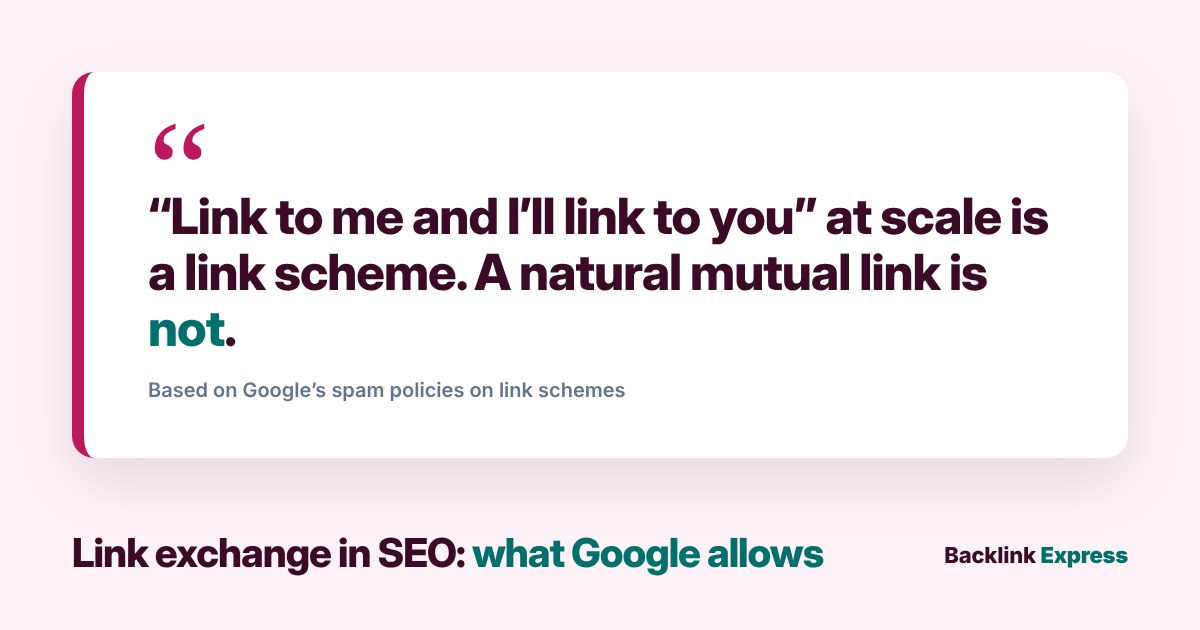
A link exchange in SEO is an agreement between two or more sites to link to each other so each gets a backlink. Google does not ban reciprocal links. Its spam policies name “excessive link exchanges” as link spam and the deciding factor is whether the link exists to manipulate rankings or because it helps a reader.
Here is my position after working in SEO and link building since 2012: the word “excessive” is where most advice goes wrong. People read it as a quota and ask how many swaps are safe. The better question is simpler. Would this link exist if the other site never linked back? If the answer is no, you are trading ranking credit and the count is beside the point.
This guide covers what link exchanges and reciprocal links are, what Google’s policy actually says, where normal reciprocal linking is fine, the real risks on both sides of the swap and the alternatives that build links you do not owe anyone for. It explains the practice. It does not teach anyone to run or hide one.
What is a link exchange and how does it work?
A link exchange is a deal: I link to your site, you link to mine. The link is the payment. In SEO the goal is almost always ranking credit, because a backlink from a relevant page is one of the signals search engines use to judge a page. If you want the basics of why that signal matters, start with our guide on what backlinks are and how Google treats them.
A reciprocal link is the result you can see: Site A links to Site B and Site B links to Site A. The two terms are often used as if they mean the same thing, but they do not.
- Reciprocal link: a pattern. Two sites link to each other. It can happen with no agreement at all.
- Link exchange: a transaction. One link is placed on the condition that another is placed in return.
That difference matters more than anything else in this article. A reciprocal link can be perfectly natural. A link exchange is, by definition, a link that was conditional.
The phrase also has an older meaning. LinkExchange was a 1990s banner-ad network for small websites, which Microsoft acquired in November 1998. That is why part of the search results for “link exchange” talks about ad history and another part, mostly in Pakistan, is about a currency exchange company. Neither is what SEOs mean today.
The common types of link exchange
| Type | What happens | How Google’s policy sees it |
|---|---|---|
| Direct (A to B, B to A) | Two sites agree to link to each other | Named directly: “Link to me and I’ll link to you” |
| Three-way or ABC exchange | A links to B, B links to C, C links to A, so no two sites link to each other directly | Still a conditional link built for rankings. The loop changes the pattern, not the purpose |
| Guest post swap | Two sites publish each other’s guest articles, each with a link back | Depends on whether the link was the price of publication |
| Partner or “resources” pages | A page that exists only to list sites that link back | Named directly: “partner pages exclusively for the sake of cross-linking” |
| Exchange networks and platforms | Members trade links through a central list, credits or matching system | Link spam at scale and the hardest kind to unwind |
What Google’s spam policies actually say
Google’s spam policies for Google web search (last updated 28 August 2026 at the time of writing) define link spam as “the practice of creating links to or from a site primarily for the purpose of manipulating search rankings.” The examples include buying or selling links for ranking purposes, automated link building and this one:
“Excessive link exchanges (“Link to me and I’ll link to you”) or partner pages exclusively for the sake of cross-linking.”
Three things in that line are worth reading slowly.
- “Primarily for the purpose of manipulating search rankings.” The test in the definition is purpose. Two sites linking to each other is not the violation. Linking in order to rank is.
- “Link to me and I’ll link to you.” Google spells out the transaction. The condition is the problem, not the fact that both links exist.
- “Excessive.” Google publishes no number. Nobody outside Google knows a safe ratio and anyone quoting one is guessing.
The policy also notes that Google finds violations “through automated systems and, as needed, human review,” and that sites which break the rules “may rank lower in results or not appear in results at all.” Human review can end in a manual action, which you would see in Search Console.
One more detail most articles skip: the same section says paid links are fine when they are qualified with rel="sponsored" or rel="nofollow", because then they pass no ranking credit. That principle applies here too. A link that carries no ranking credit cannot be a ranking trade.
When reciprocal links are completely normal
Reciprocal links are everywhere on the web and most of them are innocent. Ahrefs’ study by Tim Soulo (published 2019, updated 2020) found that 73.6% of the 140,592 domains in its sample had some reciprocal links and 43.7% of 112,440 top-ranking pages had some too. The author flags the limits himself: penalised sites probably dropped out of the sample and the data shows correlation, not cause. Still, it settles one question. The mere presence of reciprocal links is not a red flag. You can read the Ahrefs reciprocal links study for the method.
Reciprocal links are normal when each one would exist on its own merits. Typical examples:
- A software company lists its integration partners and those partners list it back, because users of one product need the other.
- A supplier links to a distributor’s store locator and the distributor links to the supplier’s spec sheets.
- Two researchers cite each other’s work because the work is related.
- A local business links to the trade association it belongs to and the association lists its members.
- A journalist quotes your data and links to it and months later you link to their article from your press page.
In every case the link answers a reader’s question on that page. Nobody needed the return link to justify the first one.
The test: exchange or natural reciprocal link?
Since Google gives no number, you need a test you can apply to a single link. This is the one we use. If a link fails two or more of these, treat it as an exchange, whatever anyone calls it.
| Question | Natural reciprocal link | Link exchange |
|---|---|---|
| Would the link exist without the return link? | Yes | No, it was conditional |
| Who started it and how? | A business or editorial relationship | An outreach email offering a swap |
| Is the linked page useful to readers of this page? | Clearly | Loosely, or only to the site owner |
| Where does the link sit? | In context where the topic comes up | Inserted into old posts, footers or a “partners” page made for it |
| What is the anchor? | Brand, URL or a natural phrase | A keyword the other site wants to rank for |
| How many? | A handful, tied to real relationships | A process, with a spreadsheet and targets |
| Is it part of a loop or network? | No | Often ABC loops or a platform |
The anchor row deserves a second look. A swapped link with an exact-match commercial anchor is the clearest signal there is that the link was built to rank, not to inform. Our guide to exact anchor text in link building covers why anchor patterns get noticed.
Is link exchange bad for SEO?
A link exchange carries more downside than upside for most sites. Not because every swap triggers a penalty, but because the realistic outcomes are either “it does nothing” or “it creates a problem you later have to clean up.” Here are the real risks.
1. The links may simply not count
This is the most common outcome and the least discussed. When links look built for rankings, the cheapest response for a search engine is to give them no weight. You will not get a notice. You will spend outreach time, give away a link from your own content and see no movement. That is the most likely result when an agency or a Reddit thread says exchanged links are “ignored.”
2. Manual action on links to your site
If a reviewer sees a pattern, Search Console can show an “Unnatural links to your site” manual action. Google’s manual actions help page describes the fix: ask site owners to remove the links or stop them passing PageRank, disavow what you cannot remove, then request a review with documentation. It also warns that disavowing everything without trying to remove links first can lead to a rejected request. That is weeks of work for links that were “free.”
3. Manual action on links from your site
Every exchange has two sides and the outbound side is your liability. Google has a separate “Unnatural links from your site” action for artificial or manipulative outbound links. If you have placed dozens of swap links in your old posts, your own site is now the one selling ranking credit, just paid in links instead of cash.
4. You end up linking to sites you would never vouch for
Exchange partners change. Domains expire, get sold and get repurposed. A link you placed in 2024 to a decent blog can point to a casino or a pill shop in 2026. Your readers see it and so do search engines.
5. Networks and ABC loops multiply the exposure
The AI Overview for “link exchange seo” currently calls three-way exchanges a “safer variation” because they avoid a direct footprint. We disagree and Google’s wording supports us. The policy targets the purpose of the link, not its shape. An ABC loop is a link exchange with an extra step designed to look like something else. If the arrangement is ever spotted, the extra step reads as intent, not innocence. Exchange platforms are worse still, because one bad member puts every other member’s links under the same light.
For a wider view of which tactics carry this kind of risk, see our breakdown of SEO risks worth taking and the ones to avoid.
What about guest post swaps?
Guest posting is legitimate when an editor publishes your article because it serves their readers. It becomes an exchange when the deal is “publish mine and I will publish yours, both with links.” The articles might be good. The links are still the price of entry and that is the condition the policy describes.
The same goes for publishers who require a link back before accepting a guest post. Google’s link spam examples include requiring a link as part of a terms of service or contract without letting the other party qualify it. If you run a site that accepts contributions, judge the article on its merits and never make a return link a condition. Our guide to writing guest posts editors accept covers the clean version of this.
Already exchanged links? How to clean up
If you inherited a site with a history of swaps, or ran some yourself, you do not need to panic. You need an inventory and a calm decision on each link.
- Find the reciprocal pairs. Compare the domains you link to with the domains linking to you. Any SEO tool that exports referring domains and outbound links can do this in a spreadsheet.
- Run each pair through the test above. Keep links that would exist anyway. Flag links that only exist because of a deal.
- Fix your outbound side first. You control it. Remove swap links that do not help readers, or add
rel="nofollow"to ones that are still useful but were part of a deal. Delete any partner page that exists only for cross-linking. - Handle inbound links proportionately. If there is no manual action, removing or ignoring a few weak inbound swaps is usually enough. Use the disavow tool only for a clear pattern of manipulative links or when you have a manual action to answer.
- Stop the process. Cancel any platform membership and tell partners you no longer exchange links. A clean-up that keeps running new swaps is not a clean-up.
Checking the quality of the sites in your profile helps here. Our free spam score checker is a quick first pass before you look at a site by hand.
Are backlinks still worth building in 2026?
Yes. Links remain one of the ways search engines find pages and judge which ones others trust and Google still keeps a whole spam policy section about links, which it would not need if links did not matter. Google ran spam updates in March, June, August and September 2026, so enforcement is ongoing work, not a closed chapter. Backlinks are good when they are earned or properly disclosed and bad when they are traded or bought to pass ranking credit.
The question is not whether to build links. It is which links are worth the effort and which ones create a liability. Exchanges usually land in the second group because the thing you pay with, a link from your own content, is exactly the thing the policy is about.
Safer alternatives that still build links
Every alternative below gets you links without a condition attached, or with the commercial part disclosed. That is the line that matters.
| Alternative | Why it is cleaner than a swap | Best for |
|---|---|---|
| Linkable assets (original data, tools, templates) | People link because the page is useful, with nothing owed back | Sites with expertise or data to share |
| Digital PR and expert commentary | Journalists and editors choose to cite you | Brands with a story or a spokesperson |
| Editorial guest posts | An editor accepts the article on merit, with no return link required | Teams that can write well for other audiences |
| Real partnerships | Integration, supplier and association links that reflect an actual relationship | B2B and local businesses |
| Disclosed sponsored placements | The commercial deal is visible and Google’s policy says paid links marked rel="sponsored" or rel="nofollow" are not a violation |
Brands that want visibility and referral traffic on relevant sites |
On the last row, be precise. Google’s guidance on qualifying outbound links asks sites to mark ads and paid placements with rel="sponsored". Buying a placement does not make a link “safe” or “Google-approved.” It makes the deal honest. Judge the site the way a reader would: real traffic, topic fit, an editor who actually reviews content. On a marketplace like Backlink Express, the buyer picks the site and the publisher’s editor decides what goes live. If a seller hides traffic data, runs a network of near-identical blogs or publishes anything sent to it, walk away. Our guide on how to land high-authority links goes deeper on earning the editorial kind.
What this means for you
If you are an SEO or a site owner deciding whether to answer that next “let’s swap links” email, the answer is usually no. Not because one swap will sink your site, but because a conditional link is exactly what Google’s link spam policy describes and the best case is that it does nothing.
Keep the reciprocal links that come from real relationships. Drop the ones that only exist because of a deal. Put the outreach time into assets, PR and editorial placements that you would be comfortable showing a Google reviewer.
If you want placements on real sites where the deal is out in the open, browse vetted publishers on Backlink Express, check each site’s traffic and topic before you buy and keep paid links qualified the way Google asks.