Last updated: 13 November 2026
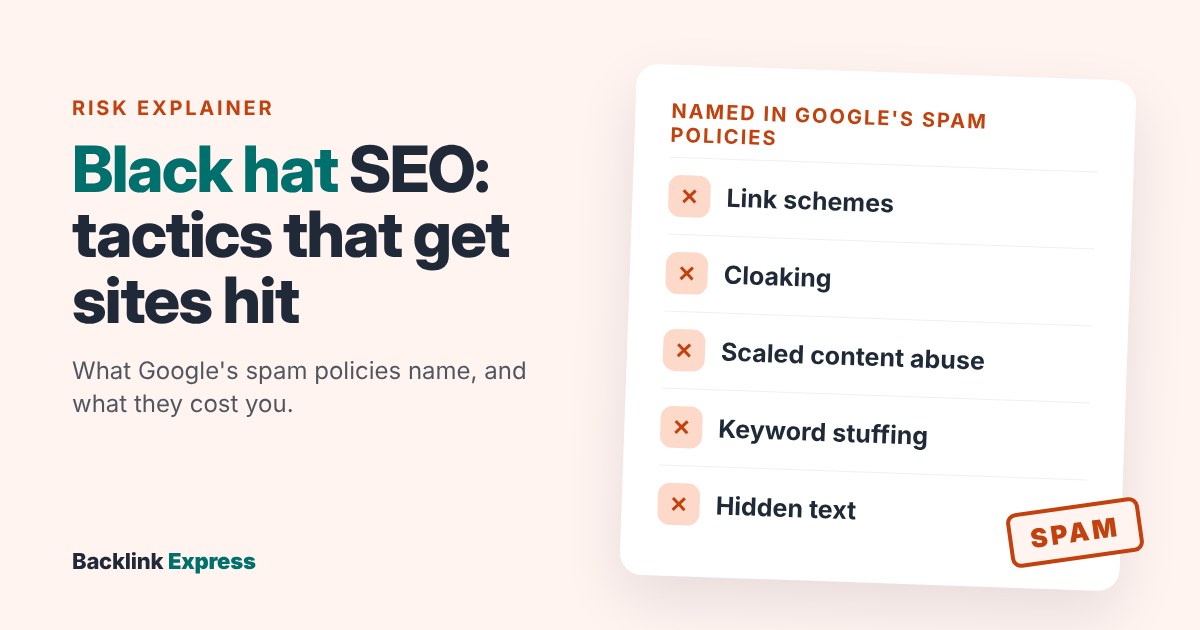
Black hat SEO is any tactic that tries to rank a page by deceiving search engines or users instead of earning the ranking and Google lists those tactics by name in its spam policies. If a tactic is on that list, you are not taking a clever shortcut. You are betting the domain.
Here is my position after working in SEO and link building since 2012: the “hat” labels cause most of the confusion. Stop asking whether a tactic feels aggressive. Ask whether Google’s spam policies name it. That one question sorts almost every tactic you will be pitched.
This guide covers each black hat tactic, the exact Google policy it breaks, what happens when you get caught, where paid links really sit, the new AI-answer version of the same game and the safer alternatives that still move rankings. It explains what these tactics are. It does not teach anyone to run them.
What is black hat SEO?
Black hat SEO is the set of practices that try to manipulate rankings in ways that break a search engine’s rules. Google’s own definition of spam is the clearest version of it: “techniques used to deceive users or manipulate our Search systems into featuring content prominently.”
The colours come from old Western films, where the villain wore the black hat. In SEO they map to three groups:
| Label | What it means | Typical examples | Risk |
|---|---|---|---|
| White hat SEO | Work that follows Google Search Essentials and helps the reader first | Useful content, technical fixes, internal links, earned editorial links, PR | Low. The worst case is slow results |
| Grey hat SEO | Tactics that are not named as spam but can tip over depending on how they are done | Guest posts with heavy commercial anchors, guest posting at scale, aggressive content refreshes | Medium. It depends on intent, scale and disclosure |
| Black hat SEO | Tactics that match a named spam policy | Cloaking, link schemes, PBNs, scaled content abuse, hidden text, sneaky redirects | High. Demotion, removal or a manual action |
So what is white hat SEO? It is the same goal, ranking, reached by making the page genuinely the best answer and by earning signals instead of faking them. Google’s test from its older guidelines still works as a gut check: would you do this if search engines did not exist?
A “black hat strategy” is simply a plan built on those tactics. It is usually short-term by design, because the people running it expect the site to be caught eventually.
How Google defines spam in 2026
Most black hat articles still quote the “Webmaster Guidelines”. Google renamed those to Google Search Essentials in 2022 and the rules that matter now live in the Google spam policies for web search, last updated on 28 August 2026.
Three facts about that page matter most:
- It names 16 specific policies plus a section on other practices that can lead to demotion or removal. If a tactic is not on the list, it is not automatically safe, but if it is on the list, there is no debate.
- It now covers AI answers. The opening definition of spam includes “attempting to manipulate generative AI responses in Google Search.” Black hat SEO and black hat GEO are the same violation in Google’s eyes.
- Detection is automated first. Google says it detects violations “through automated systems and, as needed, human review that can result in a manual action,” and that violating sites “may rank lower in results or not appear in results at all.”
Google is also enforcing more often. It confirmed four spam updates on its Search Status Dashboard in 2026 alone: March (24 to 25 March), June (24 to 26 June), August (18 to 21 August) and September (24 September to 8 October, the longest of the four).
Black hat SEO techniques and what Google says about each
This is the table I wish every client had read before hiring their first SEO vendor. Each row is a tactic you will see pitched, the Google policy it falls under and the safer route to the same goal.
| Tactic | What it is | Google policy | Safer alternative |
|---|---|---|---|
| Keyword stuffing | Cramming a keyword, or lists of places and numbers, into a page far past what reads naturally | Keyword stuffing | Write for the question; cover related subtopics instead of repeating one phrase |
| Hidden text and links | Text or links placed so visitors cannot see them but crawlers can | Hidden text and link abuse | Put content where people can read it; tabs and accordions for real UX are fine |
| Cloaking | Showing search engines different content from what users see | Cloaking | Serve the same content to everyone; use proper paywall markup for gated content |
| Sneaky redirects | Sending users somewhere other than the page Google indexed | Sneaky redirects | Use honest 301s when a page truly moves |
| Doorway pages | Many near-identical pages built to rank for similar queries and funnel to one place | Doorway abuse | One strong page per real intent; location pages only with genuinely local content |
| Scaled content abuse | Mass-producing pages, by AI, templates or spinning, mainly to rank | Scaled content abuse | Fewer pages with original insight; use AI as a drafting aid with human review |
| Scraped content | Republishing other sites’ content with little added value | Scraping | Quote and cite, then add your own analysis |
| Link schemes and paid links passing PageRank | Buying, selling or swapping links for ranking without a qualifying attribute | Link spam | Earned links; paid placements marked rel="sponsored" |
| Private blog networks (PBNs) | A network of sites, often on old domains, that exists to link to a money site | Link spam; often expired domain abuse | Links from real, independent sites with their own audience |
| Expired domain abuse | Buying a dropped domain for its old authority and filling it with low-value content | Expired domain abuse | Buy a domain for its name or audience and keep its purpose honest |
| Comment, forum and profile spam | Dropping optimised links in comments, signatures or user profiles | Link spam; user-generated spam | Join communities to help; accept that most of those links are nofollow or ugc |
| Parasite SEO | Publishing third-party content on a strong host mainly to borrow its ranking signals | Site reputation policy | Earn coverage the host’s editors would publish anyway |
| Structured data abuse | Marking up reviews, ratings or content that are not on the page | Structured data issue (manual action type) | Mark up only what users can see |
| Fake engagement and traffic bots | Automated queries or clicks sent to Google | Machine-generated traffic | Improve titles and snippets for real click-through |
| Hacked content and link injection | Placing pages or links on sites without the owner’s permission | Hacked content | None. This is not an SEO tactic, it is an attack |
| Negative SEO | Pointing spam at a competitor to get them penalised | Not a site policy for the victim; often link spam or hacking by the attacker | Monitor your own profile and focus on your own site |
Content tactics: the ones that get caught fastest
Keyword stuffing, hidden text, cloaking and doorway pages are old and Google’s systems have had two decades to learn them. They also have dedicated manual action types in Search Console: “Hidden text and/or keyword stuffing” and “Cloaking and/or sneaky redirects” are both on Google’s list.
The one that matters most in 2026 is scaled content abuse. Google’s policy names “using generative AI tools or other similar tools to generate many pages without adding value for users” as an example. Note the wording. AI is not the violation. Volume without value is.
Link tactics: where most black hat SEO actually happens
Google defines link spam as “creating links to or from a site primarily for the purpose of manipulating search rankings.” Its examples include buying or selling links for ranking purposes, excessive link exchanges, automated link building, low-quality directories, links spread across many sites’ footers and templates and forum links with optimised anchors. If you want the basics of how links are valued first, read our guide to what backlinks are and how Google treats them.
PBNs deserve a plain answer because they are pitched constantly. A PBN is a set of sites that look independent but are controlled by one party and exist to pass links. It falls straight under link spam and when it is built on dropped domains it also hits expired domain abuse. Google said in its December 2022 link spam update that SpamBrain can “detect both sites buying links and sites used for the purpose of passing outgoing links,” and that “any credit passed by these unnatural links are lost.” In other words, the most likely outcome is not a dramatic penalty. It is paying for links that quietly count for nothing.
Reciprocal linking sits on the edge. A few natural swaps between related sites are normal. “Excessive link exchanges” are named as spam. We explain where that line falls in our piece on link exchange in SEO.
Reputation and AI-era tactics
Parasite SEO is covered by what Google now calls the site reputation policy: third-party content published on a host “mainly because of that host’s already-established ranking signals.” Is parasite SEO legal? Yes, in the legal sense. It is still a named spam policy and “Site reputation policy” is a manual action type in Search Console, so the host site carries the risk too.
Google’s manual action list also includes “Back button hijacking”, which tells you Google treats manipulative user-experience tricks as spam, not only ranking tricks.
Is black hat SEO illegal?
Usually not. Breaking Google’s spam policies breaks a private company’s rules, not a law. Google’s remedy is demotion or removal from its results, not prosecution.
Some tactics do cross into law and that is where the real exposure sits:
- Hacking sites to inject links or pages is unauthorised computer access, which is a crime in most countries.
- Scraping and republishing content can infringe copyright and Google demotes sites that collect a significant volume of valid copyright removal requests.
- Fake reviews and fake testimonials are a consumer protection issue. In the US, the FTC adopted a rule in 2024 that bans fake reviews.
- Impersonating a real business to rank or convert is fraud territory and Google’s policies treat scam and imposter sites as removable.
This is a general overview, not legal advice. If a vendor’s method involves someone else’s site, someone else’s content or someone else’s name, get it checked before you pay.
Does black hat SEO still work?
Sometimes, briefly. Be honest about that, because pretending otherwise is why people stop trusting SEO advice. Practitioners on Reddit and YouTube still show black hat pages ranking and “churn and burn” sites exist precisely because some tactics move rankings for weeks or months.
The question is not “does it work” but “what does it cost when it stops”. Look at the economics:
- The asset is disposable. Black hat operators plan for the domain to die. If your business lives on that domain, you cannot plan that way.
- Links get neutralised, not just punished. SpamBrain discounting your bought links means the money is gone even if no penalty ever lands.
- Enforcement is frequent. Four confirmed spam updates in the first nine months of 2026 means any gain has a short half-life.
- Recovery is slow and uncertain. Cleaning up does not guarantee you return to your old positions, because the signals you removed were the ones propping the page up.
If you are an SEO evaluating a tactic for a client, the test is simple: could you explain it to the client’s CEO and to a Google reviewer without changing the story? If not, it is black hat, whatever the vendor calls it.
What happens if Google catches black hat SEO?
There are two kinds of hit and they behave very differently.
| Algorithmic action | Manual action | |
|---|---|---|
| Who decides | Automated systems such as SpamBrain and spam updates | A human reviewer at Google |
| Will you be told? | No. You see a traffic or ranking drop | Yes. A notice in the Manual actions report and the Search Console message centre |
| Typical effect | Pages or links demoted or ignored | Affected pages or the whole site demoted or removed |
| How to recover | Fix the cause; recovery comes as systems reprocess the site over time | Fix every affected page, then file a reconsideration request |
| Timeline | Not fixed; often months | Google says most reviews “can take several days or weeks” after you submit |
Google’s help page on manual actions lists every type, including “Unnatural links to your site”, “Thin content with little or no added value” and “Major spam problems”. A sudden ranking drop is not always spam, of course. Rule out the usual suspects in our list of common SEO issues behind ranking drops before assuming a penalty.
Grey hat SEO and the paid-link line
This is the section most black hat articles get wrong, so I will be direct. Buying a link is not automatically black hat. Google says buying and selling links “is a normal part of the economy of the web for advertising and sponsorship purposes,” and that such links do not violate its policies when they carry rel="nofollow" or rel="sponsored". Google’s guide to qualifying outbound links says sponsored is the preferred value for paid links.
What crosses the line is paying for a link so that it passes ranking credit and hiding that it was paid. That is “buying or selling links for ranking purposes” and it is link spam. If the difference between the attributes is fuzzy for you, our guide to dofollow and nofollow links covers it.
Backlink Express is a marketplace, so here is how we see it. On a marketplace the buyer picks a listed site with its traffic and price visible and the publisher’s editor decides what goes live. That is very different from a PBN. Still, no paid placement is “safe” or “Google-approved” and nobody can promise you that. What you can control is the risk. Walk away from any seller with these red flags:
- No traffic data, or traffic that collapsed recently
- No editorial review: anything you send gets published
- A hidden site list, or a refusal to name the site before you pay
- Many sites sharing the same owner, template, hosting or outbound link pattern, the classic PBN footprint
- Unrelated outbound links on every page, in topics the site never otherwise covers
- Mass-produced AI articles with no author and no reader
- No replacement or fix policy if the link disappears
Anchor text is the other grey zone. A guest post with an exact-match money anchor in every paragraph is exactly the pattern link spam checks look for. Our exact match anchor text guide shows a natural mix.
Black hat GEO: the same game in AI answers
The newest version of black hat SEO targets AI answers instead of blue links. Commentators on LinkedIn are already calling it “black hat GEO”: self-serving “best X” listicles that rank the author first, hidden instructions aimed at AI crawlers and mass-produced pages written to be quoted by chatbots.
Google closed the loophole on paper. Its spam definition now explicitly includes “attempting to manipulate generative AI responses in Google Search.” The same scaled content, hidden text and cloaking policies apply whether the target is a ranking or an AI Overview. My view: anything that would be spam in a search result is spam in an AI answer and building a brand on it is the same bet: you can lose the domain.
How to check your site for accidental black hat SEO
Many sites carry black hat risk they never chose: an old agency’s links, a hacked plugin, a writer who stuffed keywords. A one-hour check covers most of it:
- Open the Manual actions report in Google Search Console. If it says “No issues detected”, you have no manual action.
- Open the Security issues report to rule out hacked content or injected spam.
- Review the Links report for linking sites you do not recognise and for anchors that are mostly exact-match commercial phrases.
- Search
site:yourdomain.comand scan for pages you did not publish, foreign-language spam or odd subfolders. - Check vendor deliverables. Ask any past SEO provider for a list of links built and sites used. A refusal is a finding.
- Screen suspicious linking domains with a quick spam score check before deciding whether they need action.
- Use disavow only when needed. Google’s position is that most sites never need the disavow tool. It is for a manual action for unnatural links, or a large set of paid or spammy links you built and cannot remove.
Safer alternatives that still move rankings
Every black hat tactic is a fake version of something real. Swap the fake for the real thing and you keep the goal without the risk.
| Instead of | Do this | Why it holds up |
|---|---|---|
| PBN links | Placements on real, independent sites with their own traffic, disclosed where paid | The link sits on a page people read and the attribute matches how it was obtained |
| Scaled AI pages | Fewer pages with original data, examples or expert review | Survives scaled content and helpful content checks |
| Keyword stuffing | Topical coverage: answer the related questions searchers ask | Matches how Google understands language today |
| Doorway location pages | Location pages with local proof: staff, projects, reviews, directions | Each page earns its place |
| Parasite pages on big hosts | Digital PR and expert commentary the host’s editors choose to publish | Editorial oversight is exactly what the site reputation policy asks for |
| Fake reviews and schema tricks | A review request process with real customers | No legal exposure and no structured data action |
None of this is as fast as a black hat campaign promises to be. It is faster than recovering from one.
If you buy links, buy them where you can see the site, its traffic and its editorial standards before you pay and mark them as sponsored. Browse vetted publishers on Backlink Express.