Last updated: 13 November 2026
The Google sandbox is an SEO name for a pattern, not a confirmed Google feature: new sites often get indexed but struggle to rank for anything competitive for months. Google staff have denied having a sandbox several times, yet a 2024 leak of Google’s internal API documentation describes a site-age field used “to sandbox fresh spam”. Both things can be true at once.
Here is my position after working in SEO and link building since 2012: the sandbox debate is the wrong argument for a new site owner. Whether Google calls it a sandbox or not, you cannot switch it off. What you can do is prove, with Search Console data, whether your site is in a normal slow start or has a real problem that waiting will never fix. Most sites that “feel sandboxed” are in the second group.
This guide covers what Google has actually said (with sources), what the leak does and does not show, a five-check test to separate a slow start from a real fault and what new publishers should do with the waiting months.
What is the Google sandbox in SEO?
The Google sandbox is the theory that Google holds brand-new websites back from ranking well, even when their content and links look fine, until they have built enough trust. The term has circulated among SEOs since around 2004 and it has never been confirmed as a named filter.
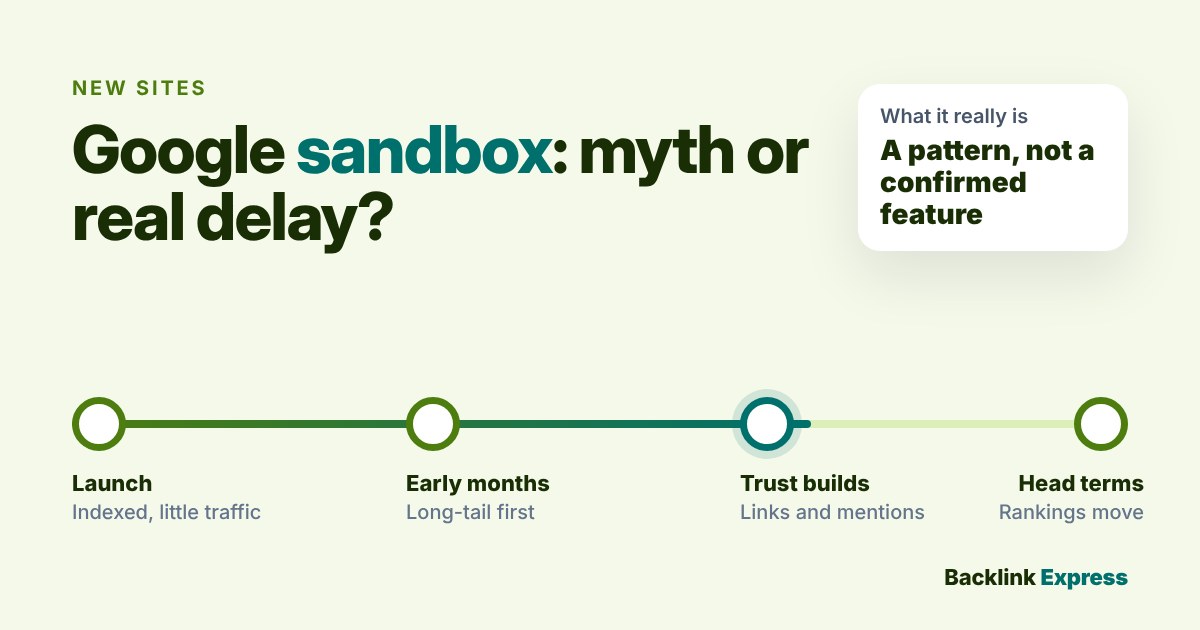
What people describe when they say “sandbox” is usually this sequence:
- Pages get crawled and indexed within days or weeks.
- Search Console shows a trickle of impressions for long, low-competition queries.
- Rankings for the head terms the site was built for sit on page 3 or deeper and barely move.
- Months later, rankings lift without any single change explaining it.
Two other ideas get mixed in. The “honeymoon period” is the opposite claim: new pages rank briefly higher, then drop. The “reverse sandbox” is another name for the same short boost. Neither is confirmed either.
One note on the search itself: “Google sandbox” also refers to unrelated Google products, such as the BigQuery sandbox, Privacy Sandbox and Google’s code-sandboxing tools. This article is only about the SEO meaning.
Is the Google sandbox real? What Google has said
Google has denied a sandbox in plain words, more than once. Google staff have also acknowledged that its systems can produce effects that look like one. Here is the record, using only statements we could trace to a source today.
| When | Who | What was said | Source |
|---|---|---|---|
| November 2005 | Matt Cutts, then at Google | Reported as saying there was no sandbox, but that some things in the algorithm “may be perceived as a sandbox” and do not apply to all industries. | Search Engine Roundtable report of a conference session |
| 12 December 2016 | Gary Illyes, Google | “we don’t have a Google sandbox” (reply on Twitter) | Search Engine Roundtable, Dec 2016 |
| 19 August 2019 | John Mueller, Google | “There is no sandbox.” (reply on Twitter) | Search Engine Roundtable, Aug 2019 |
| 2021 (reported 31 May 2021) | John Mueller, Google | Asked about a traffic spike that faded on new pages, he named both the sandbox and the honeymoon theories and said Google is not “explicitly trying to promote new content or demote new content”. He added that with new content, Google has to make assumptions. | Search Engine Journal report, with video |
Read those statements together and a consistent line appears. Google denies a deliberate timer for new sites. It does not deny that new sites rank worse at first. Its explanation is that Google knows little about a new site, so its systems work from limited signals until more data arrives.
Google’s own SEO Starter Guide (updated December 2025) says the same thing in general terms: some changes take effect in a few hours, others could take several months and you should usually wait a few weeks before judging whether a change worked. It gives no special timeline for new domains.
What the 2024 Google leak showed about the sandbox
In May 2024, internal documentation for Google’s Content Warehouse API became public after being pushed by mistake to a public GitHub repository. Rand Fishkin and Mike King published the first analyses on 27 and 28 May 2024. Google confirmed the documents were authentic and cautioned against drawing conclusions from out-of-context, outdated or incomplete information.
One field in those documents, hostAge, is the reason the sandbox debate restarted. Its description in the published API reference reads: “The earliest firstseen date of all pages in this host/domain. These data are used in twiddler to sandbox fresh spam in serving time.”
What that sentence supports and what it does not:
| Claim you will read online | Supported by the leak? |
|---|---|
| Google stores when it first saw pages on a host | Yes. That is what hostAge records. |
| The age data is used to “sandbox” something | Yes, in the field’s own wording: fresh spam, at serving time. |
| Every new site is held back for a set period | No. The text targets fresh spam and gives no duration. |
| We know how much weight it carries today | No. API documentation lists fields, not weights and Google warned some of it may be outdated. |
| The leak “proves Google lied” | Too strong. The quotes above deny a sandbox for new sites in general; the field describes a spam control. Both can be accurate. |
So the honest summary is narrower than most posts make it. Google has a documented way to treat content from new hosts differently when it looks like spam. Whether a clean new site ever feels it and for how long, is not in the documents.
How long does the Google sandbox last?
Nobody has published data that supports a fixed sandbox period and Google has never given one. Every number you see is an estimate from experience and they disagree.
Published estimates range from a few weeks to 12 months and none of them comes with a dataset.
My advice is to stop waiting for a calendar date. The slow phase does not end when a timer runs out. It ends when Google has enough evidence about your site: pages indexed, queries where you earn clicks, links from sites people actually read, a topic you clearly cover. A site that publishes nothing and earns nothing for nine months is not “almost out of the sandbox”. It is a site Google still knows nothing about.
Sandbox or a real problem? A five-check test
“Sandbox” is used to explain everything from a noindex tag left on after launch to a manual action. Run these five checks in Google Search Console before you accept that waiting is the answer. Each one rules out a cause that patience will never fix.
- Are your important pages indexed? Open the Page indexing report and inspect your key URLs. If they show “Crawled, currently not indexed”, “Discovered, currently not indexed”, “Excluded by noindex tag” or a different canonical, you have an indexing problem, not a sandbox. Our guide to crawling vs indexing maps each status to its fix and you can spot-check URLs with the Google index checker.
- Is there a manual action or security issue? Check the Manual actions and Security issues reports. If either lists anything, the cause is a penalty or a hacked site. Waiting will not lift it; fixing it and filing a reconsideration request will.
- Do you get impressions at all? In the Performance report, filter to the last 3 months. Zero impressions on indexed pages means Google does not see your pages as relevant to anything people search. That is usually a topic or content problem. A slow start still shows impressions, just for long-tail queries at low positions.
- Do the queries match what you wrote? Look at which queries bring impressions. If they are long, specific versions of your topic, Google understands what your site is about. If they are random or unrelated, your pages are not clearly about what you think they are about.
- Is the trend flat or climbing? Compare impressions and average position month over month. A normal slow start shows impressions rising and positions slowly improving for long-tail queries, even while head terms stay deep. A flat line after months of publishing points to quality, competition or links, not a sandbox.
Only when all five pass (indexed, no actions, some impressions, relevant queries, a rising trend) does “new site, give it time” fit the evidence. Then the right move is to keep doing the things that build evidence, not to sit still.
How do I get out of the Google sandbox?
You do not “get out” by a trick, because there is no switch to flip. You shorten the slow phase by giving Google more reasons to trust the site, faster. In practice that means five things.
- Win small queries first. Build your first pages around specific, low-competition questions in one topic. They rank sooner and bring your first real readers, which gives you data on what works.
- Go deep on one topic before going wide. Thirty pages that cover one subject well send a clearer signal than thirty pages across five subjects.
- Earn a few links from sites people actually read. A handful of relevant, editorial links beats a burst of low-quality ones. Our guide on how many backlinks you need to rank shows how to size this per page instead of guessing.
- Get traffic from outside Google. Newsletters, communities, social and partners bring readers while search catches up and they make a site worth linking to.
- Keep the technical basics clean. Fast pages, a sitemap, sensible internal links and no accidental noindex. These do not make a site rank, but their absence can stop it ranking.
Two things not to do. Do not move to a new domain to “escape”: a new domain starts from zero again. And do not try to force rankings with a sudden pile of manipulative links. Google’s spam policies define link spam as creating links primarily to manipulate search rankings and a new site with no history has nothing to cushion that. Our breakdown of SEO risks to take and avoid covers where the line sits.
If you do pay for a placement, Google’s guidance on qualifying outbound links asks publishers to mark paid placements with rel="sponsored". Buy placements for relevance, audience and referral traffic on real sites, not as a way to beat a supposed timer.
What about expired and aged domains?
A common shortcut is to buy an old or expired domain to skip the slow phase. Note what the leaked field actually records: the earliest date Google first saw pages on the host, not the registration date. An old domain that Google has seen for years may not look “fresh”. But you inherit its history too, including any spam links or penalties and Google’s spam policies specifically cover expired domain abuse, where an expired domain is bought and repurposed primarily to manipulate search rankings. If you buy one, buy it for a real reason (the brand, the same topic) and audit its link history first.
Does the sandbox affect old sites, new pages or redesigns?
The classic theory is about new domains. New pages on an established site are a different situation: Google already knows the site, so the new-domain theory does not apply in the same way. That is the case Mueller was asked about in 2021, when he said Google is not explicitly promoting or demoting new content.
If an established site suddenly drops after years of ranking, it is not a sandbox. Look at a core update, a manual action, a migration or a technical fault. Our list of common reasons rankings drop is a faster place to start than waiting.
What the slow phase means for new publishers
If you plan to monetize a new site by selling guest posts or sponsored placements, the slow phase matters twice. Buyers judge a publisher on visible organic traffic, topic fit and editorial quality. A site that has not yet built organic traffic has little to show them, however good its content.
So use the early months to build what buyers check later: a clear topic, consistent editorial standards, real organic traffic and a clean link profile with no history of selling links to anything that pays. When you do start accepting paid placements, mark them rel="sponsored", keep them on topic and refuse anything you would not publish on its own merit. A site that protects its own quality during the slow phase is a site buyers will still want a year later.
The bottom line
Google denies a sandbox for new sites. Its leaked documentation shows a site-age signal used against fresh spam. Neither gives a clean new site a fixed waiting period. Treat the slow phase as an evidence problem, not a timer: run the five checks, fix what they find and spend the months building topic depth, real links and real readers.
Once your site has real organic traffic and a clear topic, it is worth putting in front of buyers. List your site on Backlink Express, where buyers see your site and traffic up front and your editor decides what goes live.