Last updated: 13 November 2026
Enterprise link building is the practice of earning and buying backlinks for a large organization under one set of rules: which pages get links, which sources are allowed, who approves each placement and how paid links are labelled. It works like a governed program, not a bigger outreach team.
Here is our position after working in SEO and link building since 2012: enterprise link programs rarely fail on outreach. They fail on governance. Nobody decided which pages matter, five teams buy links on their own and paid placements go live without the label Google asks for. Fix the rules first and the tactics get easier.
This guide covers how enterprise link building works step by step, the link policy every large company needs, the sourcing mix, what it costs, how to report it and the mistakes that put a big domain at risk.
What is enterprise link building and how does it work?
Link building is getting other websites to link to yours. Google still uses those links. Its own ranking systems guide says Google has “various systems that understand how pages link to each other” and that PageRank “continues to be part of our core ranking systems” (Google Search Central, updated December 2025). If you want the fundamentals first, our guide to building a backlink strategy covers them.
Enterprise link building is the same activity with three extra layers: scale, stakeholders and risk. A startup asks “how do we get links?” An enterprise asks “which of our 40,000 URLs should get links, who signs off and what happens if a placement embarrasses the brand?”
| Factor | Standard link building | Enterprise link building |
|---|---|---|
| Scope | One site, a few target pages | Many domains, subdomains, markets and languages |
| Who decides | An SEO or founder | SEO, PR, brand, legal, procurement and regional teams |
| Main constraint | Budget and time | Approvals, brand safety and consistency across teams |
| Main risk | Wasted spend | A footprint across the whole estate that looks manipulative |
| Reporting | Links and rankings | Pipeline and revenue by market and product line |
When does a program become “enterprise”?
Company size is not the test. Your link program is enterprise-grade when at least two of these are true:
- You run more than one domain, country site or brand.
- More than one team (SEO, PR, content, regional marketing) acquires links today.
- Every vendor goes through procurement or security review.
- Legal or brand teams must approve what is published under your name.
- Your link profile has a history (old campaigns, acquisitions, past clean-ups) that someone will audit.
If two or more apply, the steps below are not optional. Without them, you will pay for links that point at the wrong pages, carry the wrong anchors and contradict each other across markets.
How enterprise link building works: the six-step operating model
The order matters: decide where links go, write the rules, pick sources, approve, execute, measure. Skipping straight to execution is where most of the waste starts.
1. Map the estate and choose target pages by revenue
List every property: main domain, country sites, subdomains, product microsites and acquired brands. Then score pages by business value, not by who asks loudest. A simple scoring sheet works:
- Revenue or pipeline the page influences (from your analytics or CRM).
- Ranking gap: is the page on page two for a valuable query, where links can move it?
- Competitive gap: how many more relevant referring domains do the top three results have?
- Internal support: does the page already get strong internal links? If not, fix that first. It is free and you control it.
The output is a ranked list of target pages per market. Most enterprise sites end up concentrating external links on category pages, product hubs and a few research assets, not on random blog posts.
2. Write one link policy for the whole company
The link policy is the core of enterprise link building. It is a short document every team and vendor signs up to. Here is what it should cover:
| Policy field | What to decide |
|---|---|
| Allowed sources | Digital PR, earned editorial links, partnerships, sponsorships, paid placements (labelled), marketplaces |
| Banned sources | PBNs, automated link tools, link exchanges, sitewide footer links, low-quality directories |
| Publisher minimums | Real organic traffic, topical fit, editorial standards, no “write for us” spam pages, clean outbound link profile |
| Anchor text rules | Brand and URL anchors as the default; descriptive anchors only where natural; no exact-match anchors in paid content |
| Link attributes | Any link that was paid for, or given in exchange for goods or services, carries rel="sponsored" |
| Brand safety | Blocked categories (gambling, adult, political, competitor sites), required disclosures |
| Approvals | Who approves what and the maximum response time |
| Ownership | One named owner for the policy and the master link log |
Anchor rules matter more at scale because patterns are easier to see across thousands of links. Our exact anchor text guide covers how to choose anchors and why brand anchors should carry most of the load.
3. Choose a sourcing mix you can defend
Enterprises have advantages small sites do not: brand recognition, original data, partners, events and executives that journalists want to quote. The sourcing mix should lean on those.
| Source | What you get | How Google’s policy treats it | Usual owner |
|---|---|---|---|
| Digital PR and original research | Editorial links from news and industry media | Earned, editorial links are what Google wants links to be | PR and content |
| Unlinked brand mentions | Links from pages that already name you | Fine when the editor agrees to add the link | SEO |
| Partners, suppliers, associations | Links from real business relationships | Fine when the link helps readers; “partner pages exclusively for the sake of cross-linking” are link spam | Partnerships and SEO |
| Sponsorships and events | Links from event and organization sites | Given in exchange for money, so they should be qualified with rel="sponsored" |
Marketing |
| Paid guest posts and placements | Predictable volume on chosen sites | Paid links should carry rel="sponsored"; buying links for ranking purposes is link spam |
SEO, via agency or marketplace |
Read that last row carefully. It is the line most enterprise guides walk around, so we cover it in its own section below.
4. Solve approvals before they solve you
Approvals kill enterprise link programs quietly. A journalist wants a quote by Thursday, legal answers in three weeks and the link goes to a competitor. Set it up like this:
- Pre-approve the low-risk work: brand mention reclamation, quotes from a pre-cleared spokesperson list and placements on publishers already on the approved list.
- Route only new publishers, new claims and new data through legal or brand review.
- Agree a response time in writing (for example, two working days) and an escalation path when it is missed.
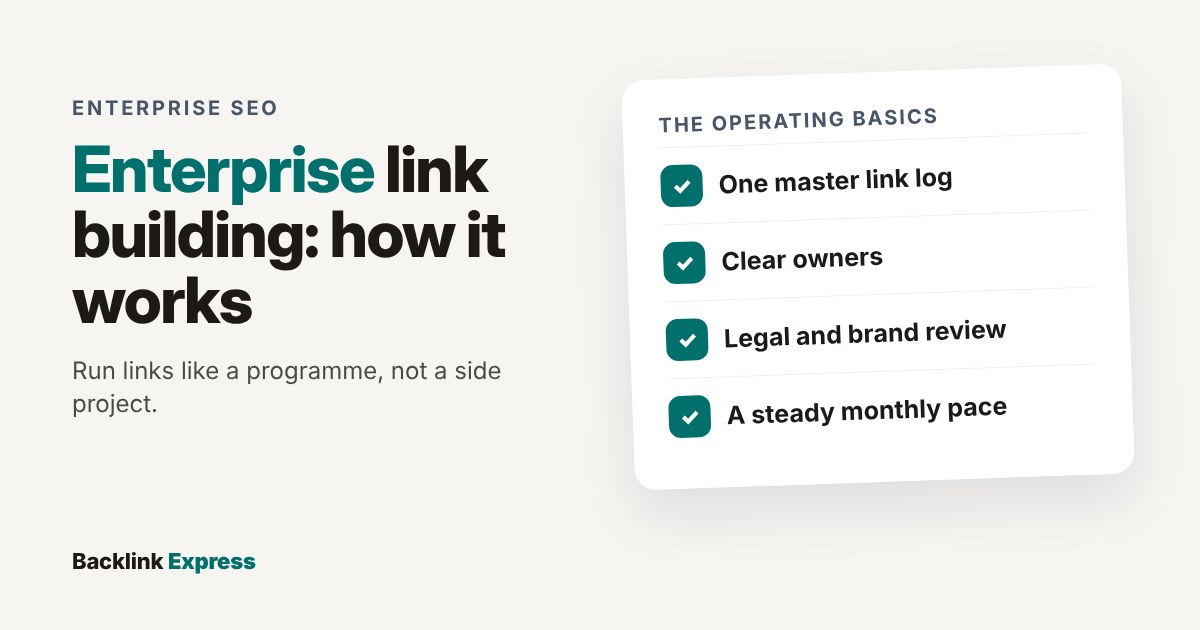
- Keep one master link log: page, publisher, date, anchor, attribute, cost, owner. If a link ever needs to be removed or explained, this log is the only fast answer.
5. Execute through the right mix of team, agency and marketplace
This is the answer to “how do you outsource link building?” at enterprise scale. Most large companies run a hybrid model: a small internal team owns strategy, the policy, target pages and approvals; outside partners handle prospecting, outreach and placement volume.
- In-house team: best for digital PR, partnerships and anything that needs the brand’s own relationships.
- Agency: best for managed outreach when you want one accountable vendor. Our list of link building agencies compares the main options.
- Marketplace: best when you want to choose each site yourself and see traffic and price before you order. On a marketplace like Backlink Express, the buyer picks the site and the publisher’s editor decides what goes live.
Whichever model you use, the vendor works inside your policy, not its own. If an agency is quietly setting strategy, choosing anchors and picking target pages, you no longer run an enterprise program. You run their program on your domain.
6. Measure what leadership actually cares about
Report in two layers. The SEO layer proves the work happened. The business layer proves it mattered.
| Layer | Metrics |
|---|---|
| Activity and quality | New relevant referring domains per target page, share of links from approved publishers, anchor mix, sponsored vs earned split, cost per placed link |
| Search outcome | Ranking movement for target pages, organic clicks from Search Console, share of voice against named competitors |
| Business outcome | Organic leads, pipeline and revenue on target pages, by market and product line |
Treat third-party scores such as DR as filters, not goals. They are vendor metrics, not Google metrics. Our explainer on DR and UR covers what they measure and where they mislead. If you need a quick check on a prospect, our free DR checker does the job.
Set expectations honestly. Links do not move rankings on a fixed schedule and nobody can guarantee a timeline. Agree a review point with leadership (a quarter is common) and judge the program on target-page movement, not total link count.
The paid-link question every enterprise must answer in writing
As the founder of a link marketplace, I will say this plainly: buying placements is a normal part of how large brands get visibility and it carries a clear rule. Google’s spam policies define link spam as “creating links to or from a site primarily for the purpose of manipulating search rankings,” and list “exchanging money for links, or posts that contain links” among the examples (Google spam policies, updated August 2026). Google asks site owners to mark paid placements with rel="sponsored" (Google’s guide to qualifying outbound links).
Enterprises should write their answer into the policy instead of leaving it to each vendor. Three points in Google’s list hit large companies harder than small ones:
- Optimized anchors in distributed content. The policy names links with optimized anchor text in articles, guest posts or press releases distributed on other sites. A press release pushed to hundreds of sites with keyword anchors is exactly that.
- Contract-required links. Requiring a link in terms of service or a contract, without letting the other site qualify it, is on the list. Check your partner agreements, reseller terms and “powered by” badges.
- Partner pages built only to cross-link. Large groups with many brands often link every site to every other site from footers and partner pages. Link where it helps users. Do not build a web of brands to pass ranking credit.
One more correction to the SERP. Skip “A-B-C” link building, where links rotate through three sites so no two link directly to each other. That is a link exchange with a different shape and the policy targets the purpose, not the shape. Leave it out of an enterprise program. Our article on link exchanges in SEO covers the risk in detail.
A labelled placement is bought for reach, referral traffic and visibility with the right audience, not to pass ranking credit. The defensible pattern for paid placements is simple: real sites with real traffic, content that would be worth publishing anyway, the label Google asks for and a log that shows all three.
How much does enterprise link building cost?
There is no standard price and published ranges vary a lot. One agency pricing guide we checked (Stellar SEO, updated December 2025) says link building in general typically costs $5,000 to $10,000 per month, or $300 to $750 per link; its own managed campaigns start at $2,500 per month. Enterprise-focused providers in the same results often quote custom pricing only. Treat any range as a starting point, not a quote.
A better approach is to build the budget from your own target list:
Monthly budget = (target links per month x blended cost per link) + content and asset cost + internal hours
Here is a worked example with stated assumptions. These are illustrative numbers, not Backlink Express prices or benchmarks:
| Input | Assumption | Monthly cost |
|---|---|---|
| Target pages in scope | 10 priority pages across 2 markets | n/a |
| Placements | 20 links per month at an assumed blended $500 each | $10,000 |
| Linkable asset | One research piece per quarter at an assumed $9,000, spread monthly | $3,000 |
| Internal time | Assumed 40 hours of SEO, PR and legal review at $75 per hour | $3,000 |
| Total | $16,000 |
Swap in your own numbers. The structure is the point: internal review time and assets are real costs and most budgets forget them. To decide how many links a page actually needs, compare your target page with the referring domains of the top three results and close the relevant gap, not the total one.
Is link building still relevant for enterprise SEO in 2026?
Yes. Google’s documentation still lists link analysis and PageRank among its core ranking systems. What has changed is where the payoff shows up. AI answer engines now summarize “best of” questions and they lean on third-party pages.
We checked this for this exact topic on 24 October 2026. Asked who to use for enterprise link building, Perplexity and Gemini have answered with lists drawn from third-party roundups and vendor guides. For an enterprise brand, that means mentions on credible industry sites now do two jobs: they pass link signals to Google and they shape what AI tools say about you.
What tools does an enterprise link program need?
No single tool runs an enterprise program. You need one tool from each of four jobs:
- Backlink data: a large link index such as Ahrefs, Semrush or Majestic for competitor gaps and prospecting.
- First-party data: Google Search Console for clicks and queries on target pages and your analytics and CRM for leads and revenue.
- Outreach and relationships: a CRM or outreach tool so contacts, pitches and placements stay with the company when people leave.
- Vetting: quick checks on every new publisher, such as our free spam score checker, plus a human look at traffic and content.
The master link log from step 4 matters more than any of these. Tools change. The record of what you built, where and under which label is what protects the domain.
Common enterprise link building mistakes
- Every team buys links on its own. Regional teams, product marketing and agencies all buy from overlapping vendors and nobody sees the combined footprint.
- Links go to the blog, revenue sits on category pages. Volume goes where links are easy, not where they move money.
- Paid placements without the label. The policy is clear; skipping
rel="sponsored"turns a marketing spend into a spam risk. - Vendors judged on DR alone. A high score on a site with no real traffic or topical fit is a weak link for you.
- Approvals with no deadline. Digital PR opportunities expire in days. A three-week review cycle kills them.
- Reporting link counts to leadership. Executives fund pipeline, not referring domains. Report both, lead with the business layer.
What this means for enterprise SEO leads
Start with the policy, not the outreach. In your first month, map the estate, rank target pages, write the one-page link policy and set the approval deadline. Only then turn on vendors and campaigns. Programs built in that order scale without surprises. Programs built the other way spend the second year cleaning up the first.
If you are ready to place links on sites you choose yourself, with traffic and price shown before you order, browse vetted publishers on Backlink Express.