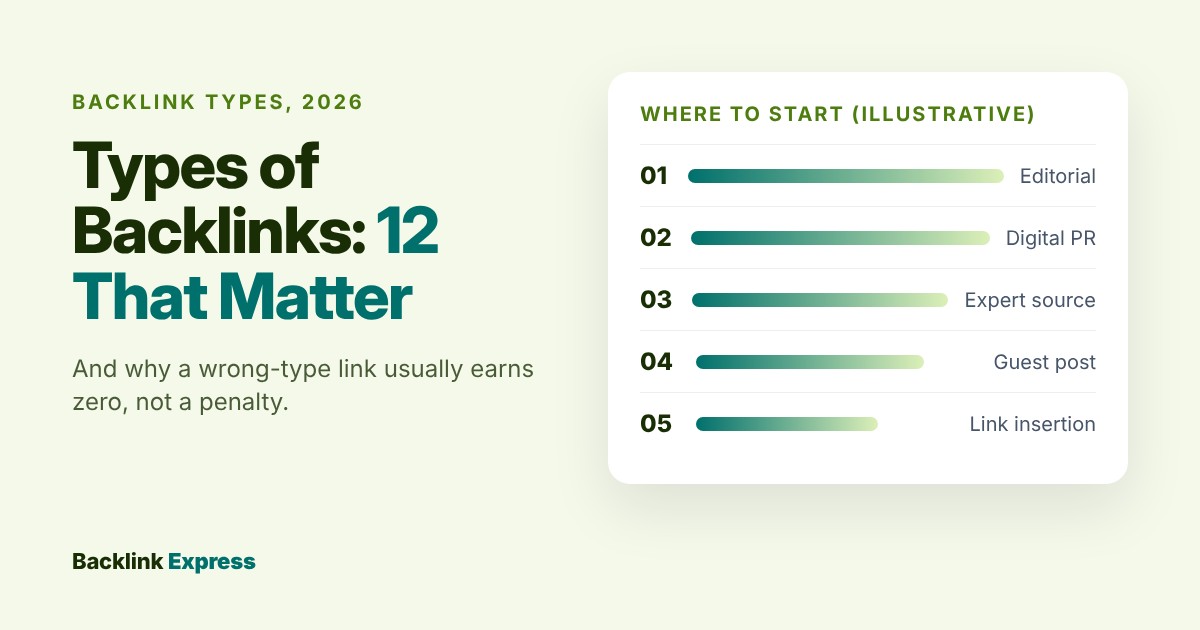
There are 12 types of backlinks worth knowing: four set by the link’s rel attribute and eight set by how the link was earned or placed. Everything else is a variation, or a tactic Google already lists as spam.
Here is the part most lists skip. Since Google’s December 2022 link spam update, a link of the wrong type usually earns you nothing rather than a penalty. So the real question is not “how many types exist” but “does this link’s type match how I got it?” After a decade in SEO and link building, that is the classification I use.
If you are new to the basics, start with what backlinks are and how they work. This guide assumes you know that and want to decide which links deserve your time and budget.
The 12 types of backlinks at a glance
Every backlink has two properties at once: an attribute (what the HTML tells Google) and a source (how it got there). A guest post link can be followed or sponsored. A directory link can be followed or nofollow. Classify both.
| # | Type | How you get it | Worth it when |
|---|---|---|---|
| 1 | Followed (no rel) | Default link with no attribute | An editor chose to place it |
| 2 | Nofollow | rel="nofollow" added by the site |
It sends real visitors or brand searches |
| 3 | Sponsored | rel="sponsored" on paid or ad placements |
The audience fits and you pay for exposure |
| 4 | UGC | rel="ugc" on comments and forum posts |
You add a genuinely useful answer |
| 5 | Editorial | A writer cites you unprompted | Always; this is the type the others imitate |
| 6 | Digital PR | Data, studies or stories journalists cover | You have something newsworthy |
| 7 | Expert source | Answering journalist queries with quotes | You can answer fast with real expertise |
| 8 | Guest post | You write an article for another site | The site has real readers in your topic |
| 9 | Link insertion (niche edit) | Your link added to an existing article | The page itself ranks and gets traffic |
| 10 | Resource page | Listed on a curated page of tools or guides | Your page is the best resource on its topic |
| 11 | Business profile and niche directory | Listing on profile or industry sites | Local SEO and consistent business details |
| 12 | Image and media credit | Credit link when others use your photo, chart or video | You publish original visuals |
The four attribute types (1 to 4)
These come from one HTML attribute. You can check any link in seconds: right-click it, choose Inspect, and read the rel value inside the <a> tag.
1. Followed links
A plain link with no rel value. Google’s documentation says regular links that you expect Google to crawl need no attribute at all. People call these “dofollow”, but there is no dofollow attribute. It is simply the absence of one.
2. Nofollow links
rel="nofollow" tells Google the site would rather not be associated with the linked page. Many guides still say Google ignores these links completely. That stopped being true in 2019. More on that in our dofollow vs nofollow guide.
3. Sponsored links
Google asks site owners to mark advertisements and paid placements with rel="sponsored", and says nofollow is still acceptable for them (Google’s guide to qualifying outbound links). If you paid for a placement, this is the type it should be. Say that plainly to every publisher you work with.
4. UGC links
rel="ugc" marks links in comments, forum posts and other user content. Google even suggests sites may remove it for trusted, long-time contributors. Earn that, and a forum link can become a followed one.
The eight source types that matter (5 to 12)
5. Editorial links
A writer links to you because your page is the best source for a claim. No ask, no payment. Every other type on this list is an attempt to get this result faster.
6. Digital PR links
You publish original data or a story, journalists cover it, and the coverage links back. These are editorial links you engineered by giving reporters something worth citing.
7. Expert source links
Journalists post queries; you answer with a quote; the article credits you with a link. The platforms changed a lot since 2024, which most guides have not caught up with. Details in the section below.
8. Guest post links
You write an article for another site and it links back, usually in the body or author bio. The value lives or dies on the host site’s real audience. Google’s spam policies call out guest posts with optimized anchor text that pass ranking credit, so keep anchors natural and paid posts qualified.
9. Link insertions (niche edits)
Your link is added to an article that already exists and may already rank. You get an aged, indexed page from day one. The catch is that you are buying the page, not the domain. We cover vetting in our niche edits guide.
10. Resource page links
Curated lists of tools and guides on a topic. Hypothetical example: a university library page listing free accessibility checkers links to a tool that is genuinely free and genuinely good. Thin lists made only to sell slots are a different thing.
11. Business profiles and niche directories
Industry associations, chamber of commerce listings and real business directories. Their value is local relevance and consistent business details, not raw authority. Google lists low-quality directory links as link spam, so be picky.
12. Image and media credit links
When someone uses your photo, chart or video, they credit you with a link. Original visuals turn into links you never had to ask for.
Which backlink types don’t matter (or hurt)?
Google’s spam policies name these as link spam. They are not types to build. They are types to recognise and avoid:
- Links bought or sold for ranking purposes that pass ranking credit, including posts with links and goods or services exchanged for links
- Excessive link exchanges and partner pages made only for cross-linking
- Links created with automated programs or services
- Low-quality directory and bookmark site links
- Keyword-rich or hidden links in widgets distributed across many sites
- Widely distributed links in footers or templates of other sites
- Forum comments with optimized links in the post or signature
- Creating low-value content primarily to manipulate linking and ranking signals
Private blog networks are not named in that list, but in my view they fall under the same rule: they are low-value sites that exist only to pass ranking credit.
One trap hides inside “safe” lists. Some top guides still recommend reciprocal links and links received in exchange for a service. Google names both “excessive link exchanges” and “exchanging goods or services for links” in its policy. A one-off partner link is fine; a system of swaps is not.
What are the three types of backlinks?
When people ask for three, they usually mean three ways a link can come into being: editorial links you earn without asking, outreach links you ask for (guest posts, insertions, expert quotes), and self-created links you place yourself (profiles, comments, directories). Editorial links carry the most weight. Self-created links carry the least, and they are where most spam lives.
What are the different types of links on a website?
Three: internal links (page to page on your own site), outbound links (your site to another), and backlinks (another site to yours). Internal links you control completely. Backlinks you can only influence.
What are Tier 1 and Tier 2 backlinks?
A Tier 1 backlink points straight at your site. A Tier 2 backlink points at the page that links to you. The idea of building Tier 2 links is to boost the Tier 1 page so it passes more value.
In practice, Tier 2 campaigns are almost always automated or low-quality links built to manipulate rankings, which is exactly what Google’s spam policies define as link spam. There is one honest version: when a guest post or press mention of yours gets cited by others naturally, that helps the page linking to you. You don’t need to build it.
Do backlinks still matter in 2026?
Yes. Google’s own ranking systems guide, updated December 2025, says PageRank “continues to be part of our core ranking systems.” What changed is what a link has to be to count, covered next.
What most types-of-backlinks guides miss
The five pages ranking highest for this keyword in October 2026 agree on the list above. They miss four things that change how you should spend your time and money.
A wrong-type link usually earns zero, not a penalty
Most guides frame bad link types as a penalty risk. Google’s December 2022 link spam update describes something different: SpamBrain neutralizes unnatural links, and “any credit passed by these unnatural links are lost.” The same post says SpamBrain can detect both sites buying links and sites used to pass outgoing links.
That changes the maths. A paid link that passes ranking credit without rel="sponsored" is not a clever shortcut. It is often money spent on a link that counts for nothing, on a site Google may already have flagged as a seller, which devalues its links for every buyer.
What to do differently:
- Judge any paid placement by what it gives you even when qualified: real readers, referral clicks, brand searches, a citation an AI answer engine can pick up.
- Expect paid links to carry
rel="sponsored", as Google’s policy says. A seller who promises “followed, undetectable” links is describing the thing SpamBrain was built to catch. - Check the host site’s outbound links. A site whose posts link out to unrelated commercial pages in nearly every article looks like the “sites used for the purpose of passing outgoing links” Google describes.
Google still runs PageRank, and tells you what links are for
Some ranking guides still repeat that backlinks are one of Google’s “top three ranking factors”, without a source. Google’s guide to its ranking systems (last updated 10 December 2025) says something more useful: Google uses systems that understand how pages link to each other “as a way to determine what pages are about”, and PageRank remains a core system.
Read that twice. Links tell Google what a page is about, not only how important it is. So the type that matters most is the one where the linking page is about your topic. A followed link from an unrelated page sends a weaker signal than its metrics suggest, and third-party scores like DR and DA are not Google metrics at all. See how to land high-authority links for vetting relevance before authority.
The expert-source platform you were told to use closed, then reopened
The AI Overview for this keyword names HARO with no dates, and one top-ranking guide still lists “HARO (Connectively)”, a brand that no longer exists. The timeline matters if you plan to earn type 7 links:
- Cision rebranded HARO as Connectively, then shut Connectively down in December 2024.
- On 16 April 2025, Featured.com announced it had acquired HARO from Cision and would revive it as a free daily email service for journalists and sources (the acquisition announcement).
What to do differently: drop any process built around Connectively, sign up for the current HARO, and spread your pitches across other query services such as Qwoted and Help a B2B Writer. Journalists work to deadlines, so speed and a specific answer beat a polished one.
The types cost very different amounts
No top-ranking guide on this keyword prices the types, yet price is how most teams choose between them. BuzzStream figures checked October 2026; the Ahrefs data was collected before the study’s November 2022 publication:
| Type | Price found | Source and sample |
|---|---|---|
| Link insertion | $361.44 average | Ahrefs study, 450 sites in nine niches; 12.6% agreed to sell (published 2022, updated July 2024) |
| Paid guest post | $77.80 average | Ahrefs study: average from the blogs that quoted a fee (180 pitched) |
| Link insertion | $179 average | BuzzStream pricing data, 62,916 sites (Oct 2026) |
| Guest post | $295 direct, $461 via a vendor | BuzzStream pricing data, 257,267 sites (Oct 2026) |
| Digital PR link | $1,250 to $1,500 per link | BuzzStream pricing data (Oct 2026) |
Two link insertion figures from two datasets disagree by about $180. That gap is the point: price depends on sample, niche and who brokers the deal, so compare cost per placement against the page’s own traffic, not against a list average. Our link building pricing breakdown builds a full cost-per-link model.
My verdict: classify by match, then by source
Earned types (editorial, digital PR, expert quotes, media credits) are the ones Google is built to reward. Go after them first if you have data, expertise or visuals worth citing.
Placed types (guest posts, insertions, resource and directory listings) are legitimate when an editor decides what goes live and paid placements carry rel="sponsored". Buy them for audience, relevance and referral traffic, and judge them by the page, not the domain.
Skip anything whose value depends on Google not noticing how it was made. Since 2022, Google mostly doesn’t punish those links. It just stops counting them, after you have paid.
If you want to compare publishers by real traffic and topic before you spend, browse vetted publishers on Backlink Express. You pick the site; the publisher’s editor decides what goes live.