Last updated: 13 November 2026
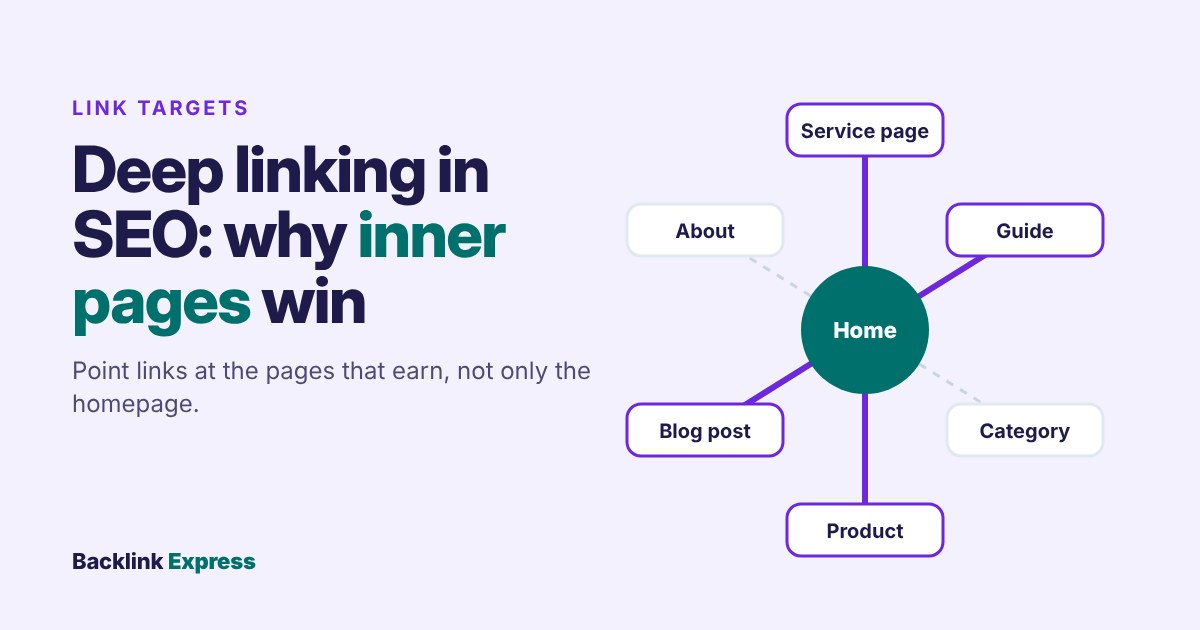
Deep linking in SEO means links that point to a specific inner page of a website, such as a guide, product, category or service page, instead of the homepage. Those links can come from other sites (deep backlinks) or from your own pages (internal deep links) and they matter because Google ranks pages, not domains.
My position after working in SEO and link building since 2012: stop chasing a homepage to deep link ratio. No published study backs any specific number and the pages that pay your bills do not care what your ratio looks like. They care whether they have enough relevant links of their own to compete with the pages ranking above them.
This guide covers what deep links are (and the other, mobile app meaning of the term), why they matter, how to read your own link distribution without a magic number, how internal deep links fit in and how to earn deep backlinks to the pages that need them.
What is deep linking in SEO?
A deep link is any link whose target URL is a page below the homepage. If a blog links to example.com, that is a homepage link. If it links to example.com/guides/keyword-research, that is a deep link. “Deep” refers to how far the page sits from the root of the site, not to anything technical about the link itself.
There are two kinds and they do different jobs:
| Type | Where the link sits | What it does for SEO |
|---|---|---|
| External deep link (deep backlink) | On another website, pointing to one of your inner pages | Sends relevance and authority signals straight to the page that should rank, plus referral visitors who land on the exact content they wanted |
| Internal deep link | On one of your own pages, pointing to another of your inner pages | Helps Google find the page, explains what it is about through anchor text and moves authority from strong pages to weaker ones |
The core idea is old and simple. Google says it “uses links as a signal when determining the relevancy of pages and to find new pages to crawl” in its link best practices documentation. A link that points at the page that actually answers a query gives that signal to the right URL.
What is an example of deep linking?
Say you run a project management SaaS. A marketing blog writes a post comparing ways to run sprint planning and links to your sprint planning template page, with the anchor “free sprint planning template”. That is a deep backlink. The reader lands on the template, not your homepage and the template page gains a relevant link from a relevant article.
Now say your own blog post on agile retrospectives links to that same template page. That is an internal deep link. Both point to the same inner URL; one comes from outside, one from inside.
Deep linking also means mobile app deep links
Search for “deep linking” and half the results are about apps, not SEO. In mobile development, a deep link is a URI that opens a specific screen inside an app instead of the app’s start screen. Google’s Search Central team describes these as links that take users “directly to specific in-app content”, set up as Universal Links on iOS and App Links on Android, in its May 2025 post on app deep links.
The same post is clear that app deep links do not change how Google Search shows your content: Search keeps using your web page content for indexing and ranking. So app deep links are a user experience and attribution tool. They are not a ranking tactic and the rest of this article is about the SEO meaning.
What is the difference between a URL and a deep link?
Every deep link is a URL, but not every URL is a deep link. A URL is just an address. It becomes a “deep link” when a link points to an address below the homepage. example.com/ is the root URL. example.com/pricing and example.com/blog/post-name are inner URLs and any link to them is a deep link.
In the app world the distinction is sharper: an app deep link may use a custom scheme or a verified web URL that the operating system hands to the app. For web SEO, you do not need anything special. A normal HTML link with an href pointing to an inner page is the deep link. Google’s documentation recommends exactly that format, an <a> element with an href attribute, because links built only with JavaScript click handlers may not be parsed reliably.
Why are deep links important for SEO?
Because the unit that ranks is the page. Your homepage does not rank for “sprint planning template”. Your template page does, or does not, based partly on the links pointing to it and the links inside your site that lead to it. Here is what deep links actually do:
- They put signals on the URL that competes. When you check the pages ranking for a keyword, you look at links to those pages, not just to their domains. A strong domain with zero links into a page is a common reason a good page stalls on page two. Our guide on DR and UR in SEO explains why page-level strength and site-level strength are tracked separately.
- They carry topical context. A link from an article about payroll software to your payroll comparison page says something specific. The same link pointed at your homepage says much less, because your homepage is about everything you do.
- They help Google find and revisit pages. Links are how crawlers discover URLs. Inner pages with no internal or external links pointing to them are easy to miss.
- They send better referral traffic. A reader who clicks a deep link lands on the answer. A reader who clicks a homepage link has to start hunting. If you care about conversions from referral traffic, the deep link wins.
- They make a link profile look like a real business. Sites that publish useful things attract links to those things. A profile where nearly every link points to the homepage, often with commercial anchors, is a pattern that tends to come from directories, profile links and bought homepage placements rather than from people citing your work.
None of this means homepage links are bad. Brand mentions, press coverage, partner pages and “about the company” references naturally point to the homepage. You want both. You just want the inner pages that make money to have their own links too. For the basics of how backlinks work as a ranking signal, see our guide on what backlinks are.
What is a healthy homepage to deep link ratio?
There is no sourced answer and anyone who gives you a precise percentage should show you the data behind it.
We checked this on 24 October 2026. One AI answer engine (Perplexity) recommended roughly 60 to 70 percent homepage links and 30 to 40 percent deep links. Another (ChatGPT) said roughly 40 to 60 percent each. Both cited agency and tool blogs and neither traced the numbers to a published study. There is no ideal deep links ratio and Google has never published one.
The ratio also changes with the type of site, so a single benchmark would mislead most people even if it existed:
| Site type | Where links naturally land | What to watch |
|---|---|---|
| Publisher or content site | Mostly articles, research and guides | Whether the articles that earn links pass authority to the pages that earn revenue |
| Strong brand or local business | Mostly the homepage (press, directories, citations) | Service or location pages with no links of their own |
| Ecommerce | Homepage plus a few viral products or guides | Category pages, which compete for the biggest keywords and rarely get linked naturally |
| SaaS | Homepage, free tools, templates and data posts | Feature, use case and comparison pages that sit behind the free assets |
So read your distribution as a symptom, not a target. If almost everything points to the homepage and your inner pages are stuck, that is worth fixing. If you have a lopsided ratio and your money pages rank fine, leave it alone. Manufacturing deep links just to hit a percentage is the same mistake as manufacturing anchor text to hit a percentage, which we cover in our anchor text guide.
How to check whether your inner pages need deep links
Instead of a ratio, run a page-level gap check. It takes an hour with any backlink tool that has a “best by links” or “top pages” report.
- List the pages that make money. Service pages, product categories, comparison pages, pricing, the guides that feed sign-ups. Ten to twenty URLs is enough to start.
- Record each page’s target keyword and current position. Use your Search Console data. Ignore pages already in the top three.
- Count referring domains to each URL, not to the domain. Then check the pages ranking above you for the same keyword and count theirs. This is the comparison that matters.
- Mark the gaps. A page with strong content, decent internal links and far fewer linking domains than the pages above it is a link gap. A page with as many links as its competitors but weak content is a content problem and more links will not fix it.
- Check internal links before buying or chasing anything. If the gap page is three clicks deep and only linked from one old post, fix that first. Internal links are free and fast.
- Prioritise by business value. Close the gap on the page closest to page one with the highest value per visit first.
The output of this check is a short list of inner URLs that need links and a rough idea of how many. That is far more useful than knowing your homepage share is 55 percent. If you want a deeper way to estimate link targets per page, see our guide on how many backlinks you need to rank.
Internal deep linking: the part you fully control
External deep links are earned. Internal deep links are a decision. Google’s guidance is blunt: “Every page you care about should have a link from at least one other page on your site.” Pages with no internal links pointing to them, often called orphan pages, are hard for crawlers to find and hard for authority to reach.
Most sites collect external links on the homepage and a handful of popular posts. Internal links are how that strength reaches the pages that need it. A practical internal deep linking routine:
- Link from your most-linked pages (check the top pages report) to the inner pages from your gap list, where the link genuinely helps the reader.
- Use descriptive anchor text. Google describes good anchor text as “descriptive, reasonably concise and relevant” and warns against generic text like “click here”.
- Link in context, inside the body copy, not only from menus and footers.
- Keep important pages within a few clicks of the homepage through categories and hub pages.
- Fix internal links that point to redirects or 404s, so they go straight to the final URL.
Google also notes there is no magic number of links on a page, though very large numbers of links stop being useful. Our full guide on why internal links matter for SEO goes further into site structure and hub pages.
How to create deep links that people actually give you
Technically, creating a deep link is trivial: link to the inner URL. The hard part is getting other sites to link to inner pages, because writers link to what is useful to their readers and most commercial pages are not useful to a writer. The fix is to build pages that deserve the link and then route their strength internally.
| Asset type | Why writers link to it | How it helps your money pages |
|---|---|---|
| Original data or survey results | Writers need a source for a number | Internal links from the data page to related service or product pages |
| Free tools and calculators | A tool solves the reader’s problem in one click | Tool pages sit next to the paid version of the same job |
| Templates and checklists | Easy to recommend in a how-to article | Link to the feature or product that does the job at scale |
| In-depth guides on a narrow topic | The best explanation of one thing gets cited | Guides can link straight to the matching service page |
| Comparison and category pages | Rarely linked naturally | Usually need outreach, guest posts or placements to close the gap |
Then use the channels that let you choose the target URL:
- Guest posts and contributed articles. When you write the article, you can cite the inner page that best supports the point. One relevant deep link in context beats a homepage link in an author bio.
- Resource and roundup pages. Pitch the specific tool, template or guide, not your company.
- Unlinked mentions. When someone mentions your data or tool without linking, ask them to link to that page, not the homepage.
- Broken link replacement. If a site links to a dead page on a topic you cover, offer your matching inner page as the replacement.
- Digital PR built around data. Coverage of a study usually links to the study page, which then feeds your internal links.
Deep links in paid placements: what Google expects
Many buyers use sponsored posts and guest post placements specifically to get deep links to money pages. That is a legitimate way to reach an audience, but Google’s rules on paid links do not change because the target is an inner page. Google asks sites to mark paid or sponsored links with rel="sponsored" (or nofollow) in its guidance on qualifying outbound links and its spam policies treat buying links that pass ranking credit as link spam.
Be honest about what you are buying: relevant placement, referral traffic and visibility in front of the right readers. Pick sites on topic, check that they have real traffic, keep anchors natural and point the link to the page that genuinely matches the article. A marketplace listing that shows the site, its traffic and its price up front makes that choice easier. One that hides those details is a reason to walk away.
Common deep linking mistakes
- Pointing every link at the homepage. It feels safe, but it leaves the pages that rank for commercial terms with nothing of their own.
- Forcing deep links into irrelevant articles. A link to your pricing page from a post about remote work culture helps nobody, including you.
- Exact-match anchors on every deep link. Deep links make it tempting to use the target keyword every time. Mix in branded, partial and descriptive anchors.
- Deep linking to pages that redirect or will be deleted. Check the URL is final and permanent before you use it in outreach.
- Earning links to a page with no internal links out. A popular guide that links nowhere wastes the authority it collects.
- Chasing a percentage. If the page you need to rank already outranks its competitors, more deep links to it are not the priority.
When deep linking will not fix your rankings
Deep links solve a link gap. They do not fix a page that does not match search intent, a thin page that adds nothing new, a technical problem that keeps it out of the index, or a keyword your site has no business ranking for yet. Run the gap check first. If the page already has as many relevant links as the pages above it, look at content, intent and crawling before you spend a dollar on links.
If your gap check shows inner pages that need relevant links, browse vetted publishers on Backlink Express, pick sites that match the page’s topic and point each placement at the URL that deserves it.