To buy guest posts that can help rankings, pick sites where the exact section your article will sit in earns its own search traffic, covers your topic and treats paid content honestly. Then pay close to measured market rates, which sit far below the price bands Google’s AI answer shows today.
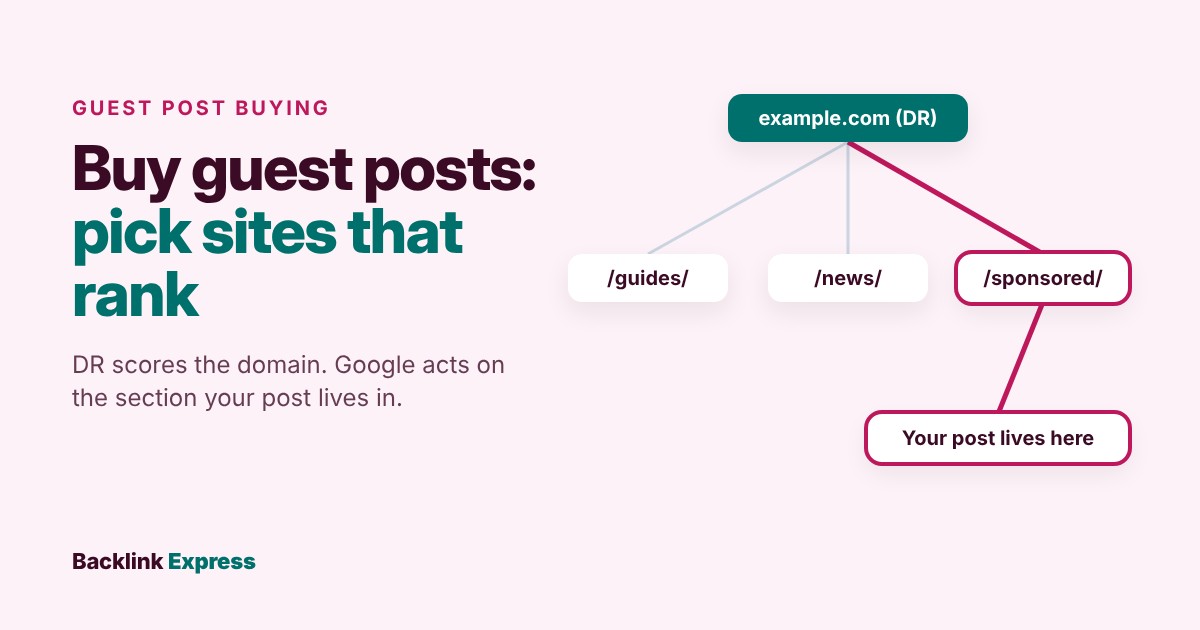
Here is my position after a decade in SEO and link building: DR is the wrong unit. It scores a whole domain, while Google now judges and acts on sections and on individual links. Every top-ranking guide I read for this keyword vets the domain. You should vet the folder your post will live in.
What makes a guest post site worth buying?
The basics are settled. Every serious buying guide checks the same five things, and you should too. Treat them as the entry ticket, not the decision.
| Check | What passes | What fails |
|---|---|---|
| Topic fit | The site publishes regularly on your subject for readers who could buy from you | A “general” blog covering crypto, CBD, pets and SaaS in the same week |
| Organic traffic | Steady or rising search traffic from countries you sell to | Flat zero, or one spike from a single viral page |
| DR or DA | Used as a rough first filter only | Used as the price tag. Both are third-party scores from Ahrefs and Moz; Google does not use them |
| Link placement | One contextual link inside the body of a real article | Author-box, footer or sidebar links |
| Site quality | Edited articles, named authors, real reasons to read | Private blog networks, content farms, pages written only to hold links |
If a seller won’t show you traffic for the site, walk. If you want the longer version of how to judge the seller itself, I covered it in how to choose a guest posting service.
Where can you buy guest posts?
You have three routes, and each one hides a different cost.
| Route | How it works | Best for | Watch for |
|---|---|---|---|
| Marketplace | You browse listed sites with traffic and price shown, pick one, and the publisher’s editor decides what goes live | Buyers who want to choose every site themselves | Listings with no traffic data or no editorial review |
| Agency or managed service | A team finds sites, pitches editors and writes the content for a per-link fee or retainer | Teams with budget and no time | Site lists revealed only after you pay |
| Freelance gig platforms | Individual sellers offer placements on their own lists | Small tests | Cheap bundles on sites built to sell links |
Doing the outreach yourself is a fourth route. It costs time instead of a fee, and our guest blogging guide shows how to write posts editors accept.
Is buying guest posts against Google’s rules?
Paying for a link that passes ranking credit is link spam under Google’s spam policies. The policy names “advertorials or native advertising where payment is received for articles that include links that pass ranking credit” directly. The same page says buying links for advertising or sponsorship is a normal part of the web, as long as the link carries rel="sponsored" or rel="nofollow".
So the honest answer: buying a guest post is not illegal and not automatically a penalty, but a paid link is not “Google-approved” either. Anyone who tells you otherwise is selling. The sections below explain how Google actually catches the risky ones and what that means for which sites you pick. For the attribute basics, see our guide to dofollow and nofollow links.
Should you buy a guest post or a link insertion?
A guest post is a new article written for the host site with your link inside. A link insertion, or niche edit, adds your link to an article that already exists. A new post gives you control over the context and topic. An insertion lands on a page that may already have age, links and traffic, but you inherit whatever that page is about. I compare the two in detail in niche edits explained.
What most guides to buying guest posts miss
I read the five top-ranking pages for this keyword one by one, plus Google’s AI Overview and a ChatGPT answer to the same question. They rank sites by domain metrics, and most of them sell “dofollow” as a feature. None of them mentions the four things below, and each one changes what you should buy.
1. Google acts on sections, so vet the folder, not the domain
In 2024 Google added site reputation abuse to its spam policies: third-party content published on a host site mainly to borrow the host’s ranking signals. In November 2024 Google clarified that “no amount of first-party involvement” changes that, naming white-label services, licensing deals and partial ownership. In its August 2026 update to the policy, Google said a manual action “will directly affect search results for the portion of the site affected” while “the rest of the site won’t be affected.”
Read that as a buyer. A DR 80 news site can carry a sponsored or contributor folder that is under a manual action, and its DR will not move. You would be paying a DR 80 price for a page in a section Google has pushed down. Google’s policy also says advertorials meant to inform readers are not abuse. The test is purpose and integration, not the label.
What to do differently:
- Ask the seller for two or three live URLs from the exact section your post will go in.
- Check that folder’s own organic traffic and keywords in Ahrefs or Semrush by entering the folder path, not the domain.
- Run
site:example.com/folder/in Google as a rough check that its pages are indexed at all. - Pass on the site if the folder gets no search traffic, has nothing to do with the main site’s topic, or exists only for paid posts.
One extra wrinkle: in the European Economic Area, Google says those manual actions do not apply, but the affected section may be separated to rank on its own over time. Either way, the section has to earn its traffic.
2. The “dofollow” premium is the risk you are paying for
Four of the five top pages treat dofollow as a quality signal, and one prices it as an upgrade over nofollow. None of the five mentions Google’s rel="sponsored" rule. That matters because of how Google detects paid links. In its December 2022 link spam update, Google said SpamBrain “can now detect both sites buying links, and sites used for the purpose of passing outgoing links.”
The second half is the part buyers skip. Google is looking at the seller’s pattern, not only at your one link. A site that publishes anything for anyone who pays, with unqualified links to casinos, loans and random SaaS tools on the same week, is exactly the profile that system was built to spot. When it does, the links that site passes are what Google is targeting, yours included.
What to do differently: open the seller’s last 20 posts before you buy. If most of them exist only to hold outbound links on unrelated topics, your link will sit in that crowd. Ask how the publisher marks paid links. A publisher with an editor, a clear topic and a stated policy on sponsored content is a safer bet than one that promises “permanent dofollow” in bold.
3. The AI answer’s price bands run far above measured averages
Google’s AI Overview for this keyword lists $400 to $900 per placement for DR 41 to 55, $900 to $2,500 for DR 56 to 70 and $2,500 to $15,000+ for DR 71 and up. All three bands cite a single blog post. Compare that with the published datasets:
| Source | What it measured | Guest post price |
|---|---|---|
| Ahrefs study (published Nov 2022, updated Jul 2024) | 180 “write for us” blogs | $77.80 average |
| BuzzStream pricing data (Oct 2026) | 257,267 sites | $295 direct, $461 through a vendor |
| Backlink Outreach Agency 2026 dataset | 526 paid placements | $150 median paid; acceptance drops past about $200 |
| Google AI Overview (Oct 2026) | Cites one blog post | $400 to $900 for DR 41 to 55 |
The bottom of the AI Overview’s lowest band is still above what BuzzStream found buyers pay publishers directly, and about five times the Ahrefs average. The datasets measure different things (the Ahrefs sample skews to smaller blogs, and niches like finance run higher), but none of them supports a $400 floor for mid-DR sites.
What to do differently: use $150 to $300 as your reference for a direct placement on a solid niche site, and expect a vendor markup on top. When a quote is several times that, ask what the extra buys: real section traffic, a strict editor, a niche with high rates. If the only answer is “DR”, walk. Our link building pricing breakdown covers why the published averages disagree.
4. In the US, a paid post is an ad, and you share the duty to disclose it
None of the five pages mentions disclosure. The FTC’s guide to native advertising says “everyone who participates directly or indirectly in creating or presenting native ads should make sure that ads don’t mislead consumers about their commercial nature,” and notes the FTC has acted against ad agencies and affiliate network operators, not only advertisers. The same guide warns that a label such as “Sponsored by [X]” may be read as funded by a brand but not written or shaped by it.
A guest post you paid for, with your product in it, is your advertising. That puts some of the responsibility on you, not only on the publisher.
What to do differently: before you pay, ask whether the publisher labels paid content and how. Prefer sites that do it clearly. This lines up with Google too: its spam policy treats native advertising written for readers as fine, and it is the hidden, link-first version that causes trouble.
Put it together: a 10-minute check before you pay
- Topic: does the site cover your subject for people who could buy from you?
- Section: get live URLs from the exact folder your post will sit in.
- Section traffic: does that folder earn its own organic traffic and keywords?
- Indexing: does
site:on that folder return pages? - Seller pattern: do the last 20 posts carry unrelated outbound links?
- Link handling: how does the publisher qualify paid links, and is the post labelled?
- Editor: does a person review and edit what goes live?
- Price: is the quote near $150 to $300 direct, and can the seller explain any premium?
- Replacement: what happens if the post is removed or edited later?
Fail two of these and move on. There is always another site.
My verdict on buying guest posts
Buy guest posts when you need relevant links faster than outreach can deliver and you are willing to vet each placement. Buy on sites where the section itself earns search traffic, a real editor decides what goes live and paid content is handled openly. Expect to pay in the low hundreds for a direct placement, not thousands.
Skip it if your plan is to buy many cheap dofollow posts on sites that publish anything. That is the pattern Google’s systems were built to find, and the money is wasted when they do. And never let DR set the price on its own. It tells you about the domain. Your link lives in one folder.
If you want to see the site, its traffic and the price before you choose, browse vetted publishers on Backlink Express and run the checklist above on each one.